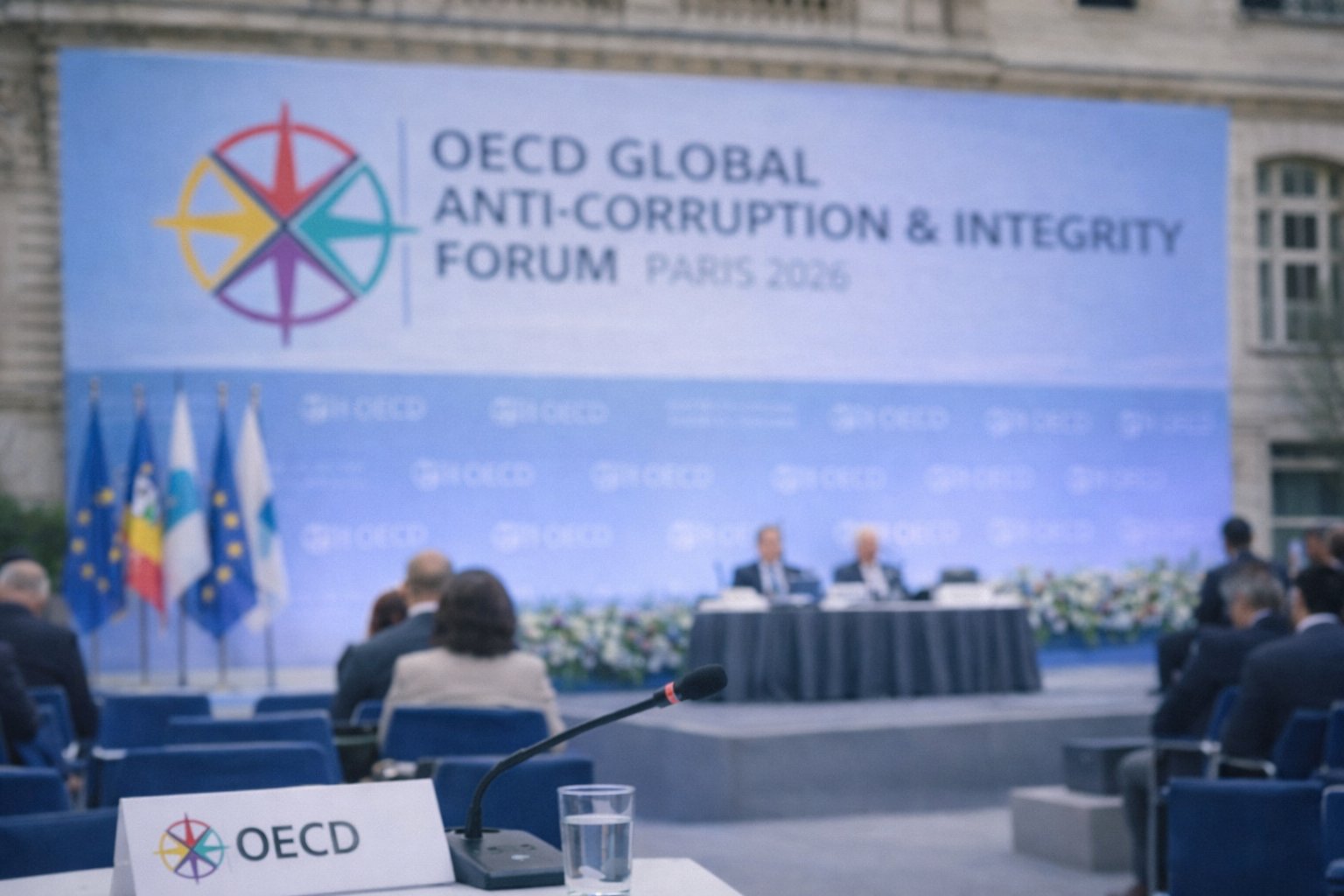
Horizon Search Institute had the opportunity to participate virtually in the OECD Global Anti-Corruption & Integrity Forum 2026 in Paris from 23 to 26 March. Joining sessions across the program, from the launch of the Integrity Outlook to discussions on illicit financial flows, compliance systems, and AI-enabled fraud detection, offered a comprehensive view of how the global community is rethinking corruption and governance today.
One idea came up repeatedly across sessions: integrity is no longer being treated merely as a safeguard against misconduct; it is increasingly seen as a strategic asset. Conversations around competitiveness, productivity, and investment made it clear that countries with stronger institutional frameworks tend to perform better economically. Sessions such as "How Compliance Shapes Competitiveness" and "Productivity and Competitiveness" emphasized that anti-corruption measures, when designed well, can reduce costs, improve decision-making, and create more predictable environments for businesses. In that sense, governance is not separate from growth. It is foundational to it.
At the same time, discussions on illicit financial flows and financing for sustainable development highlighted how deeply corruption constrains state capacity, particularly in developing economies. When public resources are lost or misallocated, the effects are not abstract. They directly limit a government's ability to invest in infrastructure, services, and long-term development. Global estimates often suggest that corruption costs over a trillion dollars annually in bribes alone, but the real cost, as many speakers noted, lies in the inefficiencies and lost opportunities that follow.
Recent evidence reinforces that corruption remains a systemic constraint rather than a marginal governance issue. The 2025 Corruption Perceptions Index, covering 182 countries and territories, reports a global average score of just 42.47 out of 100, highlighting persistent weaknesses in public-sector integrity worldwide. At the same time, the OECD Anti-Corruption and Integrity Outlook 2026 finds that while countries have made significant investments in integrity frameworks, implementation remains uneven, with gaps between policy design and real-world execution. From a business environment perspective, the World Bank continues to track bribery incidence through enterprise surveys, measuring the share of firms encountering bribe requests in routine administrative interactions, an indication that corruption directly affects everyday economic activity and investment decisions.
Beyond markets, major global institutions increasingly frame corruption as a development barrier: it raises the cost of public services, reduces access to healthcare and education, and disproportionately impacts vulnerable populations. Together, these findings suggest that corruption is not only a question of ethics or compliance, but a fundamental challenge to institutional performance, economic efficiency, and human development.
What we found particularly thought-provoking, however, was the gap between the sophistication of the tools being discussed and the underlying causes of corruption. There was significant attention on data-driven systems, compliance frameworks, and emerging technologies such as AI to detect fraud and safeguard public funds. These are undoubtedly important. Yet, the deeper questions around institutional capacity, professional incentives, and administrative culture received comparatively less attention.
From my perspective, especially reflecting on governance contexts in parts of the Global South, corruption is rarely just a failure of rules. It is often linked to how institutions function in practice: who implements policies, how decisions are followed through, and whether accountability mechanisms actually work across multiple actors. In many cases, the challenge is not the absence of frameworks, but the difficulty of sustaining coordination, discipline, and professional standards over time. These are not easy problems to solve, and they require more than technical fixes.
While the Forum acknowledged governance challenges in developing regions, there is still space for more grounded engagement with country-specific realities, including those in South Asia. The complexity of multi-stakeholder environments, resource constraints, and evolving institutional arrangements often makes implementation far more difficult than policy design suggests.
This is where initiatives like the Horizon Search Institute's focus on global governance become particularly relevant. Bridging the gap between policy ambition and implementation reality requires not only better tools, but also stronger institutional capacity, professional development, and sustained attention to how systems operate on the ground. Integrity, in this sense, is not just about preventing wrongdoing. It is about enabling states and organizations to function more effectively.
What I take away from the Forum is a simple but important reflection: addressing corruption is not only about reducing losses. It is about improving how systems perform, how decisions are made, and how trust is sustained. In a world where governance and economic resilience are increasingly intertwined, this may be one of the defining challenges of our time.
Reference
Organisation for Economic Co-operation and Development. (2026, March 23–27). OECD Global Anti-Corruption & Integrity Forum 2026: Programme and session participation [Conference]. Paris, France (virtual participation).
How to cite this reflection
Khan, A. I. (2026). Beyond compliance: What the OECD Integrity Forum reveals about governance and growth. Horizon Search Institute. https://horizonsearch.org/research/oecd-integrity-forum-2026.html