The inaugural New York Salon.
On the night of June 9, 2026, the Institute convened its first salon: a private dinner and moderated discussion that tested Horizon Scan 001 against the judgment of people who run regulated institutions for a living.
Fourteen senior leaders from financial services, healthcare policy, law, venture investment, government, the United Nations system, and academia gathered in the Library of the House of the Redeemer for an evening built around a single question: what does it actually take to govern AI inside institutions where the cost of error is measured in capital, care, or public trust?
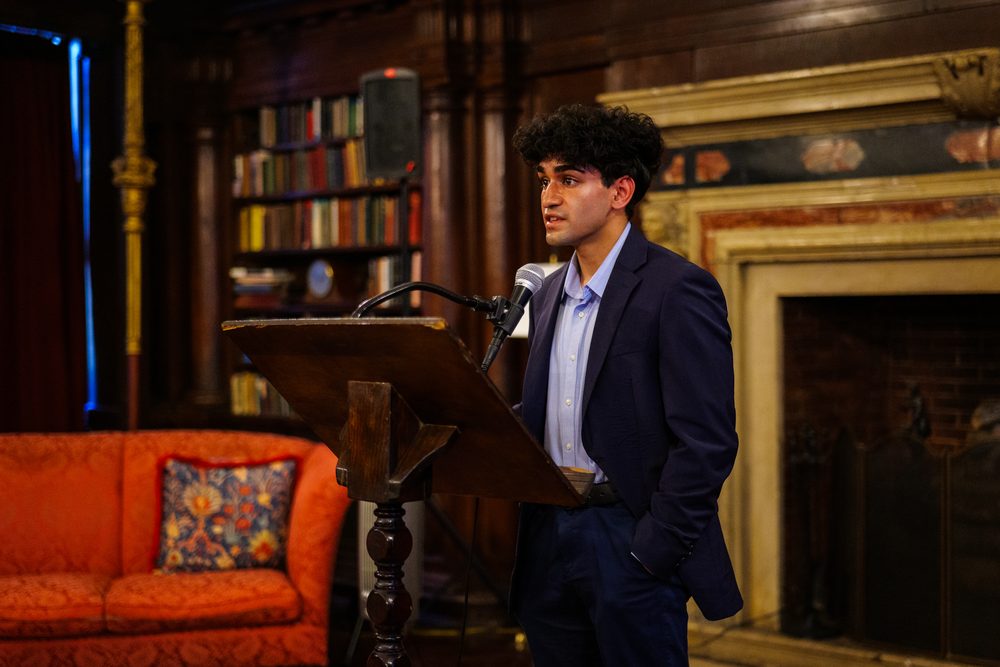
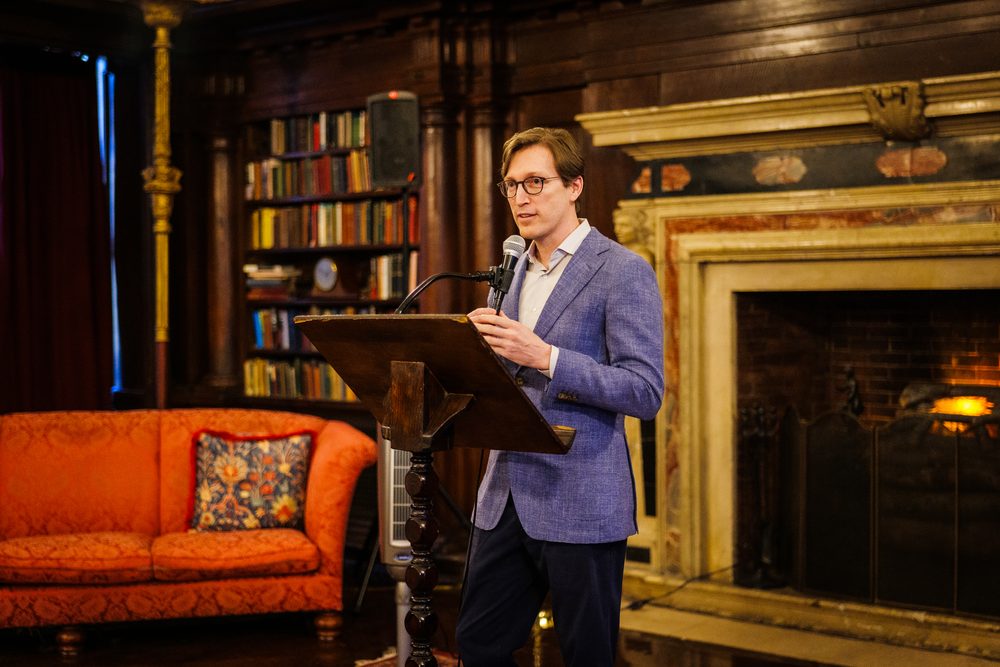
The salon marked the public introduction of Horizon Scan 001: AI Governance in Regulated Industries, the Institute's first published research under its Responsible AI pillar. Ashwin Telang, a lead author, presented its findings. Ramu Damodaran of the University for Peace at the United Nations opened the evening; David Lovejoy, the Institute's Founding Executive Director, welcomed guests and offered closing reflections; and Abdullah Ishak Khan, HSI's Inaugural Doctoral Fellow, spoke to the path ahead for the next generation of governance researchers. Prepared remarks were on the record. The discussion that followed was held under the Chatham House Rule.
The research made a pointed case. Across financial services and healthcare, deployment is outpacing the accountability meant to govern it. Finance is stretching fifteen years of model-risk infrastructure, built around the Federal Reserve's SR 11-7, to oversee agentic systems that recalibrate themselves between review cycles, deploying at the speed of software while still overseeing at the speed of the committee calendar. By one figure presented to the room, only about one in three organizations report mature governance controls for the agentic AI they are already running.
Healthcare faces the opposite problem. Where finance has too rigid a scaffold, healthcare has almost none and is improvising one mid-flight, pushing human verification back into workflows that automation had stripped out. The stakes showed in a single statistic. In Medicare Advantage, 82 percent of AI-driven prior-authorization denials are overturned on appeal, yet fewer than one percent of patients ever appeal, which means most incorrect denials are never contested and never corrected. The throughline across both sectors was that oversight can no longer end at the moment of approval, and that the institutions treating AI governance as organizational design, rather than legal compliance, will set the template the rest follow.
Oversight used to end at approval. It now begins there. The institutions that grasp that early won't simply be compliant, they'll be ahead. That is what it means to treat governance as a source of advantage rather than compliance theater. David Lovejoy, Founding Executive Director
The discussion ranged well beyond the page. One current was the cognitive cost of rapid AI adoption in the professions, in law especially, where firms are automating the very tasks through which judgment has traditionally been built, and the unease about what is lost when the work that once trained people is handed to the machine.
Another guest reached back to the history of nuclear energy, where decades of safe, abundant power were arguably forfeited to public misunderstanding and a failure to communicate, and warned against repeating that pattern with AI. A third thread turned to power itself, drawing a line between symbolic inclusion, a seat at the table, and real agency, the capacity to shape outcomes, and asking whether much of the Global South is being seated in global AI governance as a participant or as a passenger.
Under the Chatham House Rule, the views aired in discussion are not attributed to those who voiced them. The questions they raised are worth carrying forward all the same. This was the first of a series, and the conversation continues in London this autumn.
A small room, deliberately chosen.
The salon is held under the Chatham House Rule: what is said is not attributed. Who was present is a matter of record.
Guests
HSI Hosts & Team



Photographs: Doris Cao / Horizon Search Institute.