The Four Pillars

One transition,
four sites of institutional design.

The Institute organizes its research across four pillars, each addressing a different face of the same civilizational shift. The pillars are not silos. The work connecting them — how AI accountability shapes cognitive load on executives, how planetary scenarios reshape governance design, how institutional architectures determine whether transitions proceed by design or by accident — is the work the Institute exists to do.

Pillar I
Responsible AI
Emerging Technology Governance
2026 Spearhead

The institutional architecture required to govern AI is forming in real time. Most organizations using AI have no formal governance framework. State and supranational regulators are converging on lifecycle governance requirements, meaning continuous post-deployment monitoring rather than point-in-time review. The supervisory expectation is shifting from compliance to organizational design.

The Institute's Responsible AI work begins from a structural premise. The organizational architectures designed for predictable, point-in-time AI systems are insufficient for agentic systems and lifecycle governance regimes. The gap is not regulatory but institutional. Closing it requires reorganizing model risk, compliance, technology, and legal functions into integrated governance systems that operate on a different clock than traditional examination cycles.

Active research questions
  • How do board risk committees develop AI risk appetite frameworks when system behavior cannot be fully specified ex ante?
  • What does continuous lifecycle monitoring require operationally, and what is the eighteen-month build path for institutions starting from compliance-only postures?
  • How should the three lines of defense be restructured for agentic systems where ownership is distributed across product, engineering, compliance, and legal?
  • Where do MAS lifecycle controls, EU AI Act post-deployment obligations, FDA Total Product Lifecycle frameworks, and SR 11-7 evolution converge in operational expectations?
Active work under this pillar

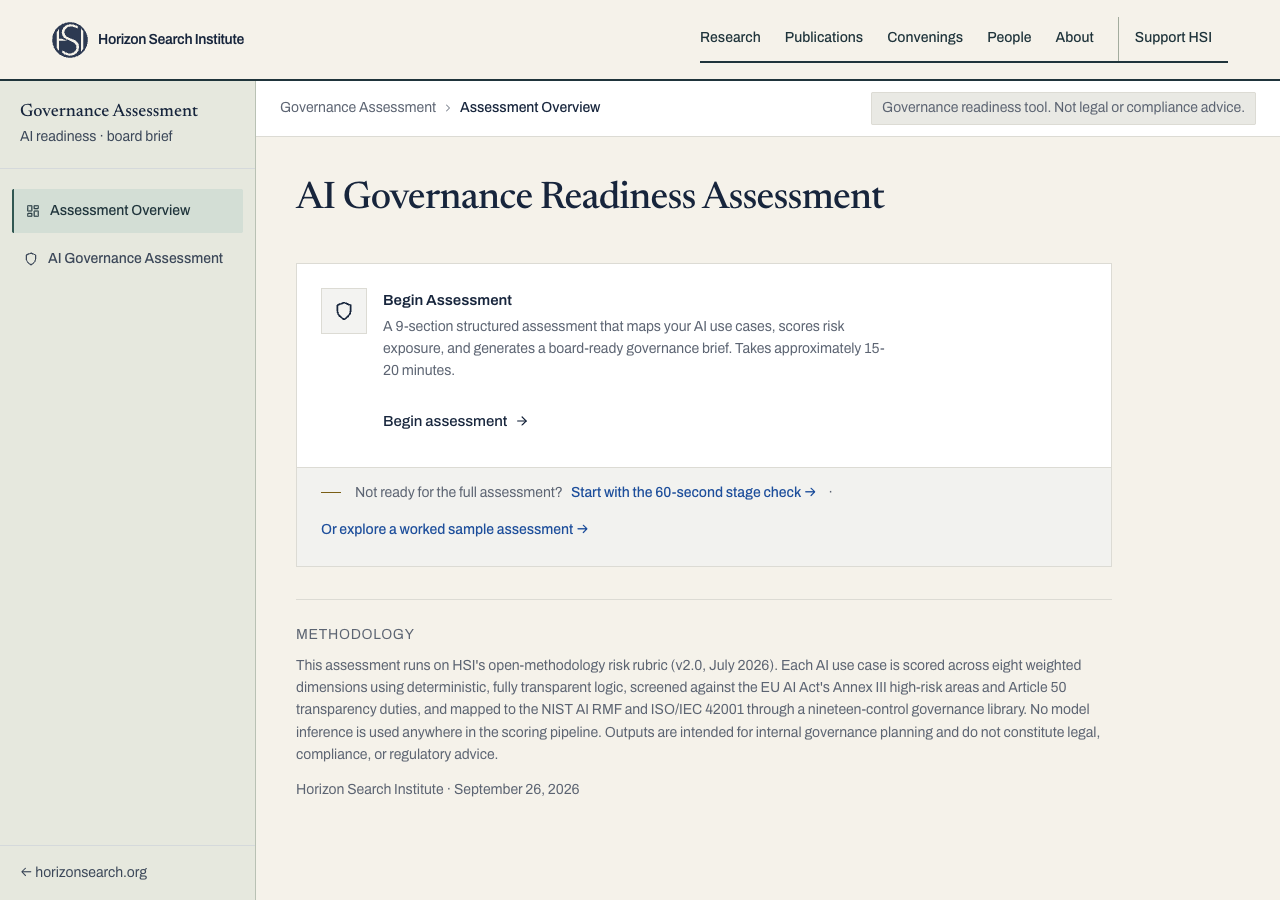
Horizon Scan 001: AI Governance in Regulated Industries (forthcoming). The AI Governance Pulse and Navigator open-methodology assessment tools. HSI Briefs on financial sector and healthcare AI governance. Track II working sessions on cross-jurisdictional regulatory convergence.

Visit pillar hub →
Pillar II
Human Performance
Cognitive Liberty & Neurogovernance

Sound institutional judgment depends on cognitive conditions that current information environments are engineered to fragment. Attention has become the scarcest resource in most decision-making contexts. Information diet is a governance variable that organizations have not yet learned to manage.

The Institute's Human Performance work treats cognitive conditions as institutional infrastructure. The same way organizations manage capital allocation, talent pipelines, and physical security, they will need to manage cognitive sovereignty: the conditions under which their leaders, analysts, and decision-makers can think clearly under accelerating information pressure.

Active research questions
  • What does cognitive sovereignty mean at the institutional level, and how do organizations operationalize it?
  • How do attention economies and engineered fragmentation degrade institutional decision quality, and what governance structures resist this degradation?
  • What does post-AI cognitive performance look like for executives, analysts, and operators?
  • How should institutions structure information diet, decision rhythms, and recovery protocols for cognitive resilience?
Active work under this pillar

Forthcoming HSI Briefs on cognitive performance in high-stakes decision environments. Research on attention economies and institutional resilience in development.

Visit pillar hub →
Pillar III
Planetary Futures
Post-2030 Pathways

Most institutional risk frameworks were built for stable systems. The 2030+ horizon is not stable. Compound transitions across technology, climate, governance, and social systems create non-stationary risk environments that traditional frameworks cannot model.

The Institute's Planetary Futures work develops scenario architectures and institutional risk frameworks for non-stationary environments. This is not climate forecasting or geopolitical risk analysis in the conventional sense. It is the question of how institutions organize themselves to navigate uncertainty that compounds rather than resolves.

Active research questions
  • What scenarios should inform 2030+ institutional risk frameworks, and what does scenario stress-testing look like for non-stationary systems?
  • How do institutions plan against compound transitions where technology, climate, and social systems interact in non-linear ways?
  • What is the institutional logic for long-horizon investment under deep uncertainty?
  • Where do planetary, technological, and governance transitions create cascade risks that current frameworks underweight?
Active work under this pillar

Forthcoming HSI Briefs on long-horizon institutional risk frameworks. Forthcoming Horizon Scan on cascade risk modeling across technology, climate, and governance transitions.

Visit pillar hub →
Pillar IV
Governance & Diplomacy
Track II Diplomacy & Networked Multilateralism

The institutions designed for the multilateral order of the late twentieth century are not designed for the governance challenges of the 2030s. Track II diplomacy, informal expert-led dialogue across jurisdictions, has historically been a complement to formal multilateralism. In an era of fragmented authority and accelerating technology, Track II becomes a primary mode of cross-border governance work.

The Institute's Governance and Diplomacy work develops frameworks for structured multi-stakeholder alignment, networked multilateralism, and Track II dialogue on governance questions that cross jurisdictional boundaries.

Active research questions
  • What governance infrastructure supports cross-jurisdictional coordination on technology and AI when no single regulator has authority?
  • How can Track II convenings be structured to produce institutionally consequential outputs rather than commentary?
  • What does networked multilateralism look like in practice for governance questions that exceed any single state's reach?
  • How do institutions translate dialogue into structured agreement at decision-making scale?
Active work under this pillar

HSI Salons (New York June 2026, London October 2026, Tokyo February 2027) function as Track II convenings on cross-jurisdictional governance. Strategic Council research notes on multilateral governance design forthcoming.

Visit pillar hub →
Continue

Across the four pillars, one editorial architecture.

The Institute publishes original research across the pillars on a layered cadence. Field signals every two weeks, briefs each month, Horizon Scans each quarter, and an Annual Outlook each year.