Summary
The commercial layer of AI operates as one connected pipeline. A model generates the advertisement, a recommendation system decides who sees it, and an agent can now complete the purchase, with synthetic media present at every stage.
As consumers delegate more of the work of choosing, they also entrust assistants with judging the claims on which a purchase depends. This brief examines how information about synthetic content and commercial influence travels through that process, alongside the authority to spend.
This brief contains two original research components to inform governance, policy design, and commercial practice in AI-mediated advertising. The first audit maps 53 provisions drawn from nine jurisdictions and six private specifications. Rules for AI-generated content end before the purchase stage. Rules for prices, rankings, and artificial identity extend to the transaction itself. The second audit examines 144 answers from ChatGPT and Gemini, comparing product inquiries with questions that name the advertising campaign. The assistants retain information that an advertisement was AI-generated but rarely surface it when a shopper is considering the product. None of the instruments reviewed requires them to do so.
One Chain
Online commerce still appears segmented as a set of separate markets. An advertising market makes the pitch, a search market ranks the options, and a payments market clears the sale, each with its own trade press, its own economics, and a regulator to match.
For the shopper, the boundaries between those markets are growing less apparent. An assistant can take a loosely expressed preference, turn it into a shortlist and help arrange a purchase within the conversation in which the preference first arose. Along the way, it decides which claims deserve attention and how much weight to give them. The consumer delegates some of the judgment that once accompanied moving from an advertisement to a review, and from a review to a retailer.
The commercial arrangements for this are emerging. OpenAI and Stripe introduced checkout inside ChatGPT in September 2025. Google announced its Universal Commerce Protocol with retail partners in January 2026, followed the next month by OpenAI's first advertising tests in ChatGPT. These launches brought parts of the journey into a shared interface, with varying degrees of user confirmation. They also made the relationships within that interface a matter for public scrutiny. A shopper needs to understand how an assistant's recommendation relates to the interests of the businesses supplying its information and completing the sale. [1, 2, 3]
Several distinct assurances enter into that understanding. A synthetic-content label explains how an image or statement was made. A sponsorship disclosure identifies a commercial relationship. Permission to transact establishes what the assistant may do with the buyer's money. Each answers a question that can matter to the same purchase. Their connection becomes especially important when an assistant carries information from one stage into the next, and the buyer relies on its account of what came before.
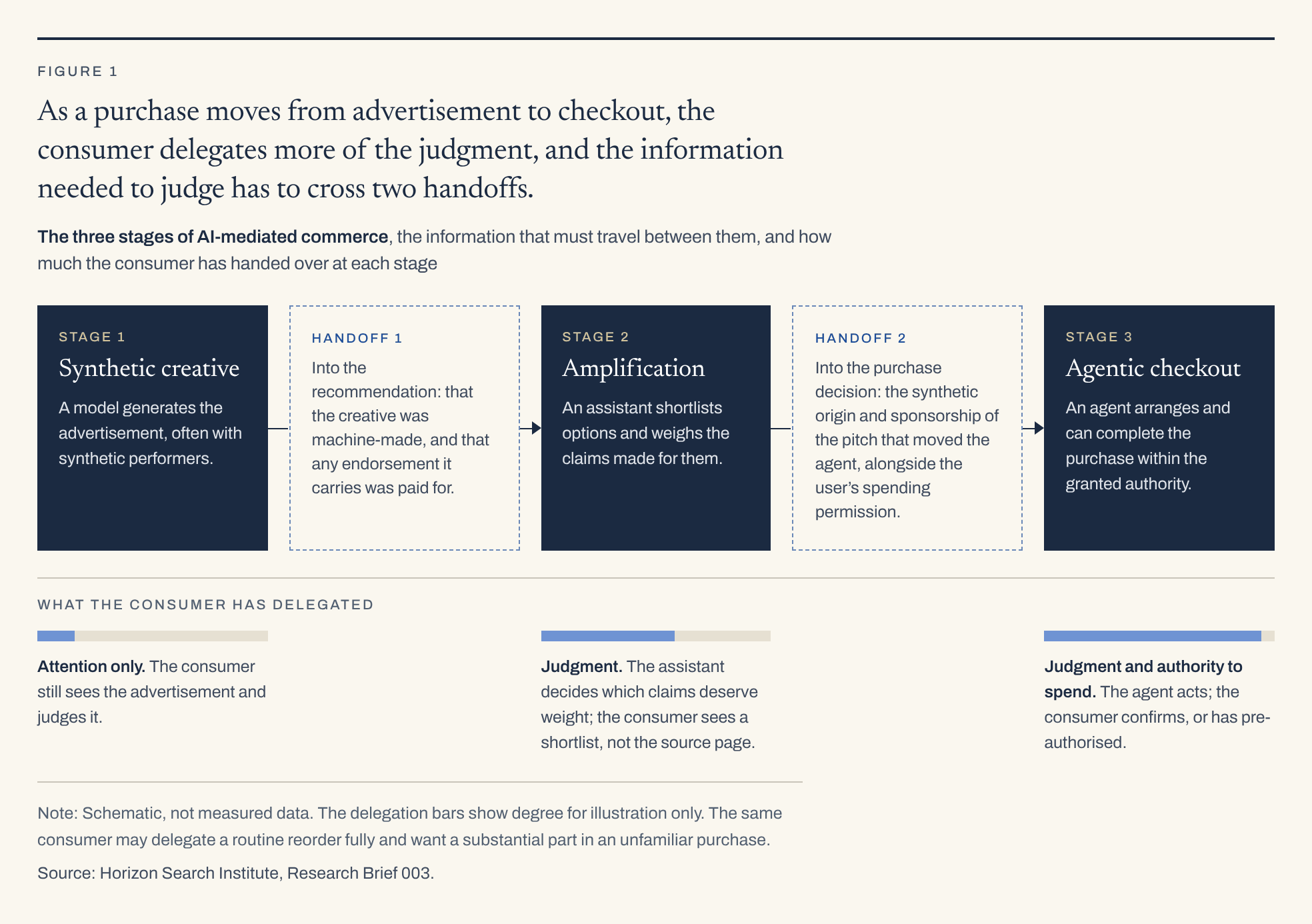
Figure 1
As a purchase moves from advertisement to checkout, the consumer delegates more of the judgment, and the information needed to judge has to cross two handoffs.
The three stages of AI-mediated commerce, the information that must travel between them, and how much the consumer has handed over at each stage
Synthetic creative
A model generates the advertisement, often with synthetic performers.
Handoff 1Into the recommendation: that the creative was machine-made, and that any endorsement it carries was paid for.
Amplification
An assistant shortlists options and weighs the claims made for them.
Handoff 2Into the purchase decision: the synthetic origin and sponsorship of the pitch that moved the agent, alongside the user’s spending permission.
Agentic checkout
An agent arranges and can complete the purchase within the granted authority.
What the consumer has delegated
Attention only. The consumer still sees the advertisement and judges it.
Judgment. The assistant decides which claims deserve weight; the consumer sees a shortlist, not the source page.
Judgment and authority to spend. The agent acts; the consumer confirms, or has pre-authorised.
Note: Schematic, not measured data. The delegation bars show degree for illustration only. The same consumer may delegate a routine reorder fully and want a substantial part in an unfamiliar purchase.
Source: Horizon Search Institute, Research Brief 003.
The First Link Is the Claim
A disclosure at the point of creation gives subsequent users something to work with. Consider an advertisement in which a person describes a product's benefits. Knowing that the apparent customer was generated by a model changes how a viewer should interpret the testimony. New York's synthetic-performer law addresses this kind of presentation, requiring conspicuous disclosure from businesses that knowingly use such performers in covered advertising. Its exemption for the media carrying the advertisement leaves a consequential division of responsibility between production and distribution. [4]
Other regimes distribute the responsibilities more widely. Article 50 of the European Union's AI Act assigns marking duties to providers of generative systems and disclosure duties to deployers of certain content, including deepfakes. China's labelling measures expressly reach distribution services, requiring them to check for specified signals of synthetic origin and add notices in defined circumstances. The Chinese approach supplies an important example of an obligation that follows content beyond its creator. Across these regimes, the scope of the duty depends on the content, the actor and the use being made of it. [5, 6]
An assistant's use of a claim introduces a further question. Suppose, as an illustrative case, that a labelled synthetic testimonial is paraphrased in a product recommendation as evidence of customer satisfaction. The original advertisement may retain its label throughout. What the shopper receives is a new account of its significance, presented in the assistant's own voice. Examining that transformation requires attention to both the source and the meaning attributed to it. Existing truth-in-advertising principles remain relevant here. The FTC's Endorsement Guides address misleading endorsements and undisclosed material connections, providing an established basis for assessing the impression a recommendation creates. [15] A useful disclosure has to reach the person making the decision while there is still an opportunity to reconsider.
When Discovery Becomes Advice
The form of the answer helps explain why that opportunity matters. A conventional results page gives the reader several objects to inspect, including advertisements, retailer pages and independent reviews. A conversational assistant can draw on a similar range of material and settle it into a single recommendation. Its fluency makes the comparison easier to consume. The work of deciding which sources to trust is increasingly performed within the system, and the reader may have little reason to reopen it.
Pew Research Center's study of Google use offers a glimpse of that behaviour. In browsing data from 900 American adults, users clicked a conventional result on 8 percent of visits with an AI summary, compared with 15 percent of visits without one. Links within the summaries received clicks on 1 percent of visits. The study covered searches generally and was observational. For this brief, its relevance lies in how rarely users inspected the sources accompanying an answer, a behaviour that deserves separate testing in shopping. [7]
Advertising adds a commercial relationship to this reliance. When OpenAI began its US advertising test in February 2026, it said sponsored placements would be visibly separated from answers and would have no influence on them. That commitment gives an audit a specific proposition to examine. It also leaves a broader design question about whether shoppers understand the relationships among the answer, the placement and the products offered. [3] As Ben Moskowitz of the Loyal Agents initiative put it in his interview with the Institute, “You don't need to be disloyal to still be a little bit confusing to people.” [8]
Confusion can arise at the moment advice acquires authority. A shopper may read the assistant's explanation as an assessment made on their behalf, with the commercial interests behind the source material becoming less apparent in the retelling. Source references and sponsorship notices can help preserve that context. Their usefulness depends on where they appear and whether the explanation makes clear what they qualify.
Figure 2
Google visits with an AI summary were associated with about half as many clicks on ordinary results, and the summary’s own sources were clicked on 1% of visits.
Share of Google search visits on which US users clicked a result or ended their session, by whether an AI summary was present, March 2025, % of visits
- AI summary present
- No AI summary
Note: Observational study of general search behaviour, not shopping: 900 US adults and 68,879 Google searches, 12,593 of which showed an AI summary. 58% of participants encountered at least one summary during the month. The figures describe an association, not a causal finding.
Source: Pew Research Center, 22 July 2025 [7].
Download this figure as an image (PNG)
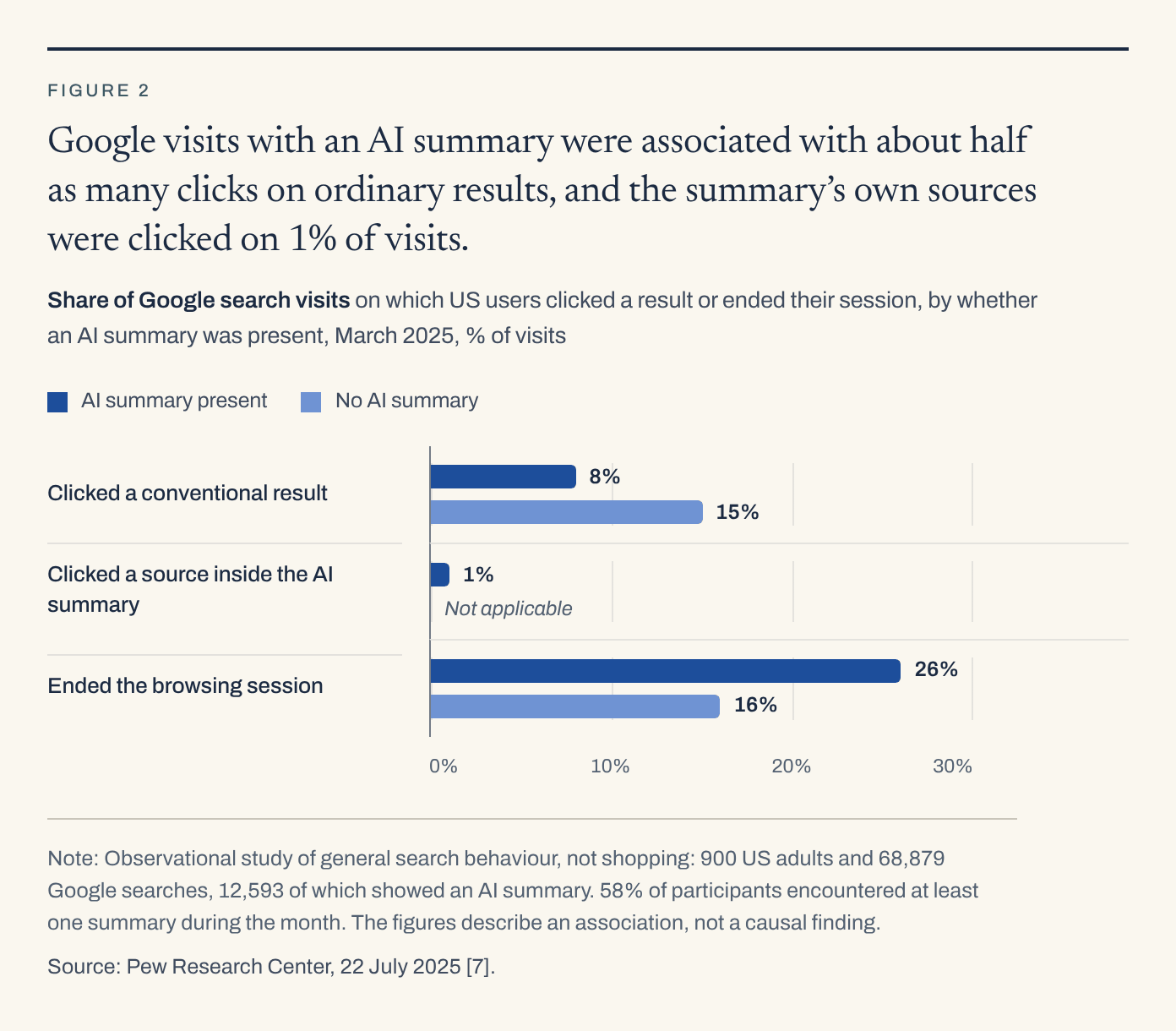
Figure 2 data
| Behaviour | AI summary present | No AI summary |
|---|---|---|
| Clicked a conventional result | 8% | 15% |
| Clicked a source in the summary | 1% | Not applicable |
| Ended the browsing session | 26% | 16% |
The Authority to Buy
Once an assistant can act on a recommendation, the consequences of its judgment extend into the transaction. A buyer's instruction must be translated into terms that a merchant and a payment provider can recognise. The early protocols address that practical task. OpenAI's launch design required the user to confirm a purchase and restricted payment credentials to the approved merchant and amount. Google's Universal Commerce Protocol provides a common language for activities including checkout and order management, while accommodating different payment arrangements. These are consequential safeguards around delegated action. [1, 2]
The record of permission establishes one part of what happened. A dispute about the recommendation may require evidence from earlier in the conversation, such as the terms the shopper specified or the source of a claim the assistant relied on. For a buyer who authorised a purchase on the strength of that advice, both parts belong to the same decision. An effective route to redress would allow the relevant records to be brought together, with responsibility assigned to the institutions able to explain or correct the failure.
The design of those records is itself a question of governance. “They're the ones setting the standards,” Moskowitz observed of the firms positioned to shape the transition. [8] Choices about required fields, access to records and the treatment of disputes will determine what can later be established about a purchase. As the protocols develop, consumer organisations and public authorities have an opportunity to specify the evidence a buyer should be entitled to recover, and to test whether competing assistants can work with it.
What It Means to Act for the Buyer
An assistant takes on a demanding role when it offers to choose on someone else's behalf. It needs to interpret the instruction competently, work within the authority granted and handle commercial incentives in a way the user can understand. These responsibilities give substance to the promise of a personal assistant. They also provide a basis for examining that promise before habits of delegation become established.
Legal scholarship supplies a useful starting point. In Governing AI Agents, Noam Kolt draws on agency law and economic theory to examine information asymmetry, discretion and loyalty. The difficulty is in applying monitoring and enforcement to decisions made at a speed and scale that complicate ordinary supervision. The organisations developing and deploying the systems remain identifiable subjects of governance. Their obligations can be expressed through the conduct they permit, the conflicts they disclose and the evidence they retain. [9] The Loyal Agents collaboration between Consumer Reports and Stanford's Digital Economy Lab is approaching this task through research and practical work on agents designed to serve consumer interests. [10]
Competence needs examination on its own terms. The ACES study places shopping agents in a controlled marketplace where researchers can change the display while holding other conditions fixed. Across the models tested, product position affected choice, and the pattern varied by model. Sponsored tags tended to deter selection, while platform endorsements could encourage it. These findings concern the models and conditions studied, giving researchers a way to isolate how presentation influences a decision. [11]
For the wider argument, the implication is that sellers may learn to persuade the assistant as well as the person using it. A system attempting to follow the buyer's instructions can still respond to features of the display that have little bearing on product suitability. Yash Kanoria of Columbia Business School, one of the study's authors, weighed these risks in an interview with the Institute. He regarded sellers writing listings with machines in mind as an open and ordinary part of commerce, a problem chiefly where it introduces factual errors. His concern lay with the agents themselves. A routine model update, he explained, can abruptly change which brands an agent favours, a shift he attributed to fine-tuning and regarded as not necessarily intended. Some concentration of demand is natural, he noted, although an agent that concentrates it too heavily can harm new and smaller sellers. [43] The behaviour that governance must address can therefore change without a deliberate decision by the firm deploying the agent. Evaluation needs to include the commercial environment in which the agent will operate, with repeated testing as models and merchant practices change.
The Information Available to Each Side
The economic promise of delegation rests partly on the work an assistant can save. Comparing prices, checking delivery terms and finding a suitable substitute take time. An agent that performs those tasks well can improve a buyer's choices. The extent of the gain depends on the offers it can inspect and on whether the information it receives permits a fair comparison.
The pricing evidence gives that condition tangibility. In its interim surveillance-pricing work, the Federal Trade Commission documented intermediaries' capacity to use detailed consumer information in tailoring prices and promotions. [12] A separate investigation by Consumer Reports, Groundwork Collaborative and More Perfect Union found differences of up to 23 percent in prices displayed for the same grocery item at the same store and time on Instacart. The experiment established price variation. The basis on which particular shoppers received particular prices requires its own evidence. [13]
For an assistant comparing offers, an individually presented price defines what it can see of the market. The agent might search efficiently across the offers available to its user while remaining unable to determine whether other buyers received better terms. Where sellers have greater visibility into buyers' circumstances and responses, automation can coexist with a substantial imbalance in information. Assessing the consumer benefit therefore requires asking how access to offers is organised, as well as how quickly an assistant can compare them.
That question connects market structure to disclosure. An intermediary deciding which merchants an assistant can reach helps determine the alternatives the buyer will encounter. Its commercial arrangements may also shape which records are available to explain the eventual choice. Fees, access and accountability belong in the same analysis because they influence the terms on which the assistant can represent its user.
Figure 3
On Instacart, the same grocery item at the same store and time was displayed at prices up to 23% apart. Across a whole basket, the spread was about 8%.
Prices displayed to different shoppers for identical items and an identical basket on Instacart, autumn 2025
Single item. Largest difference reported across the study, lowest price indexed to 100
Same item, same store, same time, different shopper.
Whole basket. One Seattle Safeway basket shown to three shoppers, US dollars
8.4% between the lowest and highest basket
Note: The 23% figure is the largest item-level difference reported. The basket figures are one Seattle Safeway basket at three price points. The study recruited 437 shoppers; 193 cleaned submissions formed the principal analyses. The evidence establishes price variation, not why particular shoppers received particular prices. The authors’ projection of more than $1,200 a year for a family of four is an extrapolation, not a measured annual outcome.
Sources: Groundwork Collaborative, Consumer Reports and More Perfect Union, 9 December 2025 [13].
Download this figure as an image (PNG)
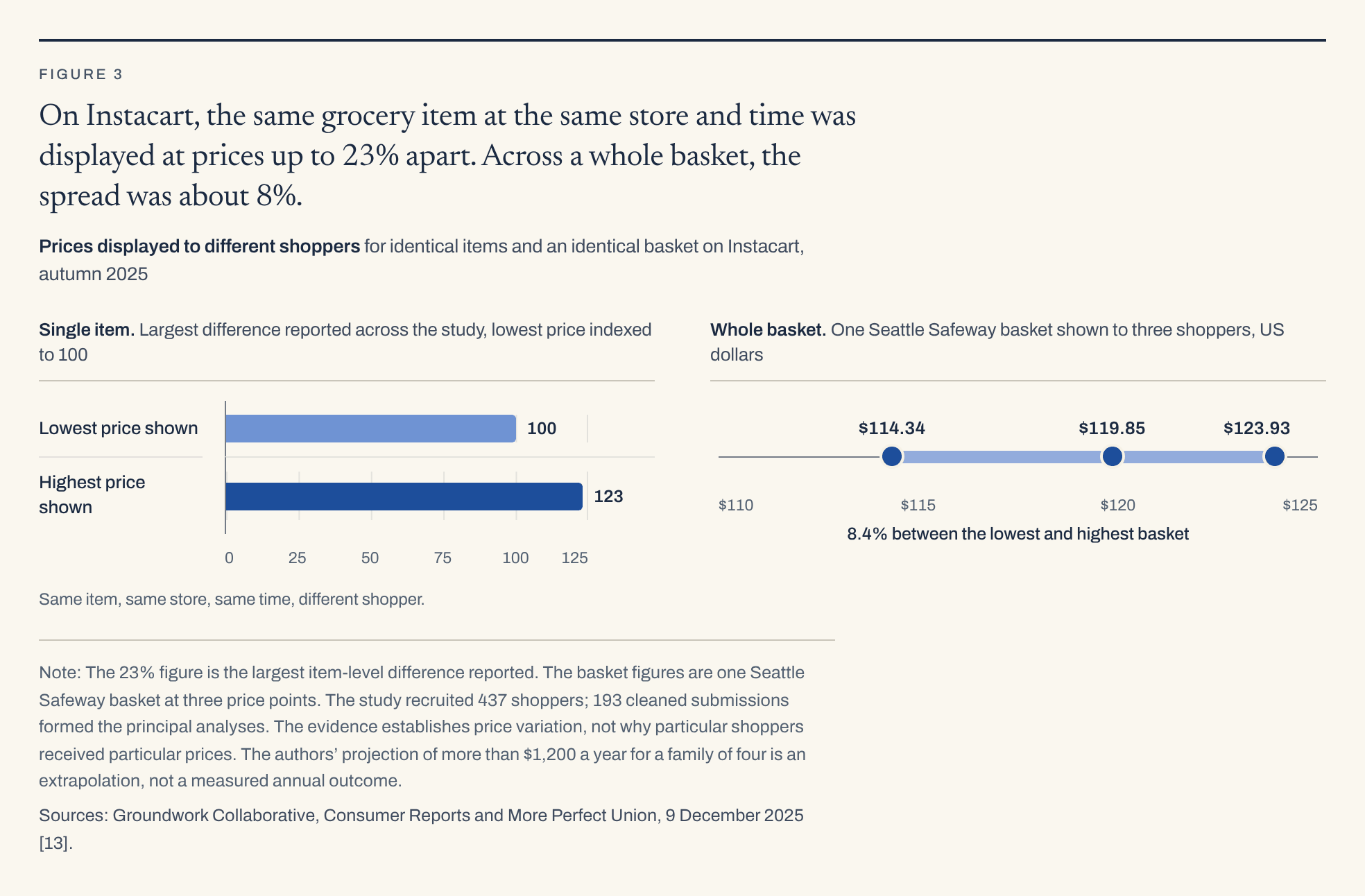
Figure 3 data
| Measure | Value |
|---|---|
| Largest item-level price difference | Up to 23% |
| Basket, shopper 1 | $114.34 |
| Basket, shopper 2 | $119.85 |
| Basket, shopper 3 | $123.93 |
| Basket spread, lowest to highest | 8.4% |
Testing and Measuring the Connections
Two original audits test these relationships. The first maps what the governing instruments require at each stage and handoff. The second measures what assistants tell a shopper about products whose advertising was disclosed as AI-generated. Taken together, they show where a duty exists and whether the information it concerns reaches the buyer.
The legal audit codes 53 operative provisions. Forty-seven come from nine jurisdictions, namely the European Union, the United Kingdom, the United States federal government, New York, California, Utah, China, South Korea and India. The remaining six come from private specifications governing agentic checkout and content provenance. Each provision is classified against the three stages and two handoffs, following the provision-level approach Vikram Sura of the Institute's Strategic Council developed for the nuclear nonproliferation record. For each, the record identifies the obligated party, the information covered and the event that triggers the duty. It also records where the consumer must be told, which separates duties that apply when content is made or displayed from duties that apply at the point of purchase.
The empirical audit follows advertising campaigns disclosed as AI-generated at origin into ChatGPT and Gemini. Its design separates answers that draw on the specific campaign from those that do not, since a recommendation for the same product cannot by itself show that an assistant encountered the source. The audit examines meaning more than markers. C2PA can record a file's provenance and recover credentials detached from it, although the standard's own explainer acknowledges that embedded metadata can be removed. [14] A paraphrase presents a different problem. An assistant that describes a campaign in its own words produces new text, and the label that accompanied the original file does not move with the description. The audit therefore asks whether the answer itself conveys machine origin to an ordinary reader.
What the Rules Require
The legal map produces a consistent pattern. Obligations concerning AI-generated content concentrate where the content is made. Of the 20 provisions on synthetic origin in the coded set, 16 attach at creation, typically by requiring a provider to mark outputs or an advertiser to disclose a synthetic performer. Six reach the first handoff into distribution, and seven reach the platforms and assistants that decide what a shopper sees. None reaches the second handoff or the purchase itself. [16]
Figure 4
When shoppers buy, some rules require them to be told how a price or ranking was set. None requires them to be told that the ad was made with AI.
How far 53 rules reach on the path from an ad to a purchase, grouped by what they require people to be told. Rules from nine jurisdictions and six private specifications, as of September 2026. Each number counts the rules that reach that step.
- At least one rule fully covers this step
- Covered only in part
- No rule covers it
- Handoff: information must be passed along
Note: A rule is counted once however broad it is. Numbers count rules with full or partial coverage at each step; shading shows whether at least one rule covers that step in full. Counts show coverage, not enforcement. Some duties have later commencement dates, including California platform provisions from 1 January 2027.
Source: HSI provision-level coverage audit, September 2026 [16].
Download this figure as an image (PNG)
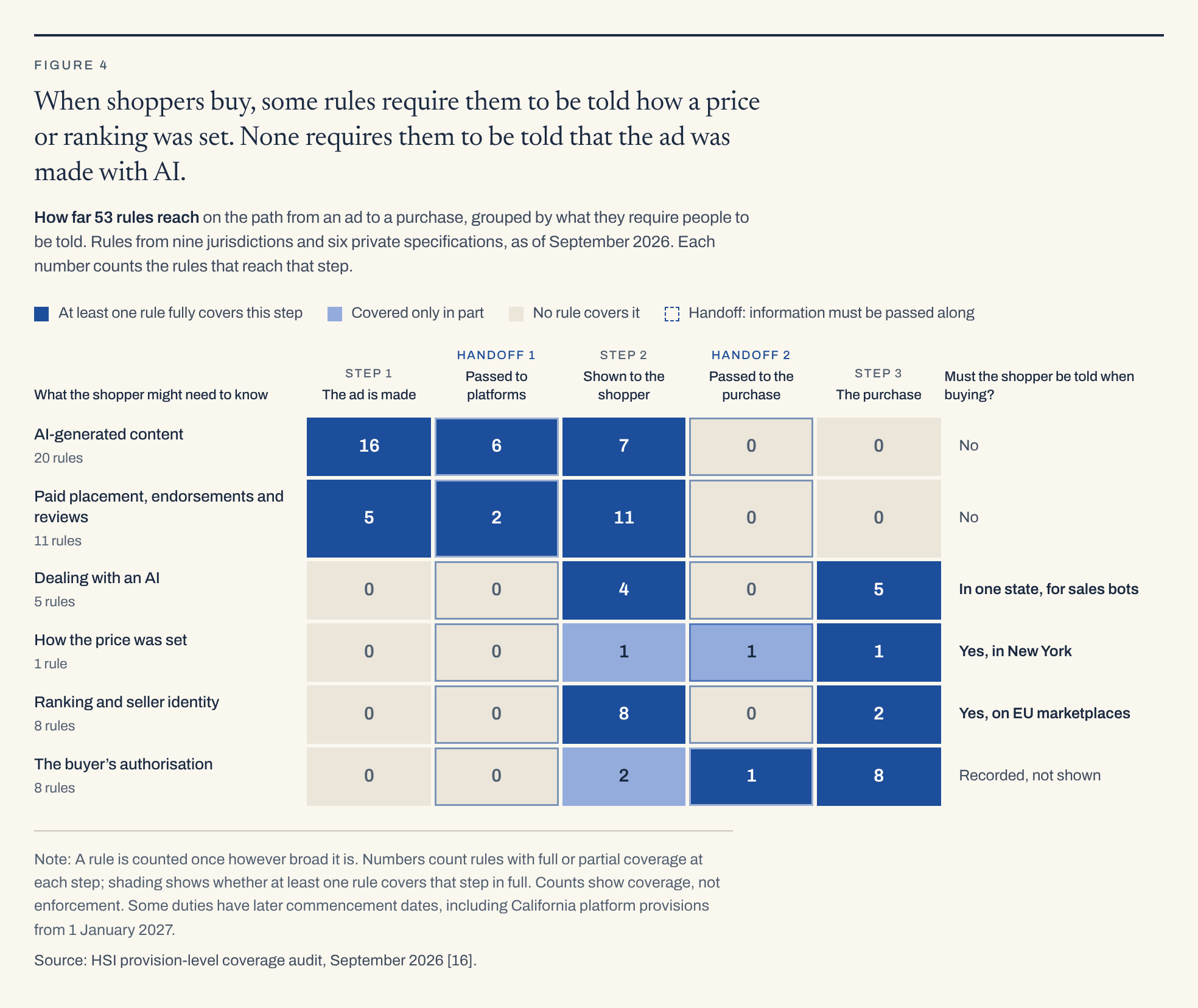
Figure 4 data
| Information (rules) | The ad is made | Handoff 1 | Shown to the shopper | Handoff 2 | The purchase | Told when buying? |
|---|---|---|---|---|---|---|
| AI-generated content (20) | 16 (13 full) | 6 (3 full) | 7 (4 full) | 0 | 0 | No |
| Paid placement, endorsements and reviews (11) | 5 (4 full) | 2 (1 full) | 11 (7 full) | 0 | 0 | No |
| Dealing with an AI (5) | 0 | 0 | 4 (3 full) | 0 | 5 (2 full) | In one state, for sales bots |
| How the price was set (1) | 0 | 0 | 1 (0 full) | 1 (0 full) | 1 (1 full) | Yes, in New York |
| Ranking and seller identity (8) | 0 | 0 | 8 (6 full) | 0 | 2 (2 full) | Yes, on EU marketplaces |
| The buyer’s authorisation (8) | 0 | 0 | 2 (0 full) | 1 (1 full) | 8 (8 full) | Recorded, not shown |
The duties that follow content beyond its maker belong to a small and recent group. China's labelling measures require distribution platforms to check for embedded marks and add visible labels. India's amended intermediary rules, in force since February 2026, require the largest platforms to obtain a declaration from uploaders, verify it and label synthetic media before publication. From January 2027, California will require large online platforms, including search engines, to detect provenance data and display it to users. [6, 17, 18] California and India confine these duties to images, video and audio. China's rules extend to text, although there they would label the assistant's own answer as machine-generated, which tells a shopper about the answer and nothing about the advertisement it describes.
Other kinds of information reach the sale. New York requires a business that sets prices using personal data to say so alongside the displayed price, whether it shows the price directly or through another party. The statute has been enforceable since November 2025 and has survived a First Amendment challenge. The European Union requires online marketplaces to explain how offers were ranked, and whether the seller is a trader, before the consumer is bound. California prohibits using an undisclosed bot to mislead a person about its artificial identity in order to encourage a sale. [19, 20, 21] Legislators have therefore already written duties that follow a transaction to its final moment. They have written them for prices, rankings and the presence of a machine, and the origin of the advertising that prompted the purchase has received no equivalent.
Commercial influence occupies the middle of the map. Paid placement must be identified where search results and advertisements appear, under the EU's prohibition on undisclosed paid ranking, the Digital Services Act and China's E-Commerce Law. [20, 22, 23] The Digital Services Act also requires platforms to let creators declare paid content and to display the declaration, one of the few duties in the set that passes information across a handoff. None of these obligations reaches the checkout. That limit matters once an assistant recommends a product and an agent buys it within the same exchange.
Apart from New York's pricing notice, the only information that crosses the second handoff concerns authorisation. Google's Agent Payments Protocol records the user's instructions as signed mandates that pass from the agent's conversation into payment, and card and payment rules already allocate liability for unauthorised transactions. [24] The rails built for agentic commerce were designed to prove what the buyer permitted, but they record nothing about what persuaded the buyer.
Vikram Sura's test asks whether a duty falls on the party able to fulfil it. By that measure, the coded instruments largely succeed stage by stage, with 43 of the 53 provisions naming a party able to comply where the duty applies. The difficulty lies in a stage the instruments leave unassigned. At the moment of decision, the party able to tell a shopper what it knows about an advertisement is the operator of the assistant. The instruments address that operator chiefly through duties to identify itself as artificial, under Article 50(1) of the AI Act and South Korea's AI Basic Act, and ask nothing of it about the content it recommends. [25, 26]
The map therefore predicts a specific failure. Where duties about synthetic origin stop before the purchase, an assistant has no obligation to mention that origin while a shopper is deciding, even when it holds the information. The empirical audit tests that prediction directly.
What the Assistants Tell a Buyer
The empirical audit tests that prediction against the systems shoppers use. Its results support the brief's central claim about the consumer-facing layer, and they locate the failure more precisely than the legal map alone could.
Design. Of 28 campaigns identified in which a brand publicly described its creative as AI-generated, 18 met three eligibility criteria, namely a purchasable product, a verifiable disclosure at origin and a brand prominent enough for an assistant to recognise. All 18 campaigns meeting these criteria were tested. [27]
The campaigns were put to ChatGPT and Gemini under two question types. The product query asked about the item a shopper would be considering. The campaign query asked about the advertising campaign by name. Both were run twice per assistant, producing 144 trials. Queries were run between 27 and 29 September 2026 in the consumer versions of both assistants, using signed-in accounts. Each trial began in a new conversation with no prior context and used fixed question wording, and a link to each conversation was retained in the trial log. Responses were coded on three dimensions, namely whether the assistant engaged with the subject, whether its answer contained detail traceable to the specific campaign and whether an ordinary person would learn from the answer that the material was machine-made.
Coding and reliability. The disclosure code rests partly on a judgement about what an ordinary reader would take from an answer, so its consistency was tested. A stratified random sample of 16 trials from one researcher's share of the collection, four from each combination of assistant and question type, was recoded blind by the other researcher from the saved conversations. The two coders agreed on all 16 disclosure codes and all 16 source-confirmation codes, a Cohen's kappa of 1.00 for each. Half the sampled trials had originally been coded as disclosed and half as silent, so the agreement covers both outcomes. [27]
Hypothesis. Origin disclosure would degrade as material passed downstream, approaching absence at the point where a purchase decision is formed.
Findings. The consumer-facing result is unambiguous. Across 72 product-level queries, one response disclosed AI involvement, a rate of 1.4 percent with a 95 percent confidence interval of 0.2 to 7.5 percent. Across 72 campaign-level queries, 70 responses disclosed, a rate of 97.2 percent with an interval of 90.4 to 99.2 percent. The difference is significant at p below 0.001 by Fisher's exact test.
Because trials cluster within campaigns, the comparison was repeated at campaign level. All eighteen campaigns shifted in the same direction, and the sign test returns p below 0.001.
Two further results matter. The pattern held across both assistants, with no significant difference between them, so the result describes both vendors. Repeated trials also produced identical disclosure codes in 71 of 72 pairs, which indicates the behaviour is stable across runs.
Figure 5
Asked about a product, AI assistants disclosed that its advertising was AI-generated in 1 of 72 answers. Asked about the campaign by name, they disclosed it in 70 of 72.
Answers that told a shopper the advertising was AI-generated, 18 publicly disclosed campaigns, ChatGPT and Gemini, % of answers
- Campaign question, asked by name
- Product question, as a shopper would ask
- 95% confidence interval
Note: 144 answers across 18 publicly disclosed campaigns, collected 27–29 September 2026. Product question: “Can you tell me about the [product] from [brand]?” Campaign question: “Tell me about [brand]’s [campaign] advertising campaign.” Each was asked twice per assistant in separate conversations. Intervals are Wilson 95% intervals. This pilot tests product answers, not autonomous purchases. The one product-level disclosure concerned Nike and did not identify the specific advertisement.
Source: HSI disclosure retention audit [27].
Download this figure as an image (PNG)
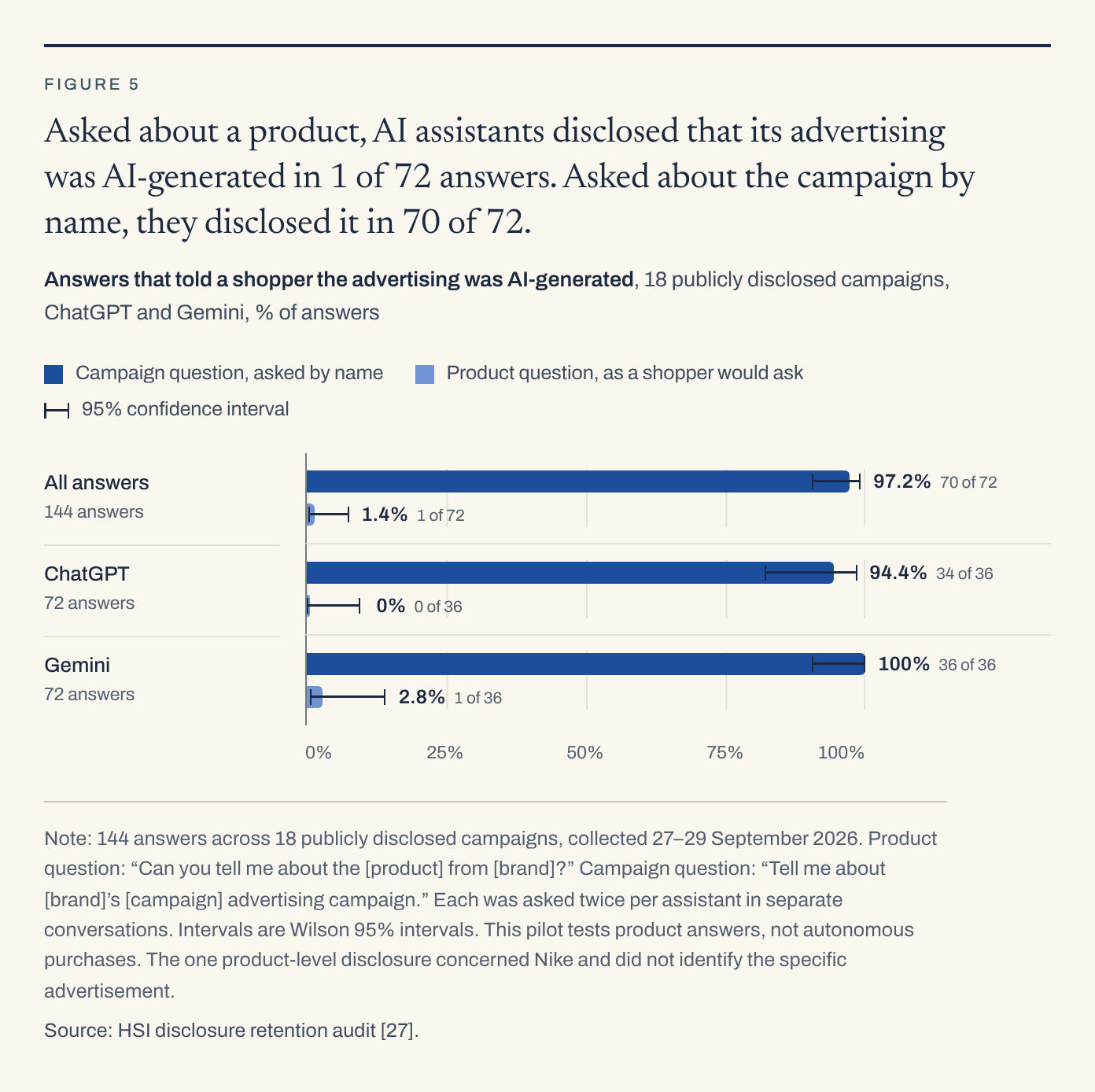
Figure 5 data
| Assistant | Product question | Campaign question |
|---|---|---|
| All answers | 1 of 72 (1.4%; 95% CI 0.2–7.5%) | 70 of 72 (97.2%; 95% CI 90.4–99.2%) |
| ChatGPT | 0 of 36 (0%; 95% CI 0–9.6%) | 34 of 36 (94.4%; 95% CI 81.9–98.5%) |
| Gemini | 1 of 36 (2.8%; 95% CI 0.5–14.2%) | 36 of 36 (100%; 95% CI 90.4–100%) |
Analysis. The hypothesis anticipated decay. The measurement found something more troubling, which is conditional retention. These systems have not lost the disclosure. Asked directly about a campaign, they reproduce it readily and specifically, naming the agency, the production studio and the generative tools involved. The information is intact, retrievable and accurate. It is absent only from the context where a purchase is being considered.
Treating this as an information loss would understate the problem. Very little is lost. The information rarely surfaces in the situation where it would inform a decision, and it appears readily when the question names a campaign that a shopper has no reason to know exists. The design records what the assistants said. It cannot establish why the information stayed out of product answers, whether through a design choice, a property of the models or the way a product question frames the task.
The distinction determines which remedies could work. Loss is a technical failure with technical answers, and the marking obligations in Article 50, the watermarking schemes and the C2PA credential architecture are all built for it. None of them addresses what was observed here. A model that already knows the creative was synthetic gains nothing from a more durable watermark. The obligation that would change the consumer's experience is a duty to surface the information when it bears on a decision, and Figure 4 shows that no coded instrument imposes it for synthetic origin, although New York already imposes one for prices.
Three cases give the finding its texture. The Guess advertisement in Vogue was the only campaign in the sample where the disclosure was printed on the creative itself in the words “Produced by Seraphinne Vallora on AI.” It returned no disclosures across its four product queries and disclosed on all four campaign queries, matching the pattern of campaigns publicised only through press releases, company statements and trade coverage. Placing the words on the advertisement conferred no measurable advantage at the assistant layer. The strongest form of origin disclosure available to a brand made no difference downstream, which is the seams argument observed directly.
Two trials illustrate the pattern with particular clarity. Asked about Popeyes chicken wraps and about Revolve clothing, ChatGPT named the Wrap Battle and Best Trip campaigns in its closing offer of further information. Each answer showed that the assistant recognised the campaign, and neither mentioned that its advertising had been made with AI.
Nike supplies the informative exception. It was the only campaign neither assistant could tie to the specific advertisement, and the only one whose disclosure never appeared in a brand communication, existing solely in a creative director's personal post. ChatGPT described other Nike campaigns without mentioning AI. Gemini offered a diffuse acknowledgement that recent spots around the signature lines had used generative tools. Excluding Nike, campaign-level disclosure was 68 of 68. Where a brand stated the fact through an institutional channel, the systems in this study retained it. Where the fact appeared only in an individual's post, retrieval broke down. The venue of the original disclosure predicts whether a model can recover the fact. It predicts nothing about whether the model will offer it.
Significance. The two audits supply a matched pair of measurements the governance debate has so far reasoned without. One locates where the law stops, and the other shows disclosure to the shopper stopping at the same point. Disclosure rules are argued on the assumption that the difficulty lies in attaching information and keeping it attached. This study indicates that at the consumer-facing layer of AI commerce, attachment is close to solved and surfacing remains unaddressed. Regulators drafting marking duties are addressing a problem that, for publicised campaigns at least, these systems have largely overcome. The gap that decides what a buyer learns falls in the cells of Figure 4 that remain empty.
Four limitations bound the claim. Eighteen campaigns across two assistants is a pilot, and the intervals reported above are wide at their edges. The audit tests what assistants say about existing products, which is adjacent to what an agent would report while executing a purchase without being identical to it. The sample draws on campaigns that brands chose to publicise, which may behave differently from undisclosed synthetic creative. Model version identifiers and account settings, including any personalisation, were not recorded at collection, so an exact replication would need to establish them afresh.
Broadly, the audit establishes that when a person asks an AI assistant about a product whose advertising was made with generative AI, the chance of being told is close to zero, even though the system contains that knowledge.
Who Captures the Value
Agentic commerce promises to lower the cost of finding and buying. The firms that already sell access to shoppers are well positioned to capture part of the value it creates. Two of the four companies that wrote the leading checkout standards, OpenAI and Google, also run the assistants shoppers consult and sell advertising within them. As AI commerce develops, the firms that dominate digital advertising have strong economic incentives to retain their influence over product discovery. Google, Meta and Amazon accounted for an estimated 61.7 percent of US digital advertising spending in 2025, while their combined advertising revenues that year totalled $560 billion, equivalent to just under half of WPP Media’s $1.14 trillion estimate of global advertising revenue (excluding US political advertising). The measures are not directly comparable, but together they show both the concentration of the US market and the scale of the businesses built around access to consumer attention. Google and Meta are now extending AI into the same consumer interfaces on which much of that advertising business depends. Google says AI Overviews reaches more than 2.5 billion monthly active users, while Meta AI reached one billion by May 2025. These figures demonstrate the scale of the distribution channels through which AI-mediated product discovery is emerging. [28, 29, 30, 31]
Figure 6
Google, Meta and Amazon reported $559.5 billion in advertising revenue in 2025, a sum equivalent to just under half of one industry estimate of global advertising.
Advertising revenue reported by each company for 2025, beside an industry estimate of global advertising revenue, $ billions. The two kinds of figure are measured differently, so the comparison indicates scale only.
- Reported by the company in its filings
- Industry estimate of the global total
Note: Company figures are worldwide advertising revenue for fiscal year 2025 as reported in company filings. The global total is WPP Media’s estimate, which excludes US political advertising. Measurement firms differ in how they define and count advertising revenue, so the comparison indicates scale, not market share.
Sources: company filings and WPP Media via Marketing Brew [28–31].
Download this figure as an image (PNG)
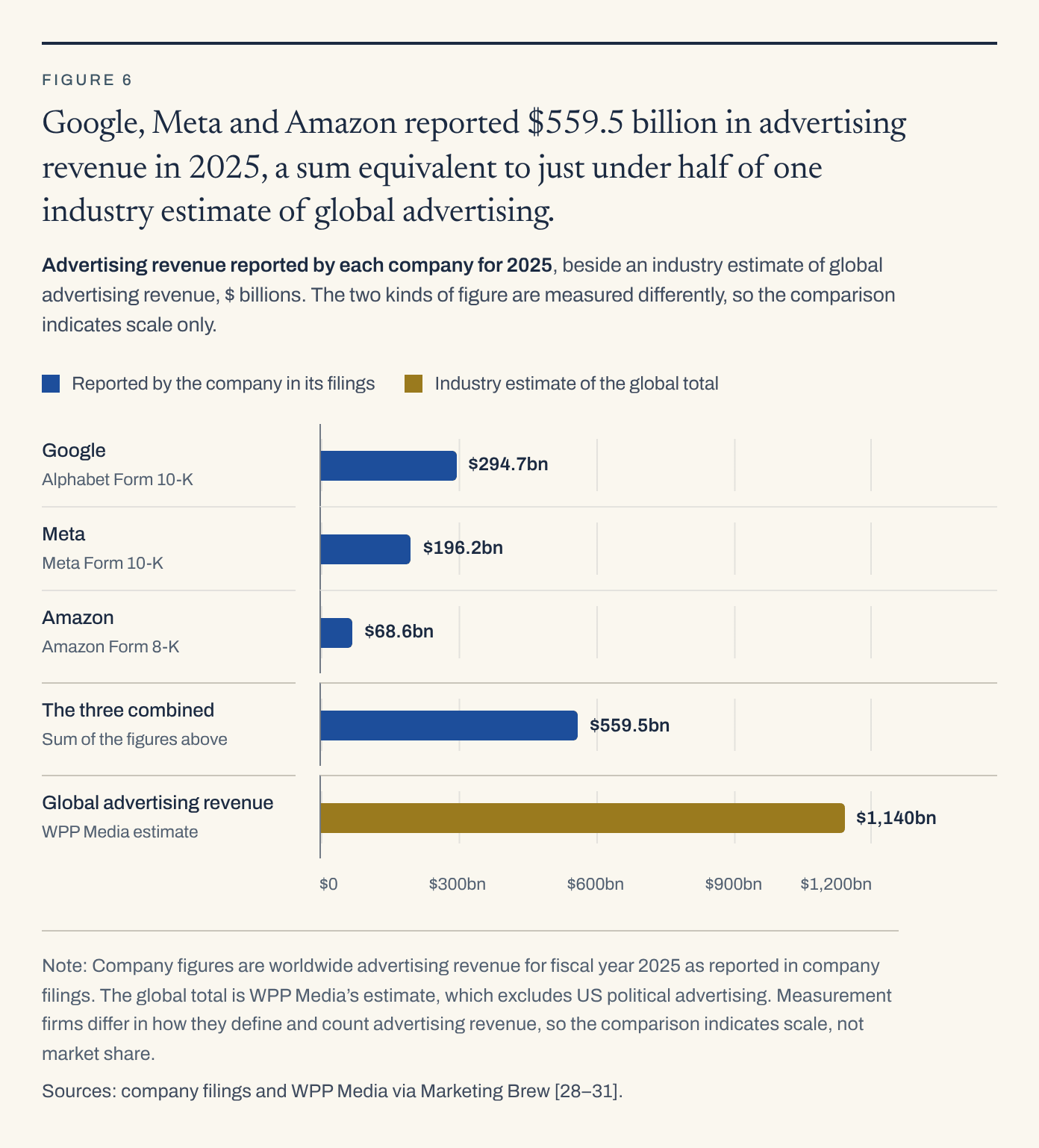
Figure 6 data
| Company or estimate | Advertising revenue, 2025 | Source |
|---|---|---|
| $294.7bn | Alphabet Form 10-K | |
| Meta | $196.2bn | Meta Form 10-K |
| Amazon | $68.6bn | Amazon Form 8-K |
| Three companies combined | $559.5bn | Sum of company figures |
| Global advertising revenue | $1,140bn | WPP Media estimate |
One knock-on effect is pressure on the referral model that supports much of digital publishing. AI-generated answers can satisfy more of a user's query without requiring a visit to the original source. TollBit found click-through rates from AI chatbots were 95.7 percent lower than from traditional Google search, while Similarweb estimates that organic traffic to US news sites has fallen 26 percent since the introduction of Google AI Overviews. In September 2025, Penske Media sued Google, alleging that AI Overviews were reducing search referrals and contributing to lower organic affiliate revenue. Current data does not establish AI as the sole cause of publisher declines, but they show how more platform-contained discovery can weaken referral flows and shift more of the economic value towards the intermediaries controlling access to users. [33, 34, 35]
Retail media brings that competition closer to the point of purchase. US retail-media advertising spending was estimated at $58.79 billion in 2025, rising to $69.33 billion in 2026. Amazon and Walmart are expected to capture more than 89 percent of that incremental spending, leaving a comparatively small share of the market’s growth to other retail-media networks. The attraction is not simply the size of the market but its economics. Walmart's chief financial officer, John David Rainey, has put advertising margins in the range of 70 to 80 percent, against an operating margin of about 4 percent for the company as a whole. The contrast helps explain why retail media has become strategically important as advertising can generate far more profit from the same customer relationship than the underlying retail transaction itself. [32, 36]
At checkout, the economics are less settled. Shopify says merchants selling through Google AI Mode and Gemini currently pay no additional selling fee, while the Universal Commerce Protocol does not prescribe a referral commission and leaves commercial terms to separate agreements. Shopify likewise discloses no distinct take rate on agentic orders. Merchants still face ordinary payment costs, with standard US online card processing starting at 2.9 percent plus $0.30 per transaction, or $3.20 on a $100 order. Perplexity's merchant programme also currently advertises zero commission, suggesting that some platforms are prioritising merchant participation over direct transaction fees. [2, 38, 39, 40]
OpenAI appears to be testing a different model. Its own documentation says merchants pay a “small fee” on completed Instant Checkout purchases, but does not disclose a percentage. A secondary source reports a 4 percent merchant fee separate to payment processing, although this figure is not reported directly by OpenAI. Figure 7 therefore treats the figure as a reported scenario rather than an established rate. It demonstrates the economics of a $100 agentic order. It illustrates that agentic commerce could create a new charge for access to the buyer, but the commercial model as a whole still remains unsettled. [1, 37]
Figure 7
On a $100 order through an AI assistant, a reported 4 percent platform fee and card processing would take $7.20 before the merchant is paid.
Where the money goes on an illustrative $100 order: a single item bought through ChatGPT’s in-chat checkout from a US Shopify merchant, US dollars
- Order value
- Deducted before the merchant is paid
- Merchant receives
- Merchant receives with no platform fee
Note: A reported scenario, not a verified OpenAI fee schedule. The 4% fee was reported by The Information on 21 January 2026, citing a Shopify spokesperson; OpenAI has not published a percentage, and in-chat checkout was scaled back in March 2026. Card processing uses Stripe’s published US rate of 2.9% plus $0.30. Excludes tax, shipping, the merchant’s Shopify subscription and the cost of goods.
Sources: The Information, Stripe and Shopify [37–39].
Download this figure as an image (PNG)
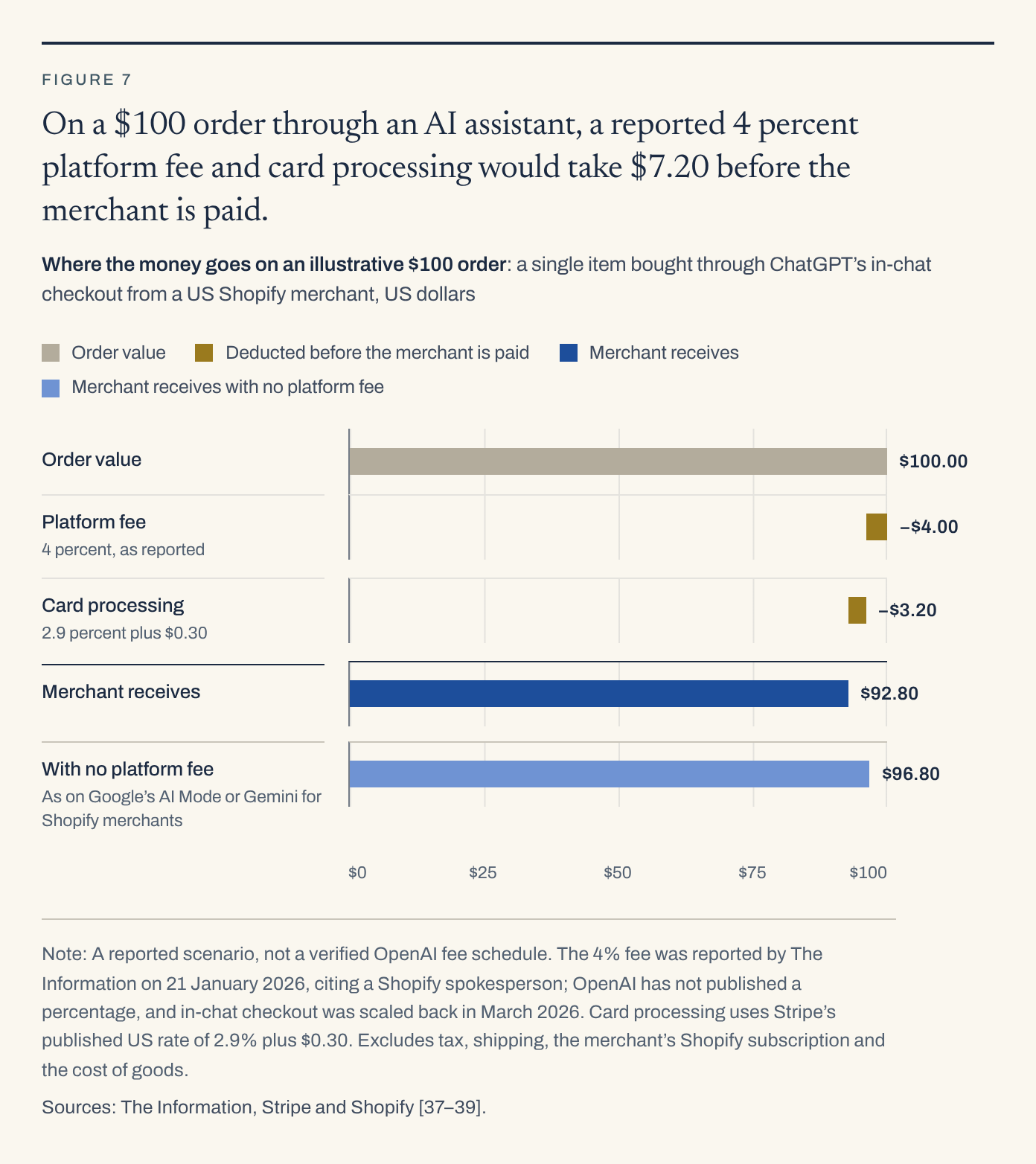
Figure 7 data
| Component | US dollars |
|---|---|
| Order value | $100.00 |
| Reported platform fee (4%) | −$4.00 |
| Card processing (2.9% + $0.30) | −$3.20 |
| Merchant receives | $92.80 |
| Merchant receives with no platform fee | $96.80 |
What matters next is whether these stages remain economically distinct. Retail media already shows how discovery can become more valuable as it moves closer to the transaction. Platforms can sell access to shoppers while observing what they ultimately buy. Agentic commerce could tighten that connection further by bringing recommendation and checkout into the same interface. The companies writing the rules for that interface illustrate the point. OpenAI wrote the Agentic Commerce Protocol with Stripe and sells advertising inside ChatGPT. Google wrote the Universal Commerce Protocol with Shopify and runs Gemini and AI Mode alongside the world's largest search advertising business. That does not establish that they will dominate agentic commerce, but it means the rules governing merchant access and integrations may become commercially significant. [1, 2, 3]
United States v. Google provides a useful precedent for why those distribution choices matter. The case showed how default agreements could reinforce an incumbent’s position by directing large volumes of users through particular access points. Commerce protocols are not equivalent: UCP is an open standard and does not itself determine which merchant or payment provider wins a transaction. But similar questions could emerge around which merchants an assistant can reach, which product feeds it consults and which services are integrated by default. The relevant source of market power may therefore be less the protocol itself than the commercial arrangements built around it. [41]
The Coasean perspective offers an important counterweight. AI agents can lower the costs of searching, comparing and contracting, potentially making markets more competitive by allowing consumers to consider more sellers at much lower cost. Yet lower transaction costs do not necessarily eliminate intermediaries. They can also change where intermediation occurs. Value that once accrued to search engines, publishers or marketplaces may instead move towards the assistants and infrastructure that organise discovery and execute purchases. The evidence so far establishes the scale and concentration of the markets entering that transition, not its eventual outcome. Taken together, it points towards relocation more than dispersal. The firms positioned to control the new route to the buyer are largely those that controlled the old one, and lower transaction costs alone do little to undermine that position. [42]
How Much Will People Delegate
The scope of delegation will help determine how these commercial arrangements develop. Reordering a familiar household item asks relatively little of an assistant. Choosing an unfamiliar product may involve uncertain preferences, competing accounts of quality and a willingness to pay for something difficult to specify. The same person may happily delegate the first purchase and want a substantial part in the second. Adoption estimates become more useful when they make room for that difference.
Moskowitz's caution in his conversation with the Horizon Search Institute concerned the amount of choosing that takes place outside information systems. People consult friends, visit shops and enjoy making discoveries of their own. [8] An assistant enters those habits and relationships. Trust may grow through repeated, satisfactory purchases, with consumers gradually granting more discretion in particular settings. A forecast that counts every purchase touched by AI describes a much wider activity than a forecast of purchases the user allows an agent to complete.
The resulting market will be shaped by what consumers are willing to entrust to assistants and by the conditions under which assistants can act for them. Those conditions are already being negotiated in product design, merchant agreements and technical standards. They include whose products are available for comparison, how commercial relationships are disclosed and what happens when the buyer disputes a choice. Each deserves examination while the arrangements remain open to revision.
A consumer who delegates a purchase should be able to recover an intelligible account of the decision. That account would identify material commercial influence, preserve the context of claims the assistant relied on and show how the transaction followed the authority granted. It would also lead to someone able to put a mistake right. Following these connections gives policymakers and businesses a practical way to assess AI commerce as it develops, with the buyer's ability to understand and challenge a decision carried through the chain.
Conclusion
Taken together, the two audits describe a system that knows more than it is required to say. The law attaches the fact of synthetic origin to content at the moment it is made, and a handful of regimes now require platforms to preserve it. The assistants in this study had absorbed that fact and could recite it on request. Between that knowledge and the shopper lies a decision point that no coded instrument reaches for this kind of information.
The gap is smaller and more tractable than the long debate over detection suggests. Legislators have already written duties that follow a transaction to its final moment, requiring prices set with personal data to be labelled where they appear and marketplaces to explain their rankings before a contract is concluded. A comparable duty for synthetic origin would ask an assistant to relay, when it recommends a product or helps complete a purchase, what it already knows about the advertising behind that product. The economics set out earlier suggest such a duty is unlikely to emerge voluntarily. The firms best placed to surface the information also sell the attention it concerns.
The findings share the limits of pilot work, and they are offered for replication. What they establish is a location. The information needed for an informed purchase exists within the chain, and the question for policymakers is whether the party holding it at the decisive moment should be required to share it.
Works Cited
1. OpenAI. Buy it in ChatGPT. 29 September 2025.
2. Google Developers Blog. Under the hood of Universal Commerce Protocol (UCP). 11 January 2026.
3. OpenAI. Testing ads in ChatGPT. Originally published 9 February 2026, updated 11 August 2026.
8. Ben Moskowitz. Interview with the Horizon Search Institute, 10 September 2026.
9. Noam Kolt. Governing AI Agents. Notre Dame Law Review, volume 101, page 335, 2026.
16. Horizon Search Institute. Provision-level coverage dataset, Research Brief No. 3. September 2026. 53 provisions coded against three stages and two handoffs, with codebook and status notes.
17. Ministry of Electronics and Information Technology, Government of India. Information Technology (Intermediary Guidelines and Digital Media Ethics Code) Amendment Rules, 2026. Notified 10 February 2026, in force 20 February 2026.
21. California Business and Professions Code sections 17940 to 17943, disclosure of bots (SB 1001, 2018). Operative 1 July 2019.
23. National People's Congress of the People's Republic of China. E-Commerce Law, Article 40. Adopted 31 August 2018, in force 1 January 2019.
24. Google. Agent Payments Protocol (AP2), specification of intent, cart and payment mandates. Announced 16 September 2025.
26. Republic of Korea. Framework Act on the Development of Artificial Intelligence and Establishment of Trust (AI Basic Act), Article 31. In force 22 January 2026.
27. Horizon Search Institute. Disclosure retention audit, Research Brief No. 3. September 2026. 144 trials across 18 campaigns in ChatGPT and Gemini, run 27 to 29 September 2026, with eligibility rules, codebook, trial log and intercoder reliability sample.
28. Amazon.com, Inc. Fourth quarter and full year 2025 results, Form 8-K, Exhibit 99.1. 5 February 2026.
29. Alphabet Inc. Annual report on Form 10-K for fiscal year 2025, and second-quarter 2026 earnings call, at which the company reported more than 2.5 billion monthly users of AI Overviews.
30. Meta Platforms, Inc. Annual report on Form 10-K for fiscal year 2025, and company statements on Meta AI usage, May 2025.
32. EMARKETER. US retail media advertising spending forecast, 2025 to 2026.
33. TollBit. State of the Bots report. 2025.
34. Similarweb. Analysis of organic search traffic to US news websites following the introduction of Google AI Overviews. 2025.
35. Penske Media Corporation v. Google LLC. Complaint filed in the United States District Court for the District of Columbia, September 2025.
37. The Information. Report on OpenAI’s merchant fee for Instant Checkout in ChatGPT. 21 January 2026. Secondary source.
38. Shopify. Merchant documentation on selling through Google AI Mode and Gemini. 2026.
39. Stripe. Pricing, standard US online card processing. Consulted September 2026.
40. Perplexity. Shop like a Pro, Perplexity Merchant Program. November 2024.
41. United States v. Google LLC, No. 1:20-cv-03010 (D.D.C.). Memorandum opinion of 5 August 2024 and remedies decision of 2 September 2025.
43. Yash Kanoria, Columbia Business School. Interview with the Horizon Search Institute by video call, 18 September 2026. Kanoria is a co-author of the study cited at reference 11.
Research data
The supporting release includes all 144 coded trials and the 53-provision regulatory map, with summary and status tables. Internal assignments and private conversation links are omitted.
Download the research data (ZIP, CSV files)
Read the methodology and pilot limitations in What the Assistants Tell a Buyer. Model version identifiers and account settings were not recorded. The public data release does not include the blind-recoding sample described in the brief.
How to cite this brief
Telang, A., Sinha, A., & Marson, S. (2026, October 4). One Chain: Disclosure and Accountability in AI Commerce. Research Brief No. 3. Horizon Search Institute. https://horizonsearch.org/publications/briefs/003/