Salons

London


The Royal Society

Held

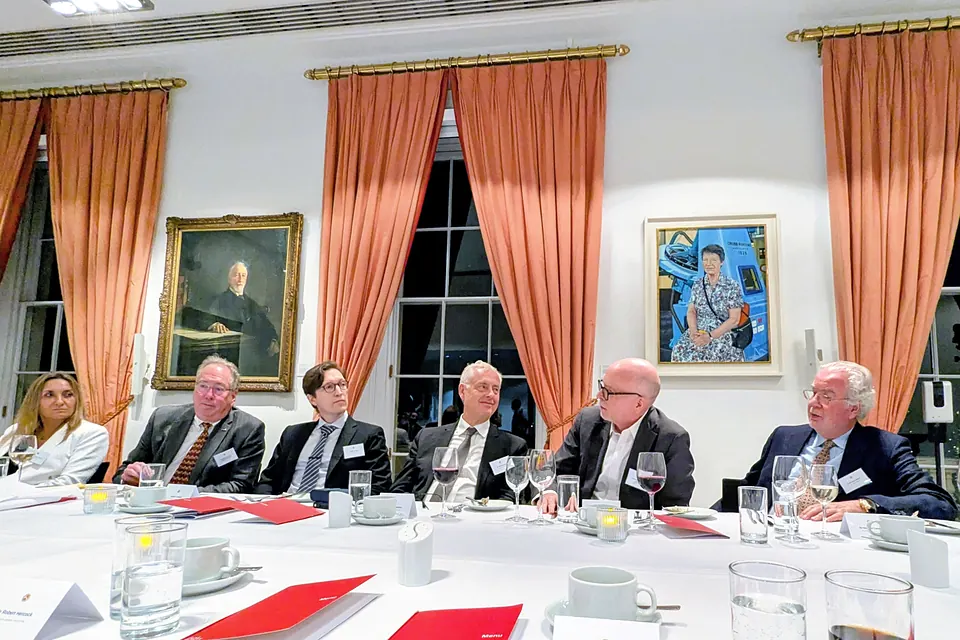
Guests at the HSI London Salon, seated at the dinner table at the Royal Society

Autumn Salon. Finance, regulation, diplomacy, and institutional governance.

The London Salon convened twenty-two governance practitioners, regulators, scholars, and HSI hosts at the Royal Society in the closing week of London’s autumn AI policy calendar. The format followed the New York model: a seated dinner and moderated roundtable, behind closed doors, structured around Horizon Scan 002, the Institute’s study of where AI governance language acquires enforceable cost and which institutions are doing the converting.

Participants largely agreed on the ends they wanted and differed on the means. The debrief sets out five themes from the evening, how they connect to the Scan, and the questions HSI will carry forward to Tokyo.

Inquiry
Where AI Is Governed
Anchored to
The 4th Annual AI Regulation Summit (Central London, October 1, 2026), gathering government ministers, senior regulators, and industry leaders. The HSI Salon convened the following week, on October 7.

Read the debrief

Tokyo


Venue to be confirmed

In preparation

The Asia anchor Salon: Human Agency in an Age of Intelligent Systems, on how societies adapt to advanced AI, explored through Japanese and wider Asian perspectives. Date and venue to be confirmed.

Tokyo would carry questions raised in New York and London into the Human Agency inquiry, and beyond governance to the broader challenges of societal adaptation. Japan’s experience with automation and demographic change offers a distinctive perspective, and its industrial and regional context connects questions of human agency with supply chains, energy, and security.

Three themes are proposed: human agency, institutional resilience, and technological interdependence. Approximately 20–24 participants from diplomacy, industry, academia, and technology would meet under the Chatham House Rule, with relevant Horizon Scan findings circulated in advance and a short, non-attributed synthesis shared afterward.

Inquiry
Human Agency

Formats

Salons are the Institute’s main format. Smaller sessions are convened when a specific research question calls for them, and an annual summit is in planning.

Anchor-city salons

Closed-door dinner roundtables, each built around a Horizon Scan and followed by a published debrief. New York and London have been held; Tokyo is in preparation.

HSI Annual Summit

HSI is planning an annual summit for researchers, policymakers, institutional leaders, and practitioners across its four research domains. The inaugural edition is planned for May 2027, with date, location, and program to be announced.

Working and field sessions

Smaller convenings of two kinds. Working sessions are tied to specific publications. Field sessions are held around events where senior decision-makers already gather. Both are sited where a city contributes something specific the research needs, whether regulatory proximity, industrial depth, or field evidence from outside the usual capitals. Typically 8 to 15 participants, by invitation, and not publicly listed.

Designed for candor, not performance

HSI Salons are closed-door and by invitation only. Prepared remarks are on the record; the discussion that follows is held under the Chatham House Rule, so what is said in it is not attributed to the person who said it. Who was present is a matter of record, published with participants’ agreement. The format is built to support honest dialogue among practitioners, scholars, policymakers, and institutional leaders who otherwise rarely share a room outside formal institutional settings.

The Institute does not publish video, transcripts, or named attribution from Salons. Insights surface through subsequent published research, with sourcing handled in accordance with the rules of the convening.

Invitations follow the research question

Participants are invited for their expertise and their stake in the question under discussion, within the limits of each format. Founding Patrons may be considered on the same basis; patronage does not guarantee attendance.