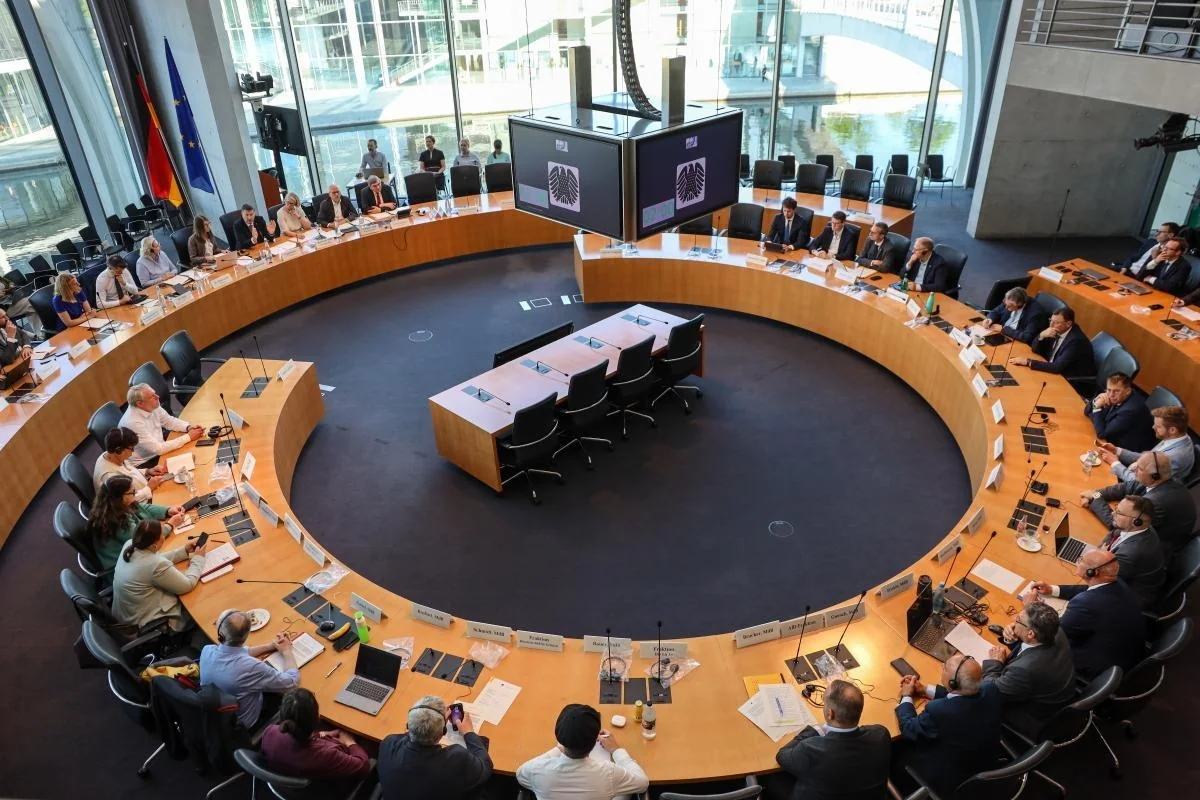
Participants seated around a large circular table during a European Commission working meeting in Berlin.
General view of a meeting during European Commissioner Apostolos Tzitzikostas’s visit to Germany, Berlin, September 22, 2026. Photo: Kyriakos Samartzidis / European Commission. © European Union, 2026, licensed under CC BY 4.0. Cropped and resized for web presentation.

How governments, companies, experts, and multilateral institutions coordinate when authority is fragmented and shared problems cross borders faster than formal institutions can respond. The work studies networked governance, institutional renewal, and structured dialogue across jurisdictions.

The institutions built for the multilateral order of the late twentieth century were not designed for the governance problems of the 2030s. Track II diplomacy, informal expert-led dialogue across borders, has historically complemented formal multilateralism. In an era of fragmented authority and accelerating technology, it carries a growing share of cross-border coordination, and the Institute’s own convening practice is part of the research.

Open questions

Questions the Institute is working on, with their current stage. Evidence and expertise are welcome at research@horizonsearch.org.

What governance infrastructure supports cross-jurisdictional coordination on technology and AI when no single regulator has authority?Planned format: Horizon ScanDrafting
What coordination infrastructure does the AI labor transition require between states, when national workforce coalitions stop at the border?Planned format: Research BriefScoping
How should international education and credentialing standards adapt when the half-life of skills is set by model releases?Planned format: Searchlight seriesScoping
How can Track II convenings be structured to produce institutionally consequential outputs rather than commentary?Planned format: Research BriefScoping
How do institutions translate dialogue into structured agreement at decision-making scale?Planned format: Research BriefPlanned

Publications

All publications
The Autonomy Clause: How Congress Defined AI Border Towers Before Proving They WorkInaaya FirozSearchlight 031
October 30, 2026
U.S. Hurricane Warnings Now Rely on Google’s AI. Who Answers When the Model Misses?Ashwin TelangSearchlight 030
October 23, 2026
Who May an AI Tell? Escalation Authority Has Become a Product SettingAvisikta Sinha · Human AgencySearchlight 029
October 16, 2026
The First Head Start Is Over: AI Cyber Defense Now Depends on Who Obtains AccessGloria Chen · Where AI Is GovernedSearchlight 028
October 9, 2026
Companies Blaming AI for Layoffs Will Have to Say So on the RecordAshwin Telang · Human AgencySearchlight 027
October 2, 2026
AI GovernanceHorizon Search Institute · Where AI Is GovernedHorizon Scan 002
September 2026 · Revised October 2026
Where Uncertainty is Overlooked: Interaction Risk in India’s Digital-Welfare and Policing InfrastructureAvisikta Sinha · Where AI Is GovernedSearchlight 024
September 11, 2026
The AI Capex Boom: From Hyperscaler Debt to Systemic RiskSamuel Marson · Compute and PowerSearchlight 022
August 28, 2026
France Forces the AI Search Licensing QuestionInaaya Firoz · Where AI Is GovernedSearchlight 021
August 21, 2026
When a Chatbot Acts as a Therapist: Tennessee’s New Law and AI Mental HealthRonan Amir · AI in Regulated InstitutionsSearchlight 016
July 17, 2026
When the Vendor Becomes the RegulatorGloria Chen · Where AI Is GovernedSearchlight 013
June 19, 2026
The Filter and the File: How the EU Just Redrew High-Risk AI ClassificationAshwin Telang · Where AI Is GovernedSearchlight 012
June 5, 2026
Four AI Regimes, Zero Coordination: The Compliance Premium of 2026Hernando Liu · Where AI Is GovernedSearchlight 011
May 22, 2026