The Thesis
On September 30, Governor Gavin Newsom signed SB 951 into law, following its presentation to him on September 9. Starting January 1, 2027, employers filing a covered layoff notice for cuts caused "in whole or in substantial part" by AI or other automated technology must identify the notice as a technology displacement. The legislative history records it as Chapter 860, Statutes of 2026.
The final text is far narrower than the spring draft that alarmed employer groups, and it adds no new notice period or headcount threshold. However, it gives California a disclosure written into statute and backed by public quarterly summaries, a combination that appears to be a first among the states. That record will be placed beside what companies have already told investors and staff about AI and their workforce.
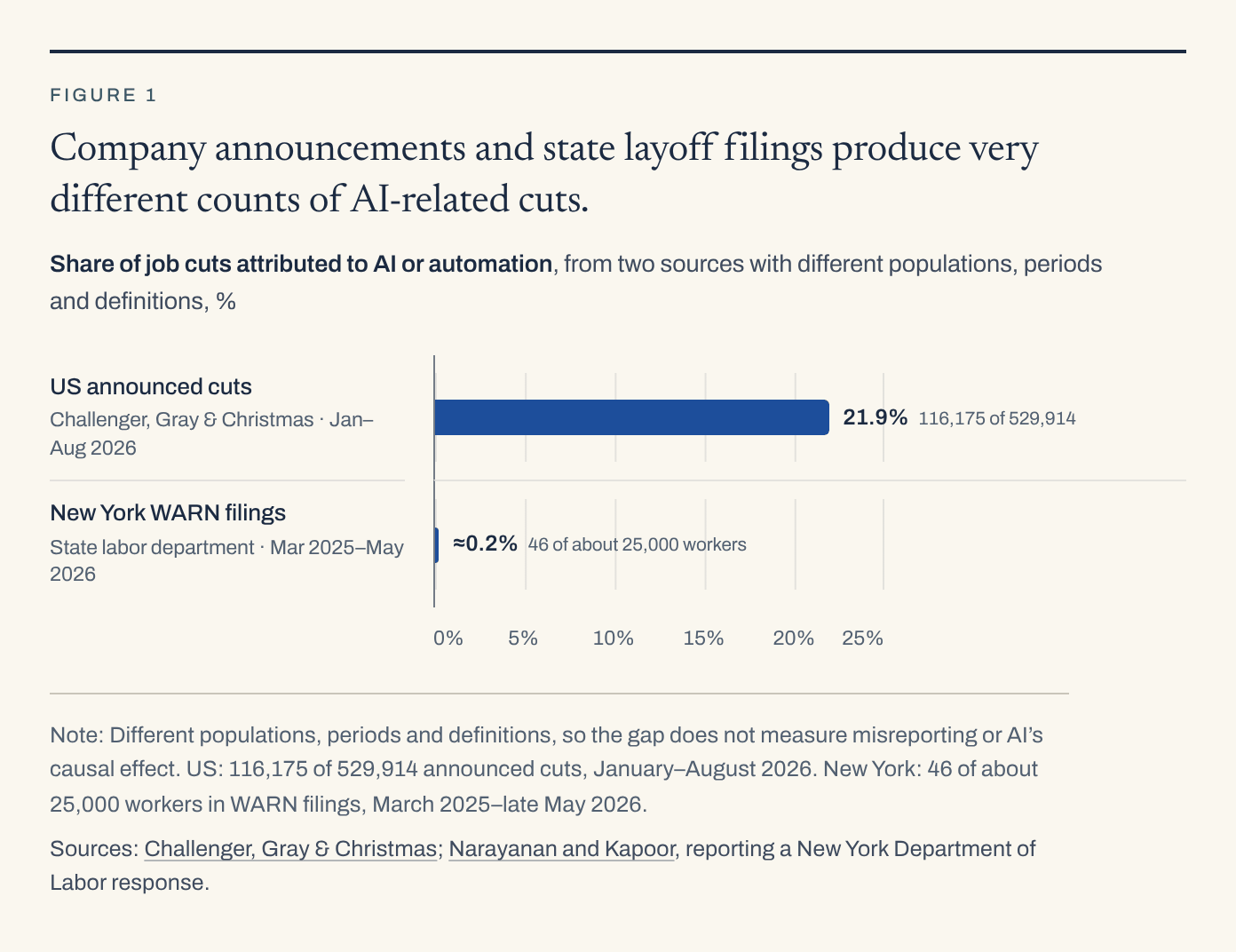
Company announcements and state layoff filings produce very different counts of AI-related cuts. They cover different employers and periods, so the gap alone cannot establish inconsistent reporting. Ultimately, companies that adopt one defensible and accurate attribution standard before the first notices are due will enter the state's summaries with an accurate and consistent public record.
The Signal
Signal 01California's New Law Keeps the AI Label and Drops the Tougher Rules
What happened. As introduced in February, SB 951 would have required 90 days' notice before AI-driven cuts affecting 25 workers or a quarter of a workforce, a second notice whenever a company stopped hiring for a role that AI had absorbed, and the name of the vendor that built or sold the system. Four rounds of Assembly amendments between June and August struck most of that design. The version enrolled on September 4 amends Cal/WARN, the state law that requires 60 days' notice before a layoff of 50 or more workers at a site with 75 or more employees. Notices for AI-driven cuts must open with a line identifying a technology displacement, then list the occupations and locations affected, the job functions to be automated and the category or type of system responsible. The Employment Development Department (EDD) will post a summary of each notice and a quarterly statewide tally, and it will report to the Legislature on AI's effects on hiring by January 1, 2028.
| Provision | Spring draft (April 2026) | Enrolled text (September 4, 2026) |
|---|---|---|
| Notice period | 90 days | 60 days, as Cal/WARN already requires |
| Trigger | 25 workers or 25% of the workforce, whichever is less | 50 or more layoffs at a site of 75 or more, as Cal/WARN already requires |
| Causation standard | "In whole or primarily" | "In whole or in substantial part" |
| Technology disclosure | The specific system and the entity that developed, sold or leased it | The category or type of system |
| Hiring freezes | A separate notice to EDD | A one-time EDD report on hiring practices due January 1, 2028 |
| Worker protections | At larger employers, no discharge without cause during notice and a right of first bid on open roles | None added |
Table drawn from the Senate committee's April analysis, the enrolled bill digest and Covington's summary of the final text.
Why it matters. The label attaches to Cal/WARN's existing thresholds, so it covers qualifying layoffs, relocations and terminations that already require notice. Its trigger phrase, "in substantial part," is not defined in the digest. The digest also does not say how a notice missing the label would be treated under Cal/WARN's existing penalty of up to $500 a day. In other words, employers are left to decide for themselves what counts as an AI layoff, much as New York employers are today. Most of the burden falls on one judgment call.
Second-order effect. Left out of the final text are provisions that business groups opposed in committee, including the longer notice window and the disclosure of model identities. They may return by another route. An executive order Newsom signed on May 21 gives the Labor and Workforce Development Agency 180 days to recommend Cal/WARN changes that would supply earlier warning of AI-driven disruption, which places those recommendations in mid-November. Employment lawyers at Ogletree Deakins expect the recommendations could include lower thresholds or AI-specific triggers. The order does not commit the state to either change. Even so, the enrolled SB 951 may prove to be a floor for California's approach.
Signal 02Companies Credit AI for Layoffs in Public but Rarely on State Filings
What happened. Challenger, Gray & Christmas, the Chicago outplacement firm that tallies the reasons companies give when they announce cuts, counted AI in 116,175 announced job cuts through August. That is about 22% of the year's total and the leading reason year to date, although AI slipped to fourth place in August with 3,462 cuts. New York has asked a version of California's question since March 2025, through a checkbox on its WARN form for "technological innovation or automation." More than 160 companies filed notices in the first year, and zero of those notices checked the box. By late May 2026, the state labor department had told Princeton's Arvind Narayanan and Sayash Kapoor that one company, Nespresso, had checked it, covering 46 of roughly 25,000 laid-off workers.
Why it matters. Considering the two figures side by side, the count built from company announcements credits AI with about one cut in five, while New York's legal filings credit it with fewer than one in 500. The two counts cover different populations, so neither figure is a truly clean estimate. The comparison cannot tell us how much of the gap comes from coverage, timing or attribution. The sources are also written for different audiences, which may shape how companies describe a decision. Announcements are addressed to investors and the press, where a forward-looking account of AI may be well received. In a Harvard Business Review survey of more than 1,000 executives, 21% reported large headcount cuts made in anticipation of AI, against 2% tied to AI already in use. Legal filings are addressed to regulators, where companies may have reason to describe causes conservatively, and New York's labor commissioner acknowledged in 2025 that defining an AI-related layoff is difficult. Asking the question, it turns out, isn't the same as getting an answer.
Recent memos show how much room the current system leaves. Intuit's chief executive said in May that the company's 17% workforce cut was unrelated to AI. On September 18, Disney's chief legal officer told nearly 1,000 staff that his department would shrink while "automating certain workflows," in a memo that used neither "layoff" nor "AI." Uber's cut of about 3,300 jobs in September came with a memo that did not cite AI as a reason for the cuts, although it did refer to the company's autonomous future. Three large employers offered three different explanations within the same five months.
Second-order effect. A mandatory label creates a record that can be checked against company statements. Earnings-call transcripts, staff memos and investor presentations are already public, and EDD's summaries would add a state record to set against them. Regulators have already treated AI claims made to investors as statements of fact. In 2024 the SEC fined two investment advisers a combined $400,000 for overstating their use of AI, and then-Chair Gary Gensler said public companies should also make sure what they tell investors about AI is true. A cut credited to AI on an earnings call and described otherwise on a state filing could give plaintiffs, unions and short sellers a documented inconsistency to test. The reverse case could draw the same scrutiny.
Signal 03AI's Clearest Effect Shows Up in Hiring, Which the New Law Does Not Track
What happened. Most of the new research points to hiring. Erik Brynjolfsson's Stanford team, which has spent a year mining ADP payroll records, released a revision of its "Canaries in the Coal Mine" paper on August 12. It finds no evidence of widespread displacement. Employment of workers aged 22 to 25 in AI-exposed occupations, however, now stands 19% below where it would be had it kept pace with less-exposed peers, and that gap has widened since the authors first measured it in August 2025. Federal Reserve economists find employment in coding occupations still growing, though about three percentage points a year slower than a no-AI path would predict. To be clear, the paper defines coders by their skills, so its category is broader than software engineering. The Budget Lab at Yale found no link, as of its April update, between AI exposure and changes in employment or unemployment. California's own tracker, which the California Policy Lab built with EDD from unemployment claims, showed the three-month average of claims from highly exposed occupations falling about 1.2% in the August update posted September 17. The tracker places that change within the range of recent fluctuations. The Stanford authors stress that these are descriptive patterns, not causal estimates of AI’s effect on employment.
Why it matters. Much of AI's early effect on work appears to operate through reduced hiring. Narayanan and Kapoor argue that experienced staff hold tacit knowledge, the unwritten know-how needed to put AI to productive use. In their account, that knowledge is one reason employers have so far slowed hiring more often than they have laid off existing staff. Yes, large layoffs are visible and countable. But what about the analyst role that discreetly stopped being posted? The spring version of SB 951 tried to capture that channel with a notice for hiring freezes. The enrolled version replaces it with a single EDD report on hiring practices due in 2028. A company that shrinks its entry-level intake through attrition has no notice to file.
Second-order effect. That gap leaves the fuller count to Washington and to researchers. The AI-Related Job Impacts Clarity Act, introduced by Senators Josh Hawley and Mark Warner in November 2025, would require quarterly reports of AI-related layoffs, AI-related hires and vacancies left unfilled for AI-related reasons. A House companion followed in June 2026. As of late September, both bills remained in committee. Until one passes, the most detailed map of the entry-level squeeze will be drawn from payroll processors and unemployment claims, sources that can locate a pattern without naming its cause.
The Metric
46
That is the number of New York workers whose layoffs were attributed to automation on the state's WARN form through late May 2026, out of roughly 25,000 laid off in the period. Nationally, companies cited AI in 116,175 announced cuts through August 2026. The two figures cover different periods and populations, so they cannot be subtracted. Still, the distance between them suggests how much of the AI layoff story rests on announcements that legal filings have yet to test. California's new law creates what appears to be the first statutory counterpart.
Figure 1
Company announcements and state layoff filings produce very different counts of AI-related cuts.
Share of job cuts attributed to AI or automation, from two sources with different populations, periods and definitions, %
Note: Different populations, periods and definitions, so the gap does not measure misreporting or AI’s causal effect. US: 116,175 of 529,914 announced cuts, January–August 2026. New York: 46 of about 25,000 workers in WARN filings, March 2025–late May 2026.
Sources: Challenger, Gray & Christmas; Narayanan and Kapoor, reporting a New York Department of Labor response.
View the data and sources
| Measure | Value | Period | Source |
|---|---|---|---|
| U.S. announced job cuts citing AI | 116,175 | Jan–Aug 2026 | Challenger, Gray & Christmas |
| U.S. announced job cuts, all reasons | 529,914 | Jan–Aug 2026 | Challenger, Gray & Christmas |
| AI share of U.S. announced cuts | About 22% | Jan–Aug 2026 | Challenger, Gray & Christmas |
| U.S. announced job cuts citing AI, August only | 3,462 | Aug 2026 | Challenger, Gray & Christmas |
| New York companies filing WARN notices | More than 160 | First year, from Mar 2025 | Hunton |
| New York filers checking the automation box | 0 | First year, from Mar 2025 | Hunton |
| New York filers checking the automation box | 1 (Nespresso) | Mar 2025–late May 2026 | AI as Normal Technology |
| New York workers in automation-attributed layoffs | 46 | Mar 2025–late May 2026 | AI as Normal Technology |
| New York workers covered by WARN filings | About 25,000 | Mar 2025–late May 2026 | AI as Normal Technology |
| Automation share of New York laid-off workers | About 0.2% | Mar 2025–late May 2026 | Calculated from the two rows above |
The Playbook
Adopt one written attribution standard. Define what "in substantial part" means inside the company, for example the share of eliminated tasks now handled by a deployed system. Legal, human resources and investor relations should sign the same definition, and it should govern staff memos, earnings commentary and state filings alike.
Reconcile the last four quarters. Compare public statements from the last four quarters that tied headcount to AI against the WARN notices filed over the same period. Discrepancies are easier to correct now, before EDD begins posting summaries and before workers and the public rely on them.
Build the record when the decision is made. Document which tasks the system absorbed, when it entered production and what category of tool it is, since the notice asks for automated job functions and system type. Records made at the time of the decision are more credible than records assembled after a challenge.
Review vendor contracts. The enrolled text asks for a category of system, while the spring draft asked for the developer's name. Confirm that confidentiality clauses would permit either disclosure, because the stricter version may return through the November Cal/WARN review.
Measure entry-level hiring now. Track intake for junior roles against a pre-2023 baseline, and follow both the Labor and Workforce Development Agency's recommendations and the federal Clarity Act. Hiring freezes are the likeliest next target for disclosure, and a baseline built today will be easier to defend than one reconstructed later.
The Attribution Test
The claim to test is "This layoff was driven by AI." A single question rarely settles a claim like this one. The evidence below can strengthen or weaken an AI attribution, and the balance of that evidence matters more than any one item.
Evidence that strengthens an AI attribution
Management can name the system and the specific tasks it now performs.
The system was in production use before the reduction was decided.
Work volume in the affected function held steady or grew after staffing fell. That pattern suggests the system absorbed some of the work, although a shift in demand can produce the same result.
Evidence that weakens an AI attribution
The system was still in pilot or procurement when the reduction was decided, which points to a cut made in anticipation of AI.
The reduction coincided with falling demand, cost pressure or a restructuring that would likely have occurred without the system.
The staff memo, the earnings call and the WARN filing, if one was made, describe the cause differently. Inconsistent accounts leave an AI role possible, although they lower confidence in any single explanation.
Among large reductions, the Harvard Business Review survey suggests that cuts made in anticipation of AI outnumber cuts tied to working AI by roughly ten to one. That ratio argues for treating early attributions with care.
The Lens
Human Performance. The label counts experienced workers who lose their jobs. The Stanford data shows weaker employment among young workers in more exposed occupations, and those first rungs of a career are where people build the judgment an AI-assisted firm will need from them later. Fewer entry-level openings narrow the path into these careers for young workers, and employers that pause junior hiring may also find a short bench of mid-level talent by the end of the decade.
Responsible AI. Attribution is a form of accountability. Crediting AI with a cut decided on other grounds inflates the technology's reputation and misleads the policymakers who rely on these counts. Understating AI's role hides displacement from the workforce boards meant to respond to it.
Governance & Diplomacy. New York's disclosure checkbox, California's statutory label and the federal Clarity Act rest on three different definitions of an AI-related job loss. Multistate employers will have to reconcile them, and the first state to enforce a mandatory label may set the working definition for the rest. Counting AI layoffs is difficult. Agreeing on what counts as one is more difficult still.
Links Worth Your Time
Why AI hasn't replaced software engineers, and won't (AI as Normal Technology). Narayanan and Kapoor test three headline AI layoffs against the reporting that followed and find that other pressures largely explain them.
No Widespread Displacement, but the AI Employment Gap for Young Workers Has Widened to 19% (Stanford Digital Economy Lab). The August revision of a widely cited payroll study of AI and early-career employment.
AI and the Labor Market (California EDD). The state's monthly AI-Unemployment Tracker, with its methodology and downloadable claims data.
New York WARN Act: No AI-Related Layoffs Reported in First Year (Hunton). A clear account of why New York's checkbox produced almost no data.
California Legislature Advances AI Employment Bills (Covington). A summary of SB 951 alongside SB 947, the companion bill on automated firing decisions, both signed by Newsom on September 30.
Sources
- CalMatters Digital Democracy — SB 951: Employment: technological displacement: notice
- California Legislative Information — SB-951 bill text and history
- California Senate Privacy, Digital Technologies, and Consumer Protection Committee — SB 951 analysis, April 20, 2026
- Covington & Burling (Inside Jobs) — California Legislature Advances AI Employment Bills
- Wiley — California Closes Legislative Session with Significant AI and Privacy Developments
- Transparency Coalition — AI Legislative Update: September 25, 2026
- Ogletree Deakins — California Legislature Proposes 90-Day Layoff Notice Requirement Due to Employer's AI Use
- Citizen Portal — Committee advances Sen. Reyes's bill extending WARN-style notice for AI displacements
- California Employers Association — Will California's WARN Act Catch Up With AI?
- Office of the Governor of California — Governor Newsom signs first-of-its-kind executive order to prepare workers and businesses for potential AI disruption
- Ogletree Deakins — Cal. Governor's Executive Order Aims at Shielding Workers From AI Displacement
- HCAMag — Gov. Newsom launches California AI jobs study, signals WARN Act changes
- Challenger, Gray & Christmas — Challenger Report: August Job Cuts Up 58%, Consumer Products, Food Lead
- Challenger, Gray & Christmas — Job Cut Announcement Report, August 2026 (PDF)
- Hunton Andrews Kurth — New York WARN Act: No AI-Related Layoffs Reported in First Year of Adding AI-Related Disclosure to the System
- OGC Solutions — Attention New York Employers: The NY WARN Act Now Requires Disclosure of AI-Related Layoffs
- AI as Normal Technology — Why AI hasn't replaced software engineers, and won't
- Harvard Business Review — Companies Are Laying Off Workers Because of AI's Potential, Not Its Performance
- CNBC — Intuit CEO says company's 17% workforce cut had nothing to do with AI
- Deadline — Disney Legal Chief Warns of "Hard Choices" and "Much Smaller Organization" as Company Layoffs Loom
- Yahoo Tech — Tech layoffs tracker 2026
- U.S. Securities and Exchange Commission — SEC Charges Two Investment Advisers with Making False and Misleading Statements About Their Use of Artificial Intelligence
- Morgan Lewis — SEC Charges Investment Advisers with Making False and Misleading Statements About Their Use of AI
- Stanford Digital Economy Lab — Canaries in the Coal Mine? Six Facts about the Recent Employment Effects of Artificial Intelligence (revised August 12, 2026)
- Stanford Digital Economy Lab — No Widespread Displacement, but the AI Employment Gap for Young Workers Has Widened to 19%
- Federal Reserve Board — AI and Coder Employment: Compiling the Evidence
- The Budget Lab at Yale — Tracking the Impact of AI on the Labor Market (April 2026)
- SSRN — Working paper on AI adoption and hiring versus separations
- California Employment Development Department — AI and the Labor Market (AI-Unemployment Tracker)
- Office of the Governor of California — California becomes the first state to launch a tool to monitor and track AI's impacts on the workforce
- Congress.gov — S.3108, AI-Related Job Impacts Clarity Act
- GovInfo — H.R. 9352, AI-Related Job Impacts Clarity Act
- Office of Rep. Steven Horsford — Horsford Introduces Legislation to Protect Workers from AI-Driven Layoffs
- Foley & Lardner — Navigating Workplace AI When Federal, State Policies Clash
- Office of the Governor of California: signing announcement, September 30, 2026
- California Legislative Information: SB 951 bill history, Chapter 860, Statutes of 2026
How to cite this issue
Telang, A. (2026, October 2). Companies Blaming AI for Layoffs Will Have to Say So on the Record. HSI Searchlight, Issue 027. Horizon Search Institute. https://horizonsearch.org/publications/searchlight/027/