At 4 p.m. Central time on October 6, before the storm forming over the southwestern Gulf even had a name, the National Hurricane Center issued a forecast whose track, in the center’s words, was “in best agreement with” two artificial intelligence models, one of them built by Google DeepMind. Forecasters stayed close to that guidance while physics-based models leaned west, with the U.S. GFS pointing toward Mississippi and Louisiana, and Hurricane Isaias came ashore near Destin, Florida, within a few hours of the time Google’s model had projected three days earlier. The episode marks a highly visible win for machine learning in the most consequential forecast the federal government issues. It also leaves emergency managers, insurers and federal buyers with the question of who answers for a privately built model once its output becomes an official warning.
The Thesis
Forecasters at the hurricane center now shape official warnings around Google DeepMind’s model, and the verification record gives them good reason to. The dependence extends well beyond a single model, however. Google trains that model partly on the center’s own storm records, will host NOAA’s operational supercomputing by the end of 2027 and is beginning to feed its own forecasts into Search, Maps and Gemini. At the same time, the administration’s budget request would zero out the budget line for NOAA’s main research office, whose Atlantic laboratory co-developed HAFS, one of the physics-based hurricane models forecasters still consult for intensity and wind structure.
The accuracy gains are significant, offering a crucial upside of buying coastal residents time. However, answerability is an emerging issue, central to accountability. Courts have shielded government forecasts from negligence claims since at least the 1950s, while the agreement that places Google’s model in the forecast room is public only in outline. Emergency managers and insurers acting on a warning therefore have little visibility into who bears the cost when the model errs.
The Signal
Signal 01The official forecast followed Google’s model
What happened. The center’s first discussion of the system, issued at 4 p.m. on October 6, placed the official track “near the fast side of the guidance, in best agreement with the GDMI and ECAI aids,” the center’s codes for Google DeepMind’s model and, by its label, the European Centre’s AI model, and it called for a hurricane by Thursday. Early on October 7, the center described “AI-model guidance remaining on the east side, and physics-based models on the west side” of the range of possible tracks, and that evening, with the official forecast leaning toward Florida, Okaloosa announced a mandatory evacuation for coastal zones around Destin and Fort Walton Beach, effective at noon Thursday. On the night of October 8, the center raised its intensity forecast because “a majority of Google DeepMind ensemble members,” along with some regional hurricane models, showed Isaias briefly becoming a major hurricane, and the storm peaked at 120 mph the next day. Isaias came ashore near Destin that Friday night as a Category 2 hurricane with 105 mph winds, killed at least four people and still had about 670,000 customers in the dark across four states at midday Saturday.
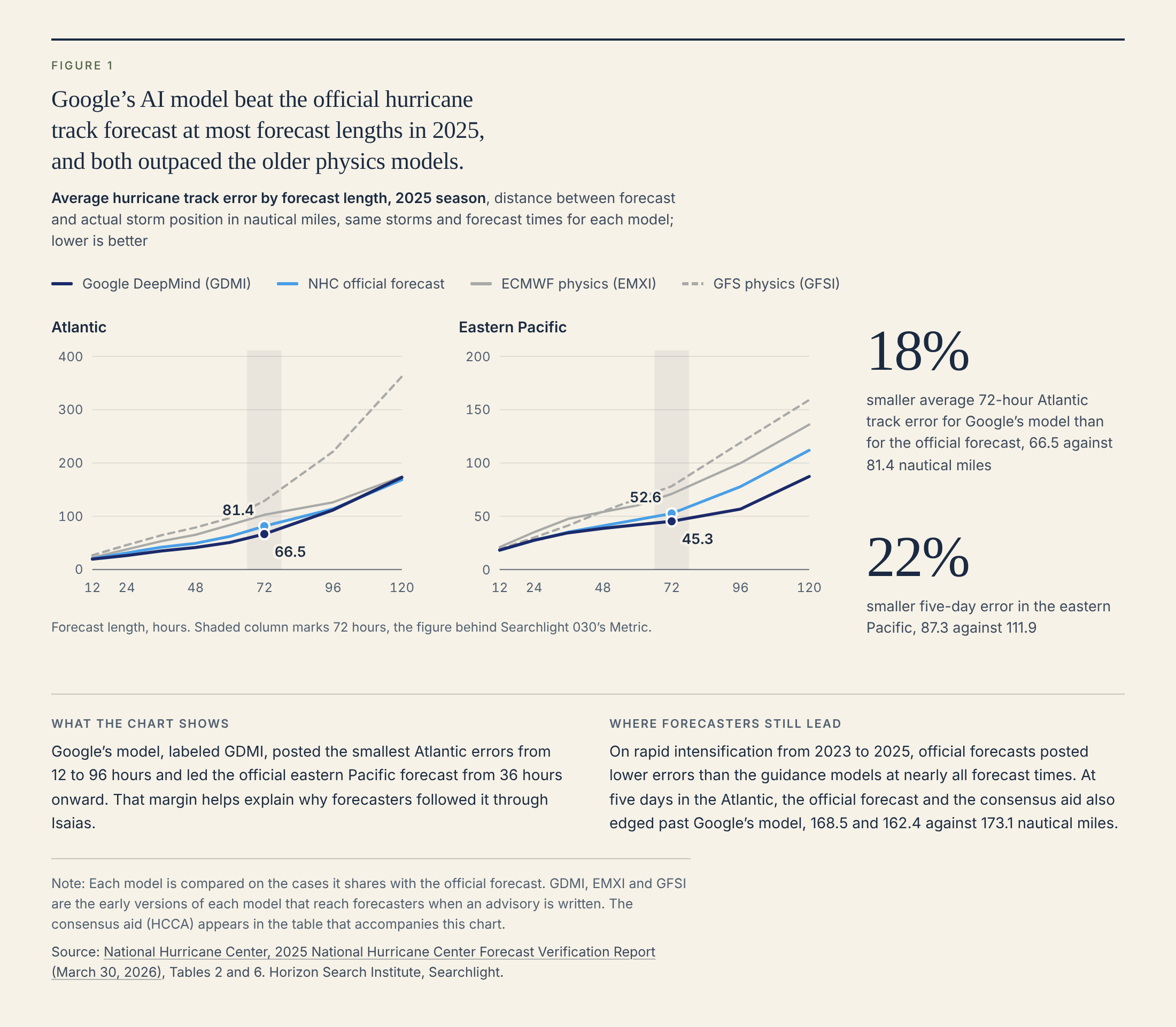
Why it matters. As recently as the 2024 season, official hurricane forecasts drew on physics-based and statistical guidance alone. The center’s 2025 verification report, which covers the first season in which it incorporated AI models into operations, shows why that changed so quickly. In the Atlantic, Google’s model posted an average 72-hour track error of 66.5 nautical miles, against 81.4 for the official forecast and 102.7 for the European Centre’s main physics-based model, and in the eastern Pacific it beat the official forecast at each lead time from 48 to 120 hours. The record on intensity is closer. Google’s model matched the official forecast at 72 hours in the Atlantic. On rapid intensification, the sudden strengthening that leaves coastlines the least time to prepare, the report found that official forecasts from 2023 to 2025 posted lower errors than the guidance models at nearly all forecast times.
The published research points to similar trends. In a Nature paper released in August, DeepMind and its collaborators reported that the model’s three-day forecasts are as accurate as earlier models’ two-day forecasts, the equivalent of a whole extra day of warning for a coastline deciding whether to evacuate. Through the first week of September, Google’s model was beating the center’s official track forecasts by as much as 30% at five days, according to hurricane specialist Michael Lowry. Data compiled by former NHC branch chief James Franklin show that across the past two seasons it has been the most accurate track guidance two to three times as often as the official forecast. Those margins can be quantified, with University at Albany atmospheric scientist Brian Tang citing an estimate that forecast improvements since 2007 save about $2 billion each time a hurricane strikes the U.S. coast.
Isaias added a vivid case to that record. An analysis by HurriLab, a North Carolina firm founded in June by Wallace Hogsett, formerly the hurricane center’s top science officer, found that the main physics-based ensembles had the storm reaching the coast a full day or more late and posted track errors more than double the five-year average, while Google’s model pinpointed the strike within a few hours three days out. NHC director Michael Brennan has called the AI “another tool in the toolbox,” and the Isaias record supports that framing on intensity, where the official forecast posted the lowest overall error and the older HWRF and HMON physics models led beyond 36 hours.
Second-order effect. The more often Google’s model beats the official forecast, the more a forecaster who departs from it will need to explain why. Departing from the AI guidance is becoming a choice, and one that specialists will have to justify in a public discussion that emergency managers along the coast follow closely. The discipline cuts both ways, since the model’s documented weaknesses cluster in the details that turn a track forecast into damage. Weather.com’s review of the storm called the sting jet, a band of winds above 100 mph on the storm’s western side near the coast, “one sore spot” for the DeepMind suite. Experimental runs of NOAA’s HAFS model showed those stronger western winds, and the review called the storm’s collapse from Category 3 to post-tropical in about 12 hours “extraordinarily unusual.” AI models learn from the historical record, and an April study in Science Advances found that they underperform on record-breaking extremes, a relevant limit in a season shaped by a super El Niño. The center’s value is shifting from producing a forecast to judging when the machine’s forecast deserves to be overruled, a skill that depends on the physics models and researchers that the next signal shows are under budget pressure.
Signal 02Google now spans the forecast from model to phone screen
What happened. Google’s place in the U.S. forecast has grown layer by layer over little more than a year. In July 2025, NOAA signed a cooperative research and development agreement, or CRADA, under which Google’s weather team provides the hurricane center with AI cyclone forecasts during active storms and NOAA performs routine evaluations of each new and updated model. That December, NOAA made a suite of AI global models operational, building them on Google DeepMind’s GraphCast before fine-tuning them on the agency’s own analyses. In July 2026, NOAA named Google Cloud the primary computing provider for its operational supercomputing system, with the Global Forecast System and its ensemble shifting through early 2027 and the full transition due by December 2027, at a price that has yet to be disclosed. In September, Google released WeatherNext 3, which produces hourly forecasts at resolutions as fine as 5 kilometers, is beginning to feed Search, Maps and Gemini and is sold to businesses through BigQuery and Earth Engine.
Why it matters. Viewed from the agency’s side, NOAA is on its way to becoming a tenant in infrastructure that Google owns. By the end of 2027, the government’s operational models will run on Google’s machines. Its hurricane specialists already check their forecasts against Google’s model, and its own AI models descend from Google’s research, so a growing share of the public warning chain will pass through one company’s systems before a resident of Destin sees an advisory. To be clear, the model layer is unusually portable. DeepMind has released the code and trained parameters of its cyclone model for anyone to build on, and the European Centre publishes its AI forecasts under an open license that permits commercial reuse. The stickier dependencies lie in computing contracts, data pipelines and people.
Part of this reliance traces to the relative decline of public capacity. Elaine Kamarck of Brookings, who has followed the agency’s staffing losses closely, reported in August 2025, citing the Associated Press, that nearly half of all weather offices were missing 20% of their staff, and she named six offices that had cut or suspended weather balloon launches. The administration’s FY2027 request then proposes $4.54 billion in discretionary funding for NOAA. It funds the Office of Oceanic and Atmospheric Research at zero, a $649 million change from the FY2026 enacted level, by transferring its research activities to other offices, while the Weather Service gains 2.7%. At an April 28 House hearing, Science Committee ranking member Zoe Lofgren called cuts to programs that improve hurricane and tornado forecasting “pennywise and pound-foolish,” and Chair Brian Babin, a Texas Republican, doubted that the request met the president’s expectations for NOAA’s core mission. NOAA Administrator Neil Jacobs told the panel that some research would be accelerated under other offices, while acknowledging that university grants would largely be cut. House appropriators have since recommended $5.85 billion for the agency, a far smaller reduction. Framed as an investment choice, the worry is that an agency relying more heavily on outside models may be eating its seed corn, trimming the research it needs to audit or replace those models later.
Perhaps most tellingly, expertise is shifting along with the infrastructure. Hogsett, who left the center’s top science post to found HurriLab, now produces one of the more detailed independent scorecards of the forecast guidance the agency relies on. Brennan, for his part, has said that center staff worked with Google to help it train on the center’s best track analysis, the authoritative historical record of each storm’s position and strength.
Second-order effect. Congress is starting to write this buy-or-build choice into law. The Weather Act reauthorization, S. 3923, cleared the Senate Commerce Committee by voice vote in March and was formally reported on September 28, and on October 16 the Congressional Budget Office put its cost at $2.9 billion over five years, including an authorization of $76 million a year from 2027 through 2030 under a section that lets NOAA develop AI-based weather models, which CBO expects to cost $287 million over the period. The bill also proposes to codify and expand NOAA’s commercial data program and to require cost comparisons between federal and commercial options, which means procurement math will increasingly decide how much of the forecast the government owns. Internationally, the World Meteorological Organization’s 2025 AI action plan reaffirmed national weather services as the “single authoritative voice” for warnings, a principle that grows harder to uphold when the company supplying guidance to one national service also publishes its own forecasts to Search and Maps users worldwide.
Signal 03Who answers when the model misses
What happened. The law on forecast liability was codified around a storm far from the Gulf. In November 1980, a rapidly developing storm on Georges Bank sank the fishing vessel Fairwind and damaged the Sea Fever, drowning crew members from both boats, and their families and a vessel owner sued over a National Weather Service forecast issued after a weather buoy feeding it had stopped reporting wind data. A district court found the government negligent, and in 1986 the First Circuit reversed. The suit came under federal maritime law, and the court applied the Federal Tort Claims Act’s discretionary-function exception to it. As the Justice Department summarized the ruling, the decision to issue the forecast while the buoy remained unrepaired reflected the exercise of discretion, and the court called a weather forecast “a classic example of a prediction of indeterminate reliability.” The ruling extended a line of cases reaching back to a 1954 Eighth Circuit decision that rejected liability for inaccurate forecasts, and what ensued was a durable shield around government forecasting, one the Justice Department urged the Supreme Court to leave in place that December. Forty years later, the forecast has acquired a private co-author, and the public summary of the 2025 agreement describes data sharing, model evaluation and a visualization site called Weather Lab while staying silent on liability, cost and duration. Financial contracts, meanwhile, already key payouts to the center’s numbers, as the World Bank’s $150 million catastrophe bond for Jamaica paid out in full after Hurricane Melissa based on the storm’s “central pressure and path, as reported by the National Hurricane Center.”
Why it matters. Responsibility for a hurricane warning is now diffused across an array of public and private hands. A Google team trains and updates the model under a research agreement. NOAA evaluates each version, and a hurricane specialist decides how far to follow it in the official forecast, which a local emergency manager then turns into an evacuation order. From 2027, the government’s own models will also run on Google Cloud. The discretionary-function shield appears to cover the specialist’s judgment, since choosing whether to follow a guidance product resembles the forecasting discretion that the First Circuit protected.
A key catch is that the shield protects the government’s choices and says little about the private model inside them. If Google revises the model mid-season, supplies it late or withdraws it, the agreement’s public outline offers emergency managers and insurers little visible recourse, and the center’s 2025 verification report already observed that the availability of some AI models was inconsistent in operations. Another is that Google now reaches the public directly. The Federal Tort Claims Act governs claims against the United States, and a 2002 review in the Bulletin of the American Meteorological Society noted that governmental immunity stops short of private-sector forecasters. The version of a forecast that appears in a Google app therefore falls under state tort and contract law, whose forecasting precedents predate AI weather products.
An analogy with aviation may be contextually helpful. Federal aviation rules state that the pilot in command “is directly responsible for, and is the final authority as to, the operation of that aircraft,” and the design rules for large airliners require quick autopilot disengagement controls for each pilot so that a human can take over at once. The hurricane center has adopted the first principle in practice by keeping its specialists responsible for the published forecast. The second principle, the ability to take control when the machine errs, depends on the physics models, observations and staff whose budgets Signal 02 describes.
Second-order effect. Buyers of AI services are starting to identify vendor dependence as a risk. An October 16 viewpoint in Insurance Journal, written by an executive at an insurance AI firm, urged insurers to pursue “model independence” across AI vendors, warning that major vendors retire older models quickly and often with little notice. A Caribbean risk council that certifies AI governance has applied the same worry to WeatherNext, describing sole reliance on a foreign frontier AI system as “a vendor concentration risk that boards are obliged to name and manage.” Reinsurers have their own reasons to watch, since Canadian Underwriter has argued that catastrophe models feeding reinsurance pricing “have had a blind spot” on rapid intensification, an area where the center’s own verification still favors its forecasters over the guidance models it examined. The forecast discussion may prove the most useful public instrument in this arrangement. During Isaias it named the Google aids, explained when the official forecast followed them and left a dated public record of the center’s judgment, which is the raw material any review of a future miss will need.
The Metric
66.5 nautical miles
What it measures. The average 72-hour track error of Google DeepMind’s model (GDMI) across the 2025 Atlantic season, against 81.4 nautical miles for the National Hurricane Center’s official forecast, 102.7 for the European Centre’s physics-based model and 128.6 for NOAA’s GFS, measured on the same storms and forecast times.
Why it matters now. The gap of about 15 nautical miles, or 18%, helps explain why forecasters followed the model through Isaias, and it puts a number on the capability that public models need to match, or at least audit, in case Google’s guidance becomes unavailable.
Source. National Hurricane Center, 2025 National Hurricane Center Forecast Verification Report (Cangialosi, Martinez, Reinhart and Papin, March 30, 2026), Table 2.
Figure 1
Google’s AI model beat the official hurricane track forecast at most forecast lengths in 2025, and both outpaced the older physics models.
Average hurricane track error by forecast length, 2025 season, distance between forecast and actual storm position in nautical miles, same storms and forecast times for each model; lower is better
- Google DeepMind (GDMI)
- NHC official forecast
- ECMWF physics (EMXI)
- GFS physics (GFSI)
Atlantic
Eastern Pacific
Forecast length, hours. Shaded column marks 72 hours, the figure behind this issue’s Metric.
18%smaller average 72-hour Atlantic track error for Google’s model than for the official forecast, 66.5 against 81.4 nautical miles
22%smaller five-day error in the eastern Pacific, 87.3 against 111.9
What the chart shows
Google’s model, labeled GDMI, posted the smallest Atlantic errors from 12 to 96 hours and led the official eastern Pacific forecast from 36 hours onward. That margin helps explain why forecasters followed it through Isaias.
Where forecasters still lead
On rapid intensification from 2023 to 2025, official forecasts posted lower errors than the guidance models at nearly all forecast times. At five days in the Atlantic, the official forecast and the consensus aid also edged past Google’s model, 168.5 and 162.4 against 173.1 nautical miles.
Note: Each model is compared on the cases it shares with the official forecast. GDMI, EMXI and GFSI are the early versions of each model that reach forecasters when an advisory is written. The consensus aid (HCCA) appears in the table that accompanies this chart.
Source: National Hurricane Center, 2025 National Hurricane Center Forecast Verification Report (March 30, 2026), Tables 2 and 6. Horizon Search Institute, Searchlight.
View the data and sources
| Forecast hour | NHC official (OFCL) | Google DeepMind (GDMI) | Consensus aid (HCCA) | ECMWF physics (EMXI) | GFS physics (GFSI) | Cases |
|---|---|---|---|---|---|---|
| 12 | 20.4 | 19.6 | 20.5 | 22.4 | 26.8 | 193 |
| 24 | 31.1 | 26.4 | 31.3 | 37.8 | 46.0 | 170 |
| 36 | 41.9 | 34.8 | 43.2 | 53.0 | 64.3 | 155 |
| 48 | 49.2 | 41.4 | 52.5 | 65.2 | 78.9 | 135 |
| 60 | 62.2 | 50.8 | 66.3 | 83.6 | 96.7 | 117 |
| 72 | 81.4 | 66.5 | 87.4 | 102.7 | 128.6 | 103 |
| 96 | 113.9 | 111.7 | 118.4 | 126.2 | 221.3 | 78 |
| 120 | 168.5 | 173.1 | 162.4 | 174.5 | 362.3 | 59 |
Source: National Hurricane Center, 2025 Forecast Verification Report, Table 2 (homogeneous sample).
| Forecast hour | NHC official (OFCL) | Google DeepMind (GDMI) | Consensus aid (HCCA) | ECMWF physics (EMXI) | GFS physics (GFSI) | Cases |
|---|---|---|---|---|---|---|
| 12 | 18.0 | 18.3 | 17.9 | 21.1 | 19.1 | 180 |
| 24 | 27.3 | 27.5 | 26.3 | 35.1 | 30.0 | 157 |
| 36 | 35.2 | 34.5 | 34.8 | 47.6 | 41.4 | 135 |
| 48 | 41.1 | 38.7 | 43.2 | 54.0 | 54.5 | 116 |
| 60 | 46.7 | 42.0 | 49.7 | 60.2 | 66.3 | 99 |
| 72 | 52.6 | 45.3 | 57.3 | 71.0 | 78.2 | 87 |
| 96 | 77.8 | 56.7 | 81.5 | 99.8 | 119.0 | 66 |
| 120 | 111.9 | 87.3 | 121.3 | 136.1 | 159.1 | 49 |
Source: National Hurricane Center, 2025 Forecast Verification Report, Table 6 (homogeneous sample).
| Forecast hour | NHC official (OFCL) | Google DeepMind (GDMI) | Consensus aid (HCCA) | ECMWF physics (EMXI) | GFS physics (GFSI) |
|---|---|---|---|---|---|
| 12 | 6.1 | 7.1 | 7.0 | 9.2 | 8.2 |
| 24 | 9.3 | 9.4 | 9.2 | 14.8 | 12.8 |
| 36 | 11.7 | 11.2 | 12.4 | 19.6 | 16.8 |
| 48 | 13.1 | 12.3 | 14.9 | 24.3 | 20.2 |
| 60 | 14.1 | 13.5 | 16.7 | 28.1 | 23.1 |
| 72 | 14.6 | 14.6 | 17.7 | 29.6 | 25.8 |
| 96 | 17.2 | 17.3 | 19.5 | 32.2 | 30.5 |
| 120 | 20.4 | 21.9 | 21.3 | 35.3 | 32.2 |
Source: National Hurricane Center, 2025 Forecast Verification Report, Table 4 (homogeneous sample).
The Playbook
Step 01Record the guidance behind each protective decision.
Emergency managers can cite the advisory number and the model aids named in the forecast discussion when they order evacuations or stage crews, because the center now identifies the AI guidance it follows and that record will anchor any after-action review.
Step 02Ask NOAA for the agreement’s continuity provisions.
Appropriations staff and state emergency agencies can request the CRADA’s language on duration, mid-season version changes and late data, given that the 2025 verification report described inconsistent availability for some AI models.
Step 03Name the data source and the fallback in forecast-linked contracts.
Insurers, reinsurers and utilities that price coverage or trigger operations on hurricane information can specify the data source, such as the center’s reported central pressure and path, and name a backup, such as the European Centre’s openly licensed AI forecasts, for the case in which a vendor model changes version or disappears.
Step 04Lean on physics guidance for wind structure near the coast.
Utilities, ports and their meteorologists can give HAFS, HWRF and HMON more influence on intensity and wind-field decisions in the final two days before a storm reaches the coast, where Isaias showed experimental HAFS runs handling a sting jet better than the AI.
Step 05Log departures from the AI the way hospitals log near misses.
Forecast offices and private meteorology teams can keep a dated record of each case in which they overrode the model and what followed, which builds the evidence for how much autonomy the guidance earns.
Step 06Follow the Weather Act’s cost comparisons.
Vendors and federal buyers can track how NOAA runs the federal-versus-commercial cost comparisons in S. 3923, since those comparisons will shape which layers of the forecast the government keeps in-house.
The Verification Test
Claim: “AI has made U.S. hurricane forecasts more reliable.”
Test. Compare the center’s 2026 verification report, due next spring, with its five-year averages for official track and intensity error, and check how the official forecast performed in the cases where specialists departed from Google’s guidance.
Pass criteria. Official track and intensity errors fall below the five-year averages, rapid-intensification errors shrink, AI guidance reaches forecasters on schedule throughout the season, and NOAA publishes how often its specialists overrode the model and with what result.
Fail smell. Gains appear only in track forecasts the AI already led, intensity and wind-structure errors stagnate, AI guidance drops out or changes version mid-storm, and the agreement’s continuity provisions remain undisclosed.
The Lens
Planetary Futures. A super El Niño helped produce a record-late first hurricane that peaked at Category 3 and collapsed to post-tropical in about 12 hours, the compressed cycle in which an extra day of track warning helps most and in which small-scale wind structure still eludes the AI. (Source)
Responsible AI. The center’s public forecast discussions offer a working model of operational AI disclosure, since they name the AI aids, explain when the official forecast follows them and leave a dated record that outside analysts such as HurriLab can audit. (Source)
Governance and Diplomacy. WMO members reaffirmed national services as the “single authoritative voice” for warnings in 2025, and a Caribbean risk council has since warned boards about concentration on a single foreign AI forecasting system, a concern for the many states that share the Atlantic’s hurricane guidance. (Source)
Links Worth Your Time
2025 National Hurricane Center Forecast Verification Report (National Hurricane Center). The annual scorecard gives the first full-season comparison of Google’s model with the official forecast by basin and lead time, and it documents where the human forecasters still lead.
Operational tropical cyclone forecasting with AI (Nature). The peer-reviewed paper behind the model describes how it was trained and evaluated against operational forecasts.
New Post-Isaias Analyses Show Not All AI Models are Created Equal (Michael Lowry, Eye on the Tropics). Lowry gathers HurriLab’s storm scorecard and James Franklin’s two-season data, and he explains why the physics models still earn their place on intensity.
The National Hurricane Center’s big bet on AI (CNN). Andrew Freedman’s report includes the director’s own description of how the center uses the model and helps Google train it.
How politics is weakening America’s weather service (Brookings). Kamarck’s report on staffing and balloon cuts supplies the public-capacity side of the story.
Cost estimate for S. 3923 (Congressional Budget Office). The October 16 estimate puts figures on Congress’s plans for AI models and commercial data at NOAA.
Sources
- National Hurricane Center — Tropical Depression Nine Discussion Number 1 (October 6, 2026)
- National Hurricane Center — Isaias Discussion Number 3 (October 7, 2026)
- National Hurricane Center — Hurricane Isaias Discussion Number 10 (October 8, 2026)
- The Weather Channel — AI models outperform rivals during Hurricane Isaias’ lifespan (October 13, 2026)
- Eye on the Tropics (Michael Lowry) — New Post-Isaias Analyses Show Not All AI Models are Created Equal (October 16, 2026)
- Eye on the Tropics (Michael Lowry) — The AI Hurricane Model that Continues to Blow Away the Competition (September 10, 2026)
- CNN — The National Hurricane Center’s big bet on AI (October 8, 2026)
- FOX10 News — Evacuation order issued for some zones, shelters to open for coastal Okaloosa County (October 8, 2026)
- Australian Associated Press via The Senior — Isaias kills four, cuts power in US southeast states (October 11, 2026)
- National Hurricane Center — 2025 National Hurricane Center Forecast Verification Report (March 30, 2026)
- Nature — Operational tropical cyclone forecasting with AI (August 6, 2026)
- Google DeepMind — WeatherNext: AI model achieves breakthrough in forecasting cyclones (August 6, 2026)
- Gizmodo — Google DeepMind’s Hurricane Forecast Model Provides a Whole Extra Day of Warning (September 28, 2026)
- The Maritime Executive (via The Conversation) — Op-Ed: America Needs Fully-Funded Hurricane Forecasting (May 24, 2026)
- Mother Jones (via The Guardian) — Trump Cuts to Weather Data May Make Forecasts Less Reliable, Experts Warn (May 18, 2026)
- NOAA Technology Partnerships Office — NOAA and Google team up to advance the use of AI hurricane and tropical weather forecast models (July 8, 2025)
- HPCwire — NOAA Deploys New Generation of AI-Driven Global Weather Models (December 17, 2025)
- NOAA — NOAA’s use of cloud infrastructure grows to include weather prediction models (July 27, 2026)
- ExecutiveGov — NOAA Migrates Weather Supercomputing System to Google Cloud (July 28, 2026)
- TechCrunch — Google’s latest AI weather model gives you no excuse to forget your umbrella (September 3, 2026)
- ForkLog — Google unveils WeatherNext 3 AI model for energy market (September 8, 2026)
- ECMWF — AIFS Machine Learning data
- NOAA Atlantic Oceanographic and Meteorological Laboratory — Hurricane Analysis and Forecast System (HAFS)
- Brookings (Elaine Kamarck) — How politics is weakening America’s weather service (August 21, 2025)
- House Committee on Science, Space, and Technology — Hearing charter: A Review of the President’s Fiscal Year 2027 Budget Request for the National Oceanic and Atmospheric Administration (April 28, 2026)
- AIP FYI — Lawmakers Warn Proposed NOAA Budget Cuts Would Gut Research, Undermine Forecasting (April 29, 2026)
- E&E News — Senate panel approves broad weather forecasting package (March 5, 2026)
- Congressional Budget Office — S. 3923, Weather Research and Forecasting Innovation Reauthorization Act of 2026 (October 16, 2026)
- Senate Committee on Commerce, Science, and Transportation — Weather Act Reauthorization Act of 2026 one-pager
- World Meteorological Organization — The WMO Executive Council acts on Artificial Intelligence (July 11, 2025)
- U.S. Department of Justice, Office of the Solicitor General — Sea Fever Corp. v. United States and Brown v. United States, Brief for the United States in Opposition (December 1986)
- Bulletin of the American Meteorological Society (Klein and Pielke) — Bad Weather? Then Sue the Weatherman! Part I: Legal Liability for Public Sector Forecasts (December 2002)
- Electronic Code of Federal Regulations — 14 CFR 91.3, Responsibility and authority of the pilot in command
- Electronic Code of Federal Regulations — 14 CFR 25.1329, Flight guidance system
- World Bank — Hurricane Melissa Triggers 100% Payout of $150 Million World Bank Catastrophe Bond for Jamaica (November 7, 2025)
- Caribbean AI Risk Management Council — The Storm an AI Called Five Days Out: What Hurricane Melissa Means for Caribbean Risk Managers in 2026 (July 1, 2026)
- Canadian Underwriter — The hurricane AI saw coming (June 2, 2026)
- Insurance Journal — Viewpoint: Model Independence Is the AI Strategy Insurers Can’t Afford to Ignore (October 16, 2026)
How to cite this issue
Telang, A. (2026, October 23). U.S. Hurricane Warnings Now Rely on Google’s AI. Who Answers When the Model Misses?. HSI Searchlight, Issue 030. Horizon Search Institute. https://horizonsearch.org/publications/searchlight/030/