The Thesis
Congress defined what makes a border tower “autonomous” and appropriated $6.168 billion for border technology, of which the administration has secured more than $1 billion to build 1,500 new AI towers. However, officials have not published data showing how often the towers correctly detect people crossing the border or how often they trigger false alarms. Meanwhile, the main privacy control on what they see is a masking setting that U.S. Customs and Border Protection (CBP) can remove at any time.
The Signal
Signal 01Congress put an AI definition in the statute, and the definition decides who gets the money.
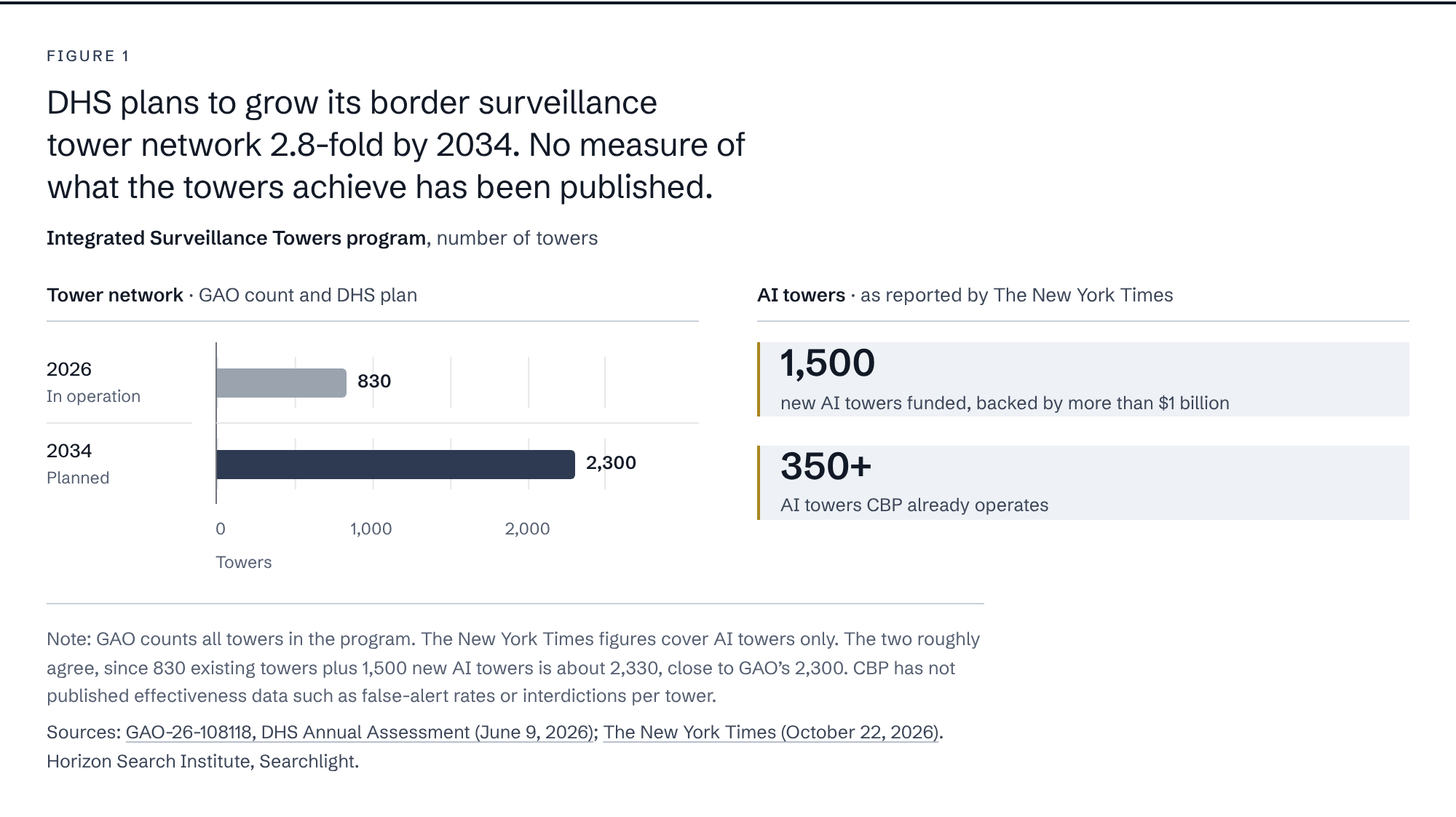
What happened. The One Big Beautiful Bill Act, signed July 4, 2025, appropriated $6.168 billion for border security, technology and screening, and barred spending on towers along the southwest and northern borders that CBP has not tested and accepted as delivering “autonomous capabilities.” The text defines autonomous as a system that uses AI, machine learning or computer vision to accurately detect, identify, classify and track items of interest in real time, “such that the system can make operational adjustments without the active engagement of personnel or continuous human command or control.” A June 2026 Government Accountability Office (GAO) assessment reports that DHS plans to grow its Integrated Surveillance Towers program from 830 towers to 2,300 by 2034, with about $1 billion going to autonomous towers. The New York Times reported that the administration has secured more than $1 billion for 1,500 new AI towers, with the goal of full coverage along the Mexican border and plans for towers near Canada, on coasts and in Puerto Rico. CBP already operates at least 350 AI towers.
Why it matters. “Autonomous” works as a procurement gate: only towers CBP certifies can be bought with these funds on the southwest and northern borders. Anduril builds most of the towers and has won more than $567 million in new CBP contracts in recent years, according to the Times, including a $363 million contract for 200-plus extended-range Sentry towers announced in June 2026. The Times reports that CBP has also approved three other companies, and GDIT says CBP certified its towers and awarded it a $71 million task order for autonomous towers. The program has run across administrations as Anduril won CBP contracts under both Trump and Biden, and the Times has noted that both parties have backed a smart wall for decades.
Second-order effect. The statutory test asks whether a tower can detect, track and adjust without continuous human control, not whether the watching produces results. The counts reconcile: 830 existing towers plus 1,500 new AI towers is roughly 2,330, which is close to GAO’s 2,300.
Signal 02The privacy controls are settings CBP can change at will, outsiders cannot see how they are used, and the evidence the towers work is thin.
What happened. According to the Times, radar detects movement, the camera pans and zooms, an AI model classifies the target as a human, animal or vehicle, and agents in a command center review the footage and decide how to respond. People with direct knowledge of the program even told the Times that CBP can black out areas of the feed, but can remove the restrictions at any time, and CBP did not say where or how often it uses the feature. CBP’s privacy guidelines say it can share footage with local, state and federal law enforcement and even foreign governments, and acknowledge that people cannot opt out. CBP also generally keeps data for 30 days unless law enforcement needs it, though officials have said data used for training AI should not be deleted, and contractors like Anduril can access it with CBP authorization. CBP says the towers have no facial recognition. Additionally, Anduril claims customers can program towers to prevent monitoring of designated areas.
Why it matters. CBP has not shown how well the towers work, including how often they help catch migrants or smugglers. The Times reports that a GAO audit this year found CBP had not set a master plan covering the program’s cost, delivery timeline or success metrics, and a 2024 GAO review found that CBP’s policies for its surveillance technologies did not consistently address key privacy protections, such as limiting the personal data collected. The towers are also considered less effective in congested urban areas according to current and former officials.
Second-order effect. The things to audit are the masking list, the retention rule, and the sharing and training-use rules, since all of them are agency settings. There likely will be local siting fights and litigation over what a tower may record and share.
Signal 03The towers are spreading past the southwest border, and local governments and landowners are the decision point.
What happened. CBP has planned towers near the Canadian border, in coastal areas, and in Puerto Rico, and the towers already stand in places like Del Mar, California, about 30 miles north of Mexico. This year, CBP secured a lease from San Clemente, California, about 75 miles from the border, for an Anduril tower on a hill overlooking the city, describing it as maritime surveillance of smuggling boats, but the plan is on hold indefinitely after objections from residents and elected officials. Towers sit on federal land or on plots leased from local governments and private owners, and few border residents know what the towers do.
Why it matters. Siting is where outsiders have leverage, and San Clemente shows it can work, since objections from residents and officials put a leased tower on hold. A county, port authority or landowner that signs a lease or grants a permit can ask for retention limits, masking zones and a stated purpose in writing.
Second-order effect. As towers reach beach towns and suburbs, people who never thought of themselves as border residents will start appearing in the footage, and many will first hear about it at a city council meeting. More councils will likely try what San Clemente’s members tried, asking CBP to write privacy limits into the lease, and CBP may favor federal property or private owners, where a public vote is unnecessary. Coastal towers also fall outside the statute’s “tested and accepted” requirement, which covers the southwest and northern borders, so the rules that govern them may end up written one lease at a time.
The Metric
2,300
What it measures. The number of surveillance towers DHS plans to operate under its Integrated Surveillance Towers program by 2034, up from 830 today, according to GAO’s June 2026 assessment of DHS acquisitions. That is a 2.8-fold increase.
Why it matters now. The tower count is scaling on a statutory timeline while officials have not published evidence of effectiveness or of how often privacy controls are used.
Source. GAO-26-108118, June 2026
Figure 1
DHS plans to grow its border surveillance tower network 2.8-fold by 2034. No measure of what the towers achieve has been published.
Integrated Surveillance Towers program, number of towers
Tower network · GAO count and DHS plan
AI towers · as reported by The New York Times
Note: GAO counts all towers in the program. The New York Times figures cover AI towers only. The two roughly agree, since 830 existing towers plus 1,500 new AI towers is about 2,330, close to GAO’s 2,300. CBP has not published effectiveness data such as false-alert rates or interdictions per tower.
Sources: GAO-26-108118, DHS Annual Assessment (June 9, 2026); The New York Times (October 22, 2026). Horizon Search Institute, Searchlight.
View the data and sources
| Data point | Value | Source |
|---|---|---|
| Towers in the Integrated Surveillance Towers program, 2026 | 830 | GAO-26-108118 |
| Towers planned by 2034 | 2,300 | GAO-26-108118 |
| Towers added, 2026 to 2034 | 1,470 (2.8-fold) | Calculated from GAO figures |
| New AI towers the administration has funded | 1,500 (more than $1 billion) | The New York Times |
| AI towers CBP operates today | At least 350 | The New York Times |
| Planned spending on autonomous towers | About $1 billion | GAO via Reason |
The Playbook
Five steps to take before the next siting vote, contract bid or board briefing:
Step 01Ask for the acceptance test.
Policy staff, investors and reporters can request CBP’s criteria and results for certifying a tower as autonomous, and whether any effectiveness measure, such as false-alert rates or interdictions per tower, is part of it.
Step 02Get masking, retention and sharing terms in writing before signing a lease.
Counties, port authorities and landowners can ask for the list of blocked areas, who can lift the blocks, how long footage is kept, whether it is used to train models, and who it may be shared with, including other agencies and foreign governments, and put the answers in the lease.
Step 03Map your own exposure.
Schools, clinics, employers and utilities near the border or a proposed site can ask whether their property sits inside a tower’s field of view and whether that view is masked.
Step 04Check vendor concentration.
Anduril builds most towers and three other companies are now approved, so investors and partners can ask what happens to a position if CBP changes its acceptance criteria.
Step 05Borrow the gate, add the outcome.
Agencies buying AI elsewhere can copy the “tested and accepted” requirement, publish the test and add a measure of whether the system does what it was bought to do.
The Verification Test
Claim under test. AI surveillance towers make the border more secure.
Test. Request CBP’s acceptance-test results for autonomous certification, its per-tower performance data (alerts, false positives, interdictions assisted), and the master plan GAO found missing, then compare them with GAO’s next assessment and any DHS inspector general review.
Pass criteria. CBP publishes a master plan with cost, timeline and success metrics, publishes certification criteria and per-tower results (including false-alert rates and urban performance), says how often it applies masking and what it shares, and an independent body evaluates effectiveness.
Fail smell. Claims of success rest on single-site anecdotes or on falling crossing counts that other factors may explain. Vendor figures count detections, such as Anduril’s claim that its towers identified hundreds of thousands of crossings, not outcomes. The masking feature’s use stays undisclosed.
The Lens
Technology. The statute defines autonomy as detecting, classifying and tracking items in real time and making operational adjustments without continuous human control, while agents still review alerts and choose the response. The main privacy control on what towers see is a masking list CBP can change at any time and has not said how often it uses.
Human Capability. Earlier tower programs failed in part because agents were expected to watch too many camera feeds at once. The AI towers turn detections into alerts, so the measure to demand is agent time saved and apprehensions per alert, not detections.
Governance and Diplomacy. About 850,000 of the people within view of the AI towers the Times located live in Mexico, CBP’s guidelines allow sharing footage with foreign governments, and towers are planned near Canada, so the program’s reach and data flows are already international.
Links Worth Your Time
Trump’s ‘Smart Wall’ of A.I. Cameras Is Watching the Border (The New York Times). The investigation behind the one-million-people figure, with the Sunland Park viewshed reconstruction and the GAO findings.
Homeland Security Is Spending $1 Billion on ‘Autonomous’ Border Surveillance Towers (Reason). Summarizes the GAO finding of 830 towers growing to 2,300 and the program’s history of cancelled predecessors.
One Big Beautiful Bill Act, Section 90004 (Agora). The statutory definition of “autonomous” and the tested-and-accepted spending restriction.
An Explosion of Surveillance Towers Is Coming to U.S. Borders (EFF). The advocacy view of the same GAO report, useful for the types of towers in the program.
New AI-powered surveillance towers are coming to the southern border (FedScoop). Details the $71 million GDIT task order and how the contract vehicle works.
Sources
Rojoef Manuel, “Anduril to Supply 200+ Tactical Sensing Towers to US Border Patrol,” The Defense Post, June 15, 2026. thedefensepost.com
U.S. Government Accountability Office, “DHS Annual Assessment: Dynamic Environment Affects Efforts to Manage Acquisition Risks,” GAO-26-108118, June 9, 2026. gao.gov
U.S. Government Accountability Office, “Law Enforcement: DHS Could Better Address Bias Risk and Enhance Privacy Protections for Technologies Used in Public,” GAO-25-107302, December 3, 2024. gao.gov
Lindsey Wilkinson, “New AI-powered surveillance towers are coming to the southern border,” FedScoop, June 9, 2026 (updated June 10, 2026). fedscoop.com
Karen Gullo, “An Explosion of Surveillance Towers is Coming to U.S. Borders, Costing Over $1 Billion,” Electronic Frontier Foundation, July 20, 2026. eff.org
Electronic Frontier Foundation, “California Coastal Community Must Reject CBP’s AI-Powered Surveillance Tower,” April 2026. eff.org
One Big Beautiful Bill Act, Pub. L. 119-21, Section 90004, “Border security, technology, and screening,” enacted July 4, 2025 (unofficial copy; official text at congress.gov). agora.eto.tech
C.J. Ciaramella, “Homeland Security Is Spending $1 Billion on ‘Autonomous’ Border Surveillance Towers,” Reason, July 30, 2026. reason.com
Bora Erden and Nicholas Nehamas, “Trump’s ‘Smart Wall’ of A.I. Cameras Is Watching the Border, and More Than a Million People,” The New York Times, October 22, 2026. nytimes.com
MIT Technology Review, “The US spent billions on border surveillance. Why can’t it catch people before they die?,” September 21, 2026. technologyreview.com
General Dynamics Information Technology, “GDIT’s Autonomous Surveillance Towers Certified by U.S. Customs and Border Protection,” press release, April 2026. gdit.com
San Clemente Times, “CBP Puts San Clemente Surveillance Tower Project on Indefinite Hold,” 2026. picketfencemedia.com
Homeland Security Today, “U.S. Customs and Border Protection Set to Purchase 200 Extended Range Sentry Towers From Anduril,” June 2026. hstoday.us
How to cite this issue
Firoz, I. (2026, October 30). The Autonomy Clause: How Congress Defined AI Border Towers Before Proving They Work. HSI Searchlight, Issue 031. Horizon Search Institute. https://horizonsearch.org/publications/searchlight/031/