The Thesis
Artificial intelligence has entered an infrastructural phase, in which the industry's ambitions ossify into substations and gigawatt-scale campuses. Its expansion turns increasingly on the consent of the communities asked to host them.
The AI buildout now depends on a layer of governance that the national AI debate has largely overlooked. Washington's fight has centered on whether federal rules should override state laws on how AI models behave. The December 2025 executive order that escalated that fight proposed leaving data center infrastructure out of its preemption framework. The physical expansion of computing, meanwhile, operates via zoning codes, annexation votes, tax abatements and utility tariffs that local voters and state regulators control.
Power bills for local residents are attaching that layer to politics. The evidence on how much data centers raise household bills is mixed. The market monitor for PJM, the grid serving Ohio, 12 other states and Washington, D.C., ties a large share of recent capacity costs to data center demand, while national studies find small and uneven effects on retail rates. Who absorbs those costs is decided in tariff proceedings and contracts that residents rarely see. Companies willing to be transparent and show communities those numbers are likely to find a receptive audience in the next round of local votes.
The Signal
Signal 01Towns voted down data centers by wide margins
What happened. Ballotpedia tracked 41 local measures on Nov. 3, with 21 in Ohio, seven in Illinois, four in Maine and three in Kansas. Seventeen were bans, 12 of which applied only above a size threshold, often 25 megawatts, while others imposed six-month moratoriums, required voter approval for large projects or asked voters to uphold rezonings and development deals. Unofficial results compiled by Duane Morris Government Strategies on Wednesday afternoon showed 37 of the 38 decided measures going against development. In Trenton, Ohio, a ban passed by 80% to 20% in a vote aimed at an 18-building Amazon Web Services campus, and Ashville voters rejected an agreement with the developer EdgeConneX for two proposed data centers by 82% to 18%. In Piqua, voters approved a charter ban on data centers above 25 megawatts with 66.7% and recalled Mayor Jim Vetter with 72.95% of the vote, along with two other commissioners, a year after the commission approved a Meta campus on about 607 acres. The lone result in the industry's favor came in Harwood, North Dakota, where voters rejected added review of large industrial projects by 75% to 25%.
Why it matters. Piqua is emblematic of the pattern. Meta had pledged $8 million for emergency services, and the developer, J5 LLC, had agreed to cover an estimated $5.13 million in infrastructure work through escrow. Recall petitions cited public input, transparency and residents' health, and voters ousted three commissioners from the body that approved the project. The Nov. 3 votes were part of a broad, months-long pushback. Data Center Watch, a project that tracks local opposition, found at least 75 projects worth about $130 billion blocked or delayed in the first quarter of 2026, roughly the scale of all of 2025, and Ohio had more than 125 local moratoriums by mid-September. Ballotpedia, as cited by Duane Morris, recorded 42 recall efforts against 80 local officials over data center projects through early October.
Polling suggests the margins reflect preferences that predate the vote. A May Gallup poll found that about 70% of Americans opposed data centers in their own area, and an October ICAPP/SurveyUSA poll found 65% of Ohio adults opposed to tax breaks for the facilities. Ben Green of the University of Michigan told Fortune that the frustration crosses party lines, describing it as "massive corporations coming in and forcing a community to deal with some type of project." In practice, the bans mainly reach proposed sites. Fortune reported that Trenton's ban likely leaves a four-building AWS campus already under construction untouched, and the Dayton Daily News reported that the effect of Piqua's amendment on the approved Meta project remains unclear.
Second-order effect. Site selection is likely to shift toward jurisdictions that lack referendum or charter-amendment processes, and statewide proposals are already extending the local model. Ohio organizers are now aiming at 2027 for a constitutional amendment banning data centers over 25 megawatts, which 57% of Ohio adults said they would support, after missing this year's July deadline. In June, State Sen. Brian Chavez introduced a package that would halve the state's data center sales tax exemption, a program worth roughly $1.6 billion in the last year, cap local property tax abatements at 50%, require surety bonds and direct Ohio regulators to create a separate electricity rate class for data centers. More local votes are scheduled, with bond referendums in Clarksville, Arkansas, on Dec. 1 and a ban on facilities of 25 megawatts or more in Mandan, North Dakota, on Dec. 15. Six-month moratoriums like the ones passed in Peru, Wells and Wiscasset, Maine, also run out the clock, which can redirect capital for projects on tight power-connection schedules.
Selected local measures (unofficial results, as of November 4)
| Locality | Measure | Vote |
|---|---|---|
| Ashville, Ohio | Uphold EdgeConneX agreement | 18% yes / 82% no |
| Trenton, Ohio | Ban large-scale data centers | 80% yes / 20% no |
| Piqua, Ohio | Charter ban for data centers above 25 MW | 67% yes / 33% no |
| Wilmington, Ohio | Four rezoning measures | About 20% yes / 80% no |
| Grove City, Ohio | Require voter approval for large projects | 55% yes / 45% no |
| Alhambra, California | Measure DB, data-center ban | 82% yes / 18% no |
| Edgewater, Florida | Charter ban | 77% yes / 23% no |
| Wells, Maine | 180-day moratorium | 82% yes / 18% no |
| Janesville, Wisconsin | Voter approval for projects over $450 million | 63% yes / 37% no |
| Harwood, North Dakota | Added review of industrial projects | 25% yes / 75% no |
Unofficial results compiled by Duane Morris Government Strategies as of 12:15 p.m. ET, November 4, 2026. Measures differ: a “yes” vote does not have the same effect in every locality. See the results and measure details.
Signal 02Power bills became a statewide campaign issue, and AI money became a liability
What happened. In late October, The Intercept wrote that the artificial intelligence industry "was poised to act as a kingmaker in the midterm elections." The campaign instead turned data centers into a liability. AdImpact told Axios that general-election ads about data centers reached $173 million, with Democrats spending $140 million, Republicans $28 million and independents $5 million, and that it was unable to identify an ad making an overtly positive case for the facilities. An NBC News exit poll reported by TIME found that 56% of voters called AI and data centers a crucial or major factor in their vote for Congress. Several statewide winners had run on the issue, according to Fast Company and TIME, and the Associated Press has called each race named here. In Texas, Gina Hinojosa defeated Gov. Greg Abbott after calling his temporary moratorium a "scam." Keisha Lance Bottoms won the Georgia governorship after campaigning on a statewide pause, and Sherrod Brown won Ohio's Senate race after casting Jon Husted as "the face of data centers in Ohio." In South Carolina, Republican Darline Graham, backed by about $4.8 million from two pro-industry groups including a Leading the Future affiliate, lost to Democrat Annie Andrews, who according to TIME had called for a two-year moratorium on new projects.
Why it matters. It is tempting to read the night as a referendum on artificial intelligence. Fortune's race-by-race review concluded that AI money "was no match for the night's broader Democratic wave," and Blue Rose Research polling cited by TIME ranked AI 29th of 39 issues, even as its salience rose more than any other issue's. Those two data points describe the same tension. Data centers were rarely the main reason people voted, yet they gave campaigns in both parties a local, visible symbol for anger about the cost of living, and Republicans as well as Democrats paid for anti-data-center ads. The results establish correlation, and the cost-of-living climate makes it difficult to isolate how many votes data centers swung.
The industry's own spending points the same way. The Intercept reported that Leading the Future, whose network held $34 million in cash, had spent $7.4 million on general-election races as of Oct. 26, and that Public First, a rival network that supports tighter regulation and whose donors include Anthropic CEO Dario Amodei, had spent $1.1 million. A Data for Progress poll commissioned by the Guardrails Alliance, a group that opposes the industry's political spending, found that about three-quarters of likely voters in Iowa, Michigan and Ohio were less likely to support a candidate backed by an AI super PAC.
Second-order effect. Facing bipartisan backlash, the industry is reframing its pitch. Build American AI, a pro-AI group linked to Leading the Future, ran at least $2.54 million in Ohio TV ads between Sept. 7 and Oct. 21 claiming that data centers had brought $40 billion in investment and over 95,000 jobs, and TIME, citing Axios, reported an effort to rebrand data centers as "AI compute campuses." Rebranding offers limited help against a referendum on a specific parcel, where residents judge the project in front of them. The political value for companies now lies in concessions that voters can verify, which places the evidence on power bills and the design of utility tariffs at the center of the next round.
Signal 03The evidence on bills is mixed, and tariffs decide who pays
What happened. As FactCheck.org observed in late October, it is now taken for granted that data centers are driving up household power bills, and the evidence supports a more limited version of that claim. In PJM, capacity prices, which pay power plants to be available at peak demand, rose from $269.92 per megawatt-day for 2025/26 to the auction cap of $329.17 for 2026/27 and remained at the cap through the 2028/29 auction held in July. The grid's independent market monitor, Monitoring Analytics, attributes $29.4 billion of the $63.6 billion in capacity charges across those four auctions to data center load. It also estimates that the all-in wholesale cost of power in the first half of 2026 was $114.50 per megawatt-hour, against $103.40 excluding the data center effects from the first two auctions, while noting that "not all of the increase in capacity market costs was a result of data center load." Nationally, the Energy Information Administration expects average residential prices to reach 18.2 cents per kilowatt-hour in 2026, up from 16.5 cents in 2024.
The research literature is more equivocal. From 2019 to 2025, the states with the highest load growth generally saw average retail prices decline after inflation, according to the 2026 edition of a Lawrence Berkeley National Laboratory and Brattle study, which also found that PJM capacity prices, pushed up partly by load growth, were a significant contributor to retail price increases in 2025. An MIT working paper revised in October estimates that data center entry raised average residential rates 2.1% from 2010 to 2024, with effects concentrated at investor-owned utilities, where the estimated increase averaged 5.6%. A team including two researchers at the Electric Power Research Institute found modest declines over 2015 to 2024 and warned that future supply constraints could reverse the effect.
Why it matters. Whether data centers raise bills relies on where spare grid capacity exists and how regulators assign the costs. Spreading fixed grid costs over more demand can lower rates, while new generation and transmission built for a few very large customers raise them unless those customers pay. The historical studies and the PJM figures also describe different eras of demand. Ari Peskoe of the Harvard Electricity Law Initiative told FactCheck.org that new campuses use "10 to 100x more electricity than the previous generation of facilities," which he said makes past studies "largely irrelevant," and Penn's Sanya Carley estimated that capacity market increases from mid-2025 to mid-2026 added about $16 a month to Ohio bills, roughly 63% of it due to data centers.
Who pays is the product of political choice. Ohio regulators approved an AEP Ohio tariff in July 2025 that requires data centers of 25 megawatts or more to pay for at least 85% of their contracted capacity during contracts of up to 12 years, plus 36 months of minimum charges if they exit, so that stranded costs fall on the data center and spare other customers. The Ohio Manufacturers' Association has since asked the Ohio Supreme Court to overturn that tariff. Virginia regulators created a separate customer class for loads of 25 megawatts or more in November 2025, with 14-year contracts, and Georgia and Texas adopted their own rules for very large customers in 2025. Companies have added voluntary commitments, including Microsoft's January promise to "pay our way" and a White House pledge signed in March by Amazon Web Services, Google, Meta, Microsoft, OpenAI, Oracle and xAI to cover the cost of new generation for their data centers.
Second-order effect. Proposals abound for keeping data center costs off household bills, and voters have few ways to check whether they work. Reporting on the White House pledge noted that many details remain unknown, including how state utility commissions will apply it, and a Harvard Electricity Law Initiative review of nearly 50 regulatory proceedings argued that confidential special contracts could be transferring Big Tech's energy costs to the public. In June, the Federal Energy Regulatory Commission ordered all six regional grid operators to justify or reform their rules for connecting large loads, including protections against cost shifting. Piqua shows the limits of pledges that residents have little means to verify, and developers that publish project-level cost allocations (enforceable through tariffs or community agreements) are positioned to compete for the sites that remain open to them.
The Metric
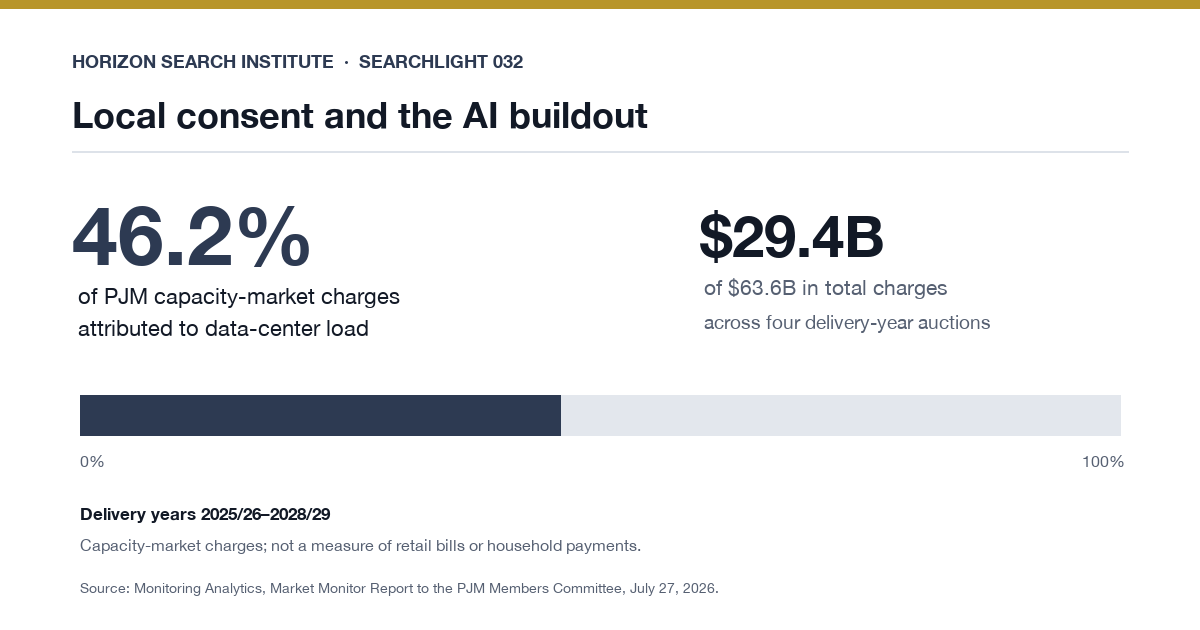
$29.4 billion
What it measures. The Independent Market Monitor for PJM attributes $29.4 billion of the $63.6 billion in capacity-market charges across four auctions, for delivery years 2025/26 through 2028/29, to data-center load. That is 46.2% of the total. It is an estimate of capacity charges, not a measure of household electricity bills.
Why it matters now. The figure measures one channel through which data-center demand can affect wholesale power costs. It does not show what households paid. The monitor notes that other factors also raised capacity costs, while contracts and utility tariffs influence how those costs are allocated.
Source. Monitoring Analytics, Market Monitor Report to the PJM Members Committee (July 27, 2026); PJM, 2028/2029 Base Residual Auction Results Report (July 14, 2026).
Figure 1
The PJM market monitor attributed $29.4 billion of four auctions’ capacity charges to data-center load.
Share of total PJM capacity-market charges · Delivery years 2025/26–2028/29
Attribution across four auctions
The estimate covers capacity-market charges in PJM auctions for the 2025/26 through 2028/29 delivery years. It is not a measure of retail electricity bills or an amount directly paid by households. Other factors also contributed to capacity-cost increases, and contracts and regulated tariffs affect how costs are allocated.
Sources: Monitoring Analytics, Market Monitor Report to the PJM Members Committee (July 27, 2026); PJM, 2028/2029 Base Residual Auction Results Report (July 14, 2026).
View the data and sources
| Data point | Value | Basis |
|---|---|---|
| Capacity charges attributed to data-center load | $29.4 billion | Monitoring Analytics, July 27, 2026 |
| Total capacity charges, four auctions | $63.6 billion | Four-auction total in source analysis |
| Attributed share | 46.2% | As reported by Monitoring Analytics |
| Delivery years covered | 2025/26–2028/29 | Four PJM base residual auctions |
The Playbook
Six steps for developers, utilities, public officials, investors and large-load customers responding to local approval risk and power-cost questions:
Step 01Screen sites for referendum exposure before securing a parcel
Developers and site-selection teams can check whether a candidate jurisdiction allows charter amendments, rezoning referendums or annexation votes, since the Nov. 3 defeats came through those channels, and budget time for a public vote where local law allows one.
Step 02Publish who pays
Utilities and developers can release each project's cost allocation, including minimum-demand charges, exit fees and transmission upgrades, in plain numbers, since tariffs like AEP Ohio's already contain protections that residents rarely see.
Step 03Write pledges into enforceable agreements
Municipal officials can convert company promises on bills, water and emergency services into community benefit agreements with audit rights and clawbacks, given that reporting on the White House pledge lists its application by state regulators among the unknowns.
Step 04Mark down pipelines for local vetoes
Investors in developers, power suppliers and specialized cloud providers can apply explicit approval risk to projects in jurisdictions with active moratoriums, recall drives or scheduled votes, such as Ohio's 125-plus moratoriums and the December ballots in Clarksville and Mandan.
Step 05Prepare for statewide versions
Government affairs teams in Ohio can follow the proposed 25-megawatt constitutional amendment aimed at 2027 and the Chavez tax-incentive package, since statewide action converts scattered local wins into uniform rules.
Step 06Engage the federal cost-shifting dockets
Large-load customers and consumer advocates can file in the FERC show-cause proceedings on large-load rules, where the national framework for who pays for grid upgrades is taking shape.
The Verification Test
Claim under test. Local consent is becoming a material constraint on where large data-center projects can be built.
Test. Track the December 1 Clarksville bond referendums and December 15 Mandan vote, the expiration of local moratoriums, and the outcomes of later site approvals. Compare project timelines and locations with local voting rules, then review whether project-level power costs appear in public tariffs or enforceable agreements.
Pass criteria. Additional local votes, permitting decisions or moratoriums materially delay or prevent projects; developers change siting or timing in response; and public agreements or utility tariffs specify how large-load costs are allocated.
Fail smell. Later votes produce no measurable change in project approval, siting or terms, or the apparent shift in approvals tracks broader development conditions rather than local-consent rules.
The Lens
Planetary Futures. Zoning, water and electricity have become the main channels through which communities shape AI's physical footprint, and Maine's six-month moratoriums show the same tools spreading to small towns far from the major grid hubs. Sources: Ballotpedia’s overview of the Nov. 3 measures.
Governance and Diplomacy. The federal preemption strategy targets state rules on models, while the votes that halted projects on Nov. 3 came from municipal charters and referendums that the executive order leaves to state and local law. Sources: the executive-order analysis; the local vote tally.
Responsible AI. Company pledges on bills and water function as voluntary commitments, and Piqua's vote suggests that communities now want those commitments in a form they can audit and enforce. Sources: Microsoft’s community-first pledge; Piqua’s vote.
Links Worth Your Time
Data Centers on the Ballot: Where Things Stand (Duane Morris Government Strategies). The most complete results table for the 2026 measures, including the six decided earlier in the year and the three still to come.
Data Centers and Electricity Prices: It's Not as Simple as Voters May Think (FactCheck.org). A careful walk through the PJM evidence, the national studies and the experts who disagree about them.
Market Monitor report to the PJM Members Committee (Monitoring Analytics). The primary source for the data center share of capacity costs, with the monitor's own caveats.
Who Pays for Growth? Evidence from Data Centers and the Grid (MIT CEEPR). The working paper explains why effects concentrate at investor-owned utilities and shrink where grid utilization improves.
Extracting Profits from the Public (Harvard Electricity Law Initiative). The review of nearly 50 proceedings shows how special contracts can shift costs to other customers.
Sources
Fast Company — Midterm elections 2026: AI data centers lost big (November 4, 2026)
Fortune — Ohio data center ballot measures in the midterm elections (November 4, 2026)
Fortune — Here's how the candidates backed by AI super PACs fared (November 4, 2026)
Dayton Daily News — Charter amendment banning large data centers wins approval (November 3, 2026)
KGOU — Oklahoma election results, November 2026 (November 4, 2026)
Ohio Capital Journal — Ohio now has over 125 active moratoriums on data centers (September 18, 2026)
Axios via Yahoo News — Data centers fuel $173 million in midterm ads (October 31, 2026)
TIME — How AI Backlash Shaped the 2026 Midterms (November 4, 2026)
The Intercept — AI Tried to Buy the Midterms (October 29, 2026)
PJM — 2028/2029 Base Residual Auction Results Report (July 14, 2026)
PJM — Capacity auction procures 138,318 MW of generation resources (July 14, 2026)
Monitoring Analytics — Market Monitor report to the PJM Members Committee (July 27, 2026)
U.S. Energy Information Administration — Short-Term Energy Outlook, Electricity (October 2026)
U.S. Energy Information Administration — Electric Power Annual, Table 2.10
arXiv (Watten, Bistline and Blanford) — Data centers and retail electricity rates (June 2026)
Harvard Electricity Law Initiative — Extracting Profits from the Public (March 5, 2025)
Cardinal News — Regulators approve Dominion Energy rate increase (November 26, 2025)
Georgia Public Service Commission — Media advisory on data center rule (January 23, 2025)
Microsoft On the Issues — Community-First AI Infrastructure (January 13, 2026)
McGuireWoods — FERC issues Section 206 show-cause orders on large-load integration rules (June 2026)
Inman — NIMBY's new target: data centers lose big at the ballot box (November 4, 2026)
How to cite this issue
Telang, A. (2026, November 6). Voters Rejected Data Centers in Dozens of Local Elections. The AI Buildout Now Requires Local Consent. HSI Searchlight, Issue 032. Horizon Search Institute. https://horizonsearch.org/publications/searchlight/032/