The Thesis
Americans have made AI a mental-health tool at scale, and public trust, clinical guidelines, and enforceable law all sit behind the behavior. Tennessee moved on the third without building a new regulatory category, borrowing a licensure definition and a 1977 consumer statute it already had.
The Signal
What happened. In January 2026, Character.AI and Google settled five wrongful-death and injury suits brought by families in Florida, Colorado, New York, and Texas who blamed the companies’ chatbots for their children’s suicides or mental-health crises. The lead case, Garcia v. Character Technologies, was filed in October 2024 by Garcia after the death of her 14-year-old son. In May 2025, a federal judge allowed the product liability and wrongful death claims to proceed, declining at that stage to hold that chatbot output is protected speech. On May 5, 2026, the Pennsylvania Department of State sued Character Technologies in court for the unauthorized practice of medicine, after a bot styled as a “Doctor of psychiatry” claimed to be licensed in Pennsylvania and supplied a fabricated license number. Washington opened a Section 6(b) FTC inquiry into seven chatbot makers in September 2025 and held a Senate hearing on chatbot harms. On July 1, 2026, Tennessee’s SB 1580 took effect, making it illegal to advertise or represent to the public that an AI system is, or can act as, a “qualified mental health professional.”
Why it matters. The striking feature of SB 1580 is how little Tennessee had to build. The bill adds a single new section to the state’s mental health code (Tenn. Code Ann. § 33-1-205) and is enforced through institutions the state already had. It leaves “qualified mental health professional” undefined, the hardest and most litigable term in any such bill, and points instead to the licensure definition already sitting in Title 33, which covers psychiatrists, psychologists, licensed clinical social workers, marital and family therapists, professional counselors, and psychiatric nurses. By declaring a violation an “unfair or deceptive act or practice,” it borrows the remedies of the 1977 Consumer Protection Act: attorney-general enforcement, a private right of action, and a civil penalty set at $5,000 per violation, above the Act’s usual ceiling. It targets the marketing claim rather than the service itself, which sidesteps the two fights that have slowed broader bills: definitional arguments over what counts as therapy, and First Amendment arguments over whether a model’s output is protected speech. A false commercial claim raises neither question.
Second-order effect. Routing through consumer-protection law hands enforcement to private individuals as well as the state. One resident with a screenshot of a homepage reading “AI therapist” has a $5,000-per-violation claim. AI-marketing enforcement now runs on the same law as any other deceptive-advertising suit. And because the statute reaches what a company says about its product rather than what the product does, a company can comply by rewriting its copy.
What happened. Pew’s “Americans and AI 2026,” released in June, found that 49% of US adults now use AI chatbots, up from 33% in 2024 and 23% in 2023, with about a quarter using them daily. One in ten use them for emotional support, and among adults under 30, it is one in five. A Harvard Business Review analysis of online forum posts, published in April 2025, ranked therapy and companionship the single most common use of generative AI, though it draws on self-reported forum discussion rather than a representative sample. The clinical layer confirms the pattern from the other side of the desk: the American Psychological Association’s (APA) 2026 survey of 1,242 licensed psychologists found that 77% have treated patients who used AI for support, and 35% have patients using AI as an additional mental health professional. Those clinicians are near-unanimous on the risk: 97% worry the tools can reinforce dysfunctional beliefs and 89% worry they can inadvertently encourage self-harm, concerns the survey ties to research in Science, where Stanford researchers tested 11 leading models and found they affirmed users 49% more often than human respondents did, and validated the user 47% of the time even when the prompt described deceptive or illegal behavior. A single affirming reply left participants less willing to apologize or repair the conflict, and more confident they had been right.
Why it matters. This is the demand the law is reacting to, and it explains why a single marketing line carries the weight it does. Pew finds that the people most likely to lean on a chatbot for emotional support, under-30s, are also the most skeptical of AI’s trajectory. Adoption is running ahead of both public trust and professional guardrails, and rules are the piece a legislature can move quickly on. Tennessee’s law does not stop the behavior. It polices one specific claim about it, that a chatbot is as good as a professional, and the APA data suggests that is the claim doing measurable harm.
Second-order effect. As clinicians start routinely asking patients about AI use, it creates an expectation that consumer mental-health tools come with crisis detection and anti-sycophancy training by default. Products that carry those guardrails and products that do not will separate along two lines at once: liability under statutes like Tennessee’s, and procurement filters applied by the employers and health systems buying wellbeing tools.
What happened. Tennessee is early, but it is not first. By the time SB 1580 took effect, at least five states had already regulated AI in mental health. Utah HB 452 moved first, effective May 7, 2025, requiring mental-health chatbots to disclose that the user is talking to a machine, barring the sale of user health data, and restricting in-chatbot advertising. Nevada AB 406 took effect July 1, 2025, barring AI outright from providing mental or behavioral healthcare, with penalties up to $15,000. Illinois signed its Wellness and Oversight for Psychological Resources Act in August 2025, banning AI-delivered therapy and treating “AI therapy” or “chatbot counselor” advertising as unlawful. New York’s AI companion law took effect in November 2025, requiring suicide-risk protocols and repeated non-human disclosures. California SB 243 followed in January 2026, adding a private right of action with a $1,000-per-violation minimum. Tennessee, in July 2026, is the sixth. Both Tennessee’s and Illinois’s bills passed unanimously.
Why it matters. Three enforcement models are now in the field: disclosure rules (Utah, New York), practice bans (Nevada, Illinois), and Tennessee’s deceptive-marketing line. The practice bans offer the broadest protection on paper and carry the greatest exposure in court, since they raise both the scope-of-practice question of what counts as therapy and the unsettled First Amendment question about model output. Tennessee’s model raises neither. It is the narrowest of the three and the only one a state can enact without inventing anything, which makes it the easiest template for the next legislature to copy.
Second-order effect. A company operating nationally now faces several AI-therapy rules at once, and each law demands something different: a disclosure state wants a notification, a practice-ban state wants the feature switched off, a Tennessee-style state wants the marketing rewritten. The near-term consequence is that the compliance for any given product is set by whichever state is strictest.
The Playbook
Collect the lawsuits filed in your state to understand the harms in play. Local facts are what move a bill and what a court will later want to see.
These are different bills with different odds. Regulating what the AI does, by banning it from providing therapy, opens two fights that will last a long time: a scope-of-practice argument over what counts as therapy, and an unsettled First Amendment argument over whether a model’s output is protected speech. Regulating what its marketing says, by barring the claim that it is a licensed professional, touches neither, because a false commercial claim is not protected speech.
Tennessee wrote no new definitions and built no new agency. It used two things every state already has: a professional-licensure code that already defines “qualified mental health professional,” and a consumer-protection statute that already bans deceptive practices and already carries penalties. The fastest bill points existing law at a new problem instead of inventing a category.
Three kinds of law have been tried, and they trade protection against durability. Disclosure rules are easy to pass and easy to evade. Practice bans are the most protective and the most exposed in court. The deceptive-marketing line reaches the marketing rather than the conduct, which makes it the hardest to challenge and the cheapest to run. Decide separately whether you want a private right of action, which enforces itself through the plaintiffs’ bar at no cost to the state, or agency enforcement, which you control but must fund.
The Verification Test
“My AI product is safe from Tennessee’s SB 1580.”
Test. Pull every public-facing surface (app-store listing, homepage, in-product copy, ad creative, and the product name itself) and search for “therapist,” “counselor,” “psychologist,” “mental health professional,” “therapy,” and any implied equivalence. Then confirm whether the product is marketed into, or reachable from, Tennessee.
Pass criteria. No public representation that the system is or acts as a qualified mental health professional, with licensed-clinician-use positioning documented. Or the product is genuinely walled off from Tennessee residents.
Fail smell. Marketing leans on therapy-adjacent language (“talk to someone who gets you,” “your pocket therapist”). Under a consumer-protection statute, the net impression on the public is what gets judged, and the fine print will not save you. The private right of action means someone other than a regulator gets to make that argument.
The Metric
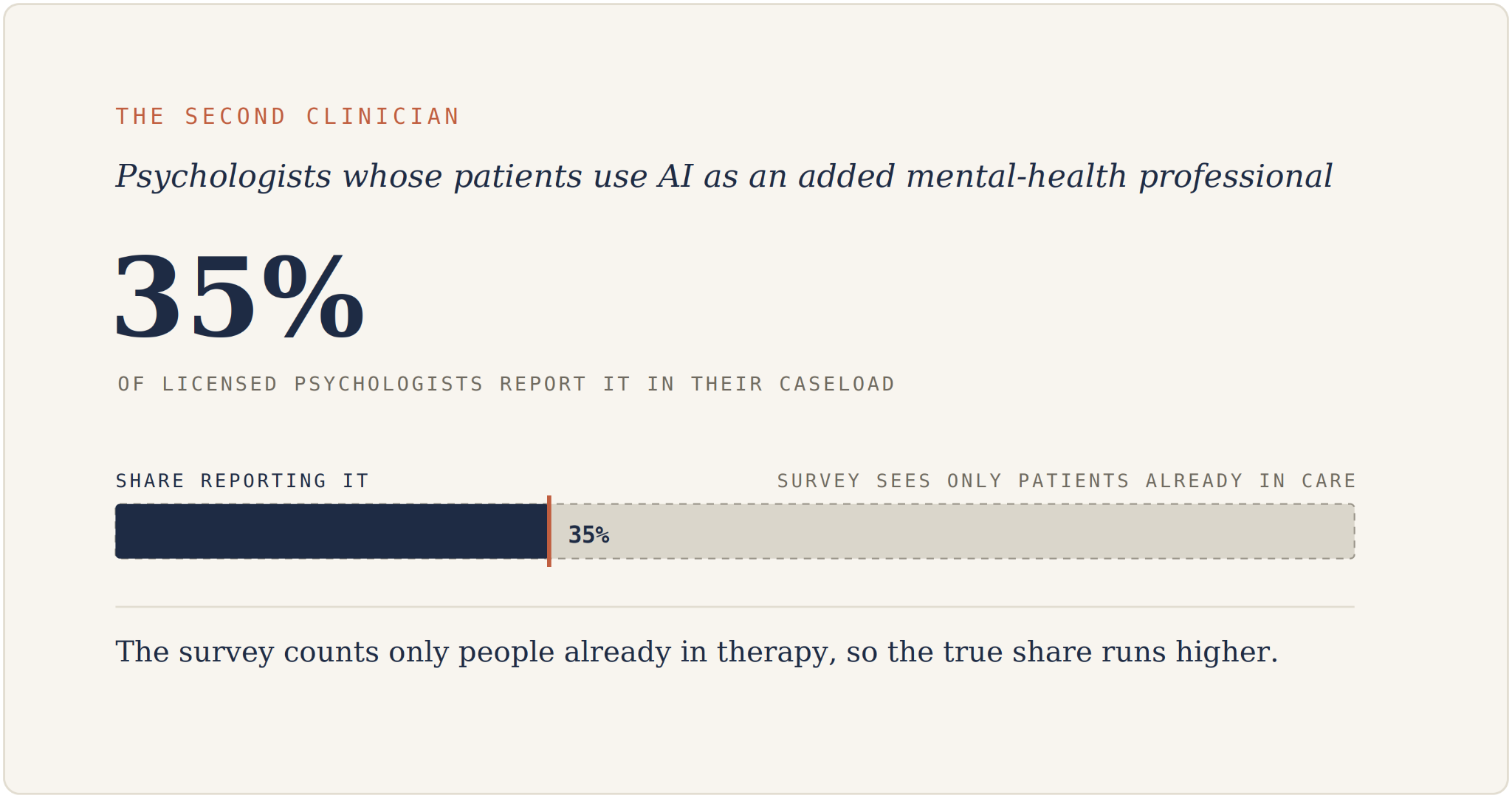
What it measures. The share of licensed psychologists in the APA’s 2026 survey who report having patients use AI to act as an additional mental health professional.
Why it matters now. This is the figure that says AI has become part of mental-health care for a meaningful slice of patients. Because the survey only sees people already in treatment, the true share is likely higher, and it excludes anyone using AI as their only support.
The Lens — Horizon Search Institute
Sycophancy has become a named clinical risk alongside its status as an alignment concern. The APA cites research in Science showing that affirmation-optimized models make users less likely to course-correct, among the first times a specific model-behavior property has been tied to a mental-health harm in a professional-body survey.
Per Pew, the under-30 cohort is the heaviest user of chatbots for emotional support (one in five) and the most skeptical of AI’s impact: a population relying on a tool it distrusts for one of the highest-stakes tasks there is.
In the absence of federal law, states are legislating one by one, and the fastest-spreading template reuses existing institutions. Tennessee SB 1580 became AI regulation by pointing an existing licensure definition and an existing consumer statute at a new problem, without a new agency or a new definition. Any state can repeat the pattern.
Links Worth Your Time
-
Pew — Americans and AI 2026
The adoption and trust levels.
-
APA — 2026 Chatbots and Mental Health Survey
The clinical layer.
-
Tennessee SB 1580 — Bill Text
Sections 1 to 3 show how little statute it takes to combine a licensure definition with a consumer-protection act.
-
Illinois WOPR Act (IDFPR announcement)
The practice-ban model, for comparison.
-
Commonwealth v. Character Technologies (Pennsylvania)
The harm made concrete.
- Pew Research Center. Americans and AI 2026: Chatbots, Smart Devices and Views on Impact. June 17, 2026.
- American Psychological Association. 2026 Chatbots and Mental Health Survey (n=1,242 licensed psychologists). June 2026.
- Tennessee SB 1580 / HB 1470, Public Chapter No. 647 (signed April 1, 2026; effective July 1, 2026), adding Tenn. Code Ann. § 33-1-205 and enforced through the Tennessee Consumer Protection Act of 1977, Tenn. Code Ann. § 47-18-101 et seq. Passed the Senate 32-0 and the House 94-0. legiscan.com
- Tennessee Consumer Protection Act of 1977, Tenn. Code Ann. § 47-18-101 et seq. (remedy set inherited by SB 1580). law.justia.com
- Cheng, M., Jurafsky, D., et al. Sycophantic AI Decreases Prosocial Intentions and Promotes Dependence. Science 391, eaec8352, March 26, 2026. DOI: 10.1126/science.aec8352.
- Garcia v. Character Technologies, Inc., No. 6:24-cv-01903 (M.D. Fla., filed October 2024); core claims survived motion to dismiss May 2025; settled in principle January 7, 2026 alongside four related suits in Colorado, New York, and Texas. Terms confidential; no admission of liability. courtlistener.com
- Commonwealth v. Character Technologies, Inc., No. 220 MD 2026 (Pa. Commw. Ct., filed May 5, 2026 by the Pennsylvania Department of State) — unauthorized practice of medicine. Case summary
- Federal Trade Commission. Section 6(b) Inquiry into Seven AI Companion Chatbot Makers. September 11, 2025.
- Utah HB 452, Artificial Intelligence Amendments (signed March 2025; effective May 7, 2025) — disclosure, data-sale ban, advertising restrictions. le.utah.gov
- Nevada AB 406 (effective July 1, 2025) — practice ban, penalties to $15,000. legiscan.com
- Illinois Wellness and Oversight for Psychological Resources (WOPR) Act, HB 1806 (signed August 4, 2025) — practice ban plus advertising prohibition. idfpr.illinois.gov
- New York AI Companion Models Law, S3008 (effective November 5, 2025) — suicide-risk protocols and non-human disclosure. nysenate.gov
- California SB 243, Companion Chatbots (effective January 1, 2026) — private right of action. leginfo.legislature.ca.gov
- Harvard Business Review. How People Are Really Using Gen AI in 2025 (therapy and companionship as leading use case). April 2025.