The Thesis
Debates over AI governance in India, as in most places, concentrate on the moment a classification is made. Is the model accurate, is the training data representative, was the deployment validated. Far less attention follows the classification after it leaves the system that produced it and enters an administrative chain built to process reported facts, not probabilities. That is a different problem from model error, and it has a different name: interaction risk. No single element poses it. It emerges in the handoff, each time one level’s probabilistic output becomes the next level’s settled fact. Every actor in the chain, the anganwadi worker, the supervisor, the district officer, the constable, the magistrate, the court, acts rationally on the information in front of it. None of them can see the uncertainty stripped away a level or two earlier. Four episodes from this year show the effect compounding as it travels.
The Signal
Four developments worth watching this week.
What happened. The Poshan Tracker has a feature called Poshan Calculator which uses WHO Child Growth Standards on the basis of height, weight, age, and gender of the child to produce an output in terms of a category like stunted, wasted, underweight, moderate or severe acute malnutrition, and normal as soon as the anganwadi worker feeds in the data. This classification is taken forward by the supervisor, then the district officer for allocating rations and programs, and sometimes a referral takes place in certain facilities based on this classification.
Why it matters. The national-level output of Poshan Tracker relative to the National Family Health Survey shows that the platform greatly underestimates prevalence as its measure of stunting was almost two points lower, while its underweight and wasting figures were close to fourteen and twelve points lower. There is not an iota of information of any kind about this bias for someone looking at anything higher than the anganwadi worker’s smartphone. A district-level officer gauging a ration entitlement based on aggregated classification levels does not have any way of knowing that what he considers as facts is much lower than actual prevalence levels because the platform only provides labels, not margins of error.
Second-order effect. There is only one known fail-safe system, which highlights improbable monthly variations in a child’s measurements at input. By the time the distortion becomes obvious in terms of aggregates, it will not be possible to identify from which particular anganwadi center and measurement this emerged.
What happened. Facial e-KYC is mandatory for Take-Home Ration from Poshan Tracker before pregnant and nursing ladies and small kids could avail themselves. Google ML Kit, which Google itself says has no facial recognition capability and is not built to identify individuals. Government data show that of 4.73 crore eligible beneficiaries, over 91% had completed initial documentation by 31 December 2025, yet only 52.7% had successfully received rations through facial recognition by that date. By August 2025, state-level figures ranged from 71.5% of eligible beneficiaries in Bihar having received rations through the system to 58.5% in Jharkhand. Government data shows variation in matching across states with some ranging to 20 point differences.
Why it matters. The software outputs only a binary result despite the matching engine outputting a continuous score before thresholding. The risk of manipulation in this case involves two levels simultaneously, that is the technical one that filters the score out before it gets to the worker and the administrative one that transforms a percentage of completed operations into a productivity indicator. Anganwadi workers claim to be ordered by their superiors to stop working with those beneficiaries who keep failing in the scanning process and switch to other beneficiaries who will pass it because ration distribution formula depends on the number of successful verifications.
Second-order effect. There are two High Court petitions challenging whether it is even possible to impose such a conditional pass mark for an entitlement provided by statute, which are Karnataka HC WP 38603/2025 and Bombay HC WP 16394/2025. The former contends that the condition violates the Digital Personal Data Protection Act, 2023.
What happened. Delhi Police’s Facial Recognition System flagged 2,873 people with alleged criminal antecedents among protesters at Jantar Mantar in July 2026, which is a list the Supreme Court later allowed the government to act on, subject to further verification, even after quashing the underlying FIRs. Delhi Police’s own 2022 RTI response set its “positive match” bar at 80% similarity, with anything below that meant to be treated as a false positive requiring further inquiry.
Why it matters. This is the same pattern of interaction risk as Signals 01 and 02, but now shifted into a different context. The document following the sweep put out by the police contains the names of the 2,873 people who have been officially identified as having some connection to murders, dacoities, and rapes; there is no mention of similarity scores or tentative matches, and no record that the field verification each identification is supposed to undergo has taken place. Error rates in independent tests of the system differ dramatically across demographic groups and camera types, and the certainty implied by the threshold does not survive exposure to actual CCTV feeds; none of this caution carries over into the police report.
Second-order effect. In the event that there is a probabilistic outcome presented as a proven match from a criminal record database, then the burden of proof becomes a responsibility of the person whose record has been flagged, which is the responsibility to show that a claim made by the system, which did not claim anything for certain, is not true.
What happened. On 13th August 2026, the Supreme Court refused to frame guidelines on ethics and transparency regarding government surveillance using AI technology, with the bench observing, “We are not the experts. It is a highly technical issue and it is in policy domain,” and advising the petitioner to send the writ petition as a representation. In the same order, the Court asked the Centre to merely look into a petition filed seeking information on the legal framework, vendor details, safety measures, and the audit status of high-risk artificial intelligence technologies used in welfare schemes, policing, and content moderation, including the Aadhaar authentication and welfare de-duplication systems.
Why it matters. Judiciary is at the top of this hierarchy, being the only institution that can ensure that along with the classification itself, the confidence level goes with it in making decisions related to welfare and policing. Faced with both asks in the same order this year, the Court chose not to act on either, thereby keeping the standard-setting responsibility for the ministries and police departments that themselves use dashboards based on completion percentage, not accuracy.
Second-order effect. Interaction risk is not limited to interactions between different levels of administration; it also happens at the institutional level where such administration is supposed to be controlled. A court that uses “we don’t have the technical knowledge to know” as an excuse for staying away is also taking a similar step by ignoring the risk of uncertainty.
The Metric
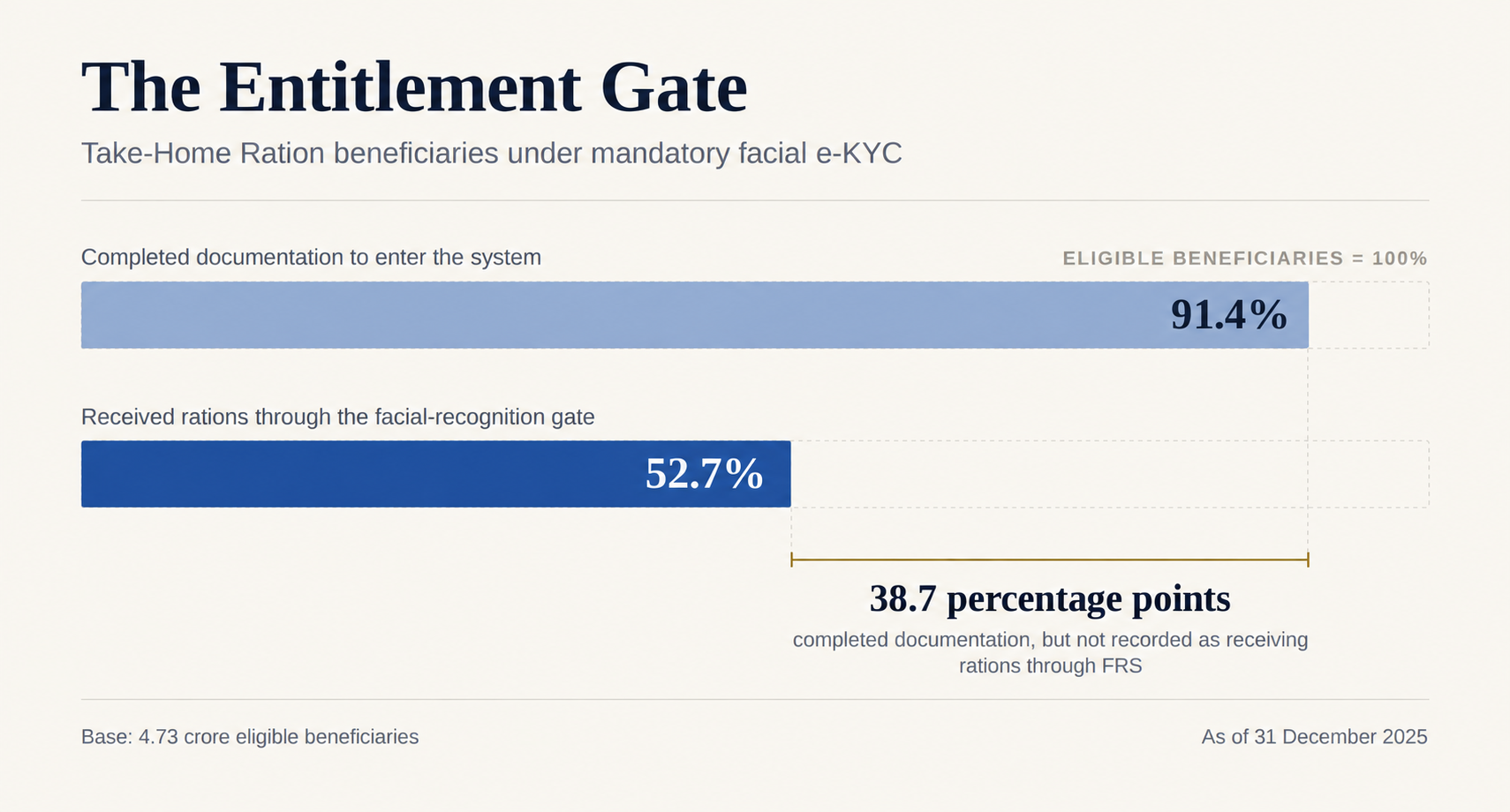
What it measures. The share of eligible Take-Home Ration beneficiaries who actually received rations through the facial recognition gate, against the share who completed the paperwork to enter it.
Why it matters now. The gap between the two figures is the entitlement cost of the threshold. Nearly four in ten beneficiaries who completed documentation had not received rations through the system, and the platform’s dashboards report completion rates, never the gap.
Source note. The ministry’s published percentages are reproduced as reported. They do not reconcile exactly with the rounded 4.73 crore eligible-beneficiary count, so HSI has not recomputed them.
The Playbook
A confidence level is required to accompany each classification throughout its life cycle. Not only at the model boundary, but also with the supervisor, the district aggregation, the police dossier, the court filing.
Instrument the handoffs, not just the models. The interaction risk lies in the difference between tiers. An audit limited to model accuracy at the point of generation is not going to uncover any problem, because there is none at that stage; the distortion occurs later, due to the actions taken on the seemingly clean output by the next tier.
Build an operational offline fallback system before scaling up the digital gateway, and allow human recourse verification at each layer and not only the first one.
Route disclosure via statute and not via RTI. An independent law regulating Facial Recognition Technology, such as the Facial Recognition Technology (Regulation of Police Powers) Bill, 2023, a private member’s bill pending in Parliament, would specify what can be used, mandatory bias assessments, and most importantly, mandatory uncertainty data transmission through administrative use and not just vendor technical documentation.
Track drift and dispute resolution results as part of an ongoing and public measure at each layer of use, and not merely as a one-time disclosure.
The Verification Test
Interaction risk is the dominant, unaddressed failure mode in India’s digital welfare and policing infrastructure. It is something which will be observed in a large number of Global South countries marked by administrative heterogeneity.
Test. Monitor if the court has yet considered the issue of disclosure in its deliberations and create a legally binding requirement that the confidence scores, error rates, or audit trails come along with the decision as it goes through the administrative levels applying it.
Pass criteria. Court order or executive regulation requires that information about the matching confidence levels, error rates per group, or accuracy margins in population level be disclosed and carried through when applying the decisions on rationing, arrests, referrals. These would allow for decisions to be made comprehensively and track failures to their actual cases and solutions to be targeted.
Fail smell. If any order or regulation emerging from it regulates only the model or the vendor (bias audits, accuracy testing upon deployment), and uncertainty is not passed on to the next administrative level; ministries still report completion rates but no accuracy or drift rate.
The Lens — Horizon Search Institute
In the governance of Indian AI, the live issue is no longer the question of whether they work as intended when they go online but if there will be an institution brave enough to rely on their uncertainty as an insurance for survival among the bureaucracy built on them.
Anganwadi workers and constables are the layer of interaction risk in practice as they absorb the difference between the reading of a camera or a calculator and the need of the layer above them for a clear fact, places where neither the classifier nor the hierarchy above them was designed with this gap in mind.
Face detection software designed for cellphones and a growth calculator based on a single clinical measure are currently being used, respectively, to control childhood nutrition and compile criminal records, which is proof that the danger of consumer-grade or overly specialized AI components lies not just in their mistakes but also in what an administrative system takes for granted they got right.
Links Worth Your Time
- AI Facial Recognition Is Denying Food To Pregnant Women Across IndiaDecode’s investigation of the Poshan Tracker e-KYC rollout, including the use of Google ML Kit and internal messages from supervisors.
- How facial recognition sees you, matches you, and sometimes gets it wrongIndia Today’s technical explainer on facial recognition, including Delhi Police’s 80% threshold and the Jantar Mantar dossier.
- Litigation challenging the compulsory requirement for Anganwadi workers to use e-KYC and FRTInternet Freedom Foundation’s tracker of the Karnataka and Bombay High Court petitions challenging mandatory facial recognition in ration delivery.
- India Today — How facial recognition sees you, matches you, and sometimes gets it wrong
- Ministry of Women and Child Development — Poshan Tracker
- Poshan Tracker — Official Platform (Poshan Calculator)
- Observer Research Foundation — Reducing stunting, building human capital: lessons from NFHS-6
- Press Information Bureau — Release on the Poshan Tracker Facial Recognition System
- Decode — AI facial recognition is denying food to pregnant women across India
- Lok Sabha — Unstarred Question Annexure AU1121 on facial recognition matching rates
- The Indian Express — Explained: facial recognition accuracy and surveillance at the Jantar Mantar protests
- Digital Personal Data Protection Act, 2023
- The New Indian Express — SC asks authorities to consider suggestions on framing guidelines on AI ethics
- LiveLaw — Supreme Court declines plea seeking regulation of AI use, asks Centre to consider representation
- The New Indian Express — Nutrition system crumbles under digital mandates in Jharkhand (Jean Drèze)
- The Hindu — Anganwadi unions move Bombay High Court against mandatory facial recognition for ration delivery
- Pulitzer Center — How I investigated the use of facial recognition in India’s flagship welfare program
- AMLEGALS — Facial recognition in India: privacy, surveillance, and the need for regulation
- HyperVerge — Facial recognition and privacy in India
- Internet Freedom Foundation — Delhi Police’s facial recognition flagged 25 jailed people at Jantar Mantar
- Internet Freedom Foundation — Litigation challenging the compulsory requirement for Anganwadi workers to use e-KYC and FRT