The Antalya Artificial Intelligence Pledge launched at COP31 on Nov. 16 with 90 endorsements. Nine came from governments. Alibaba was the only major technology company to sign. Meta, Microsoft, Google and Nvidia did not respond when Reuters asked about the pledge. Amazon declined to comment and pointed to a new climate target of its own.
Türkiye’s COP31 presidency developed the pledge with the International Telecommunication Union. It asks signatories to power AI infrastructure with cleaner energy and report on its environmental impact. It also supports climate uses of AI in developing countries. The commitments are voluntary, and endorsement stays open until COP32.
The Thesis
Antalya’s launch showed a pledge built to fix a disclosure problem, while the companies with the most to disclose declined to join it. Those companies already have climate targets of their own. Google, Microsoft and Amazon have all set goals for the electricity or emissions tied to their operations. Google’s and Microsoft’s targets are close to what Antalya asks companies to enter.
Joining would place those targets into the same format and bring them into a public stocktake at each COP. Their current goals remain outside both. The pledge also leaves aside another issue shaping U.S. data-center development: local approval. The evidence here comes from U.S. siting fights, where local governments and voters are playing a growing role in deciding whether projects move forward.
The Signal
Signal 01Companies can enter real targets. Outsiders still cannot read them.
What happened. Türkiye released the pledge text on Oct. 27. Governments sign through Annex A. Its clean-power commitment asks them to “progressively require” AI infrastructure to use zero- and low-emission energy, with no percentage or deadline. Companies and other non-government signatories use Annex B. Commitment B1 asks for the share of AI infrastructure that will run on zero- and low-emission power and a target year. Each non-government signatory is asked to choose at least one Annex B commitment. ITU lists endorsers through an online dashboard. As of Nov. 17, the commitments selected by each signatory and the values they entered could not be read from the public pledge page.
Why it matters. Bloomberg reported this month that the largest U.S. AI companies have yet to publish detailed figures on their data centers’ energy use and emissions, and CDP’s chief executive said that assessing individual data centers requires more detail. Antalya’s Annex B is meant to make that information easier to compare. The first round of submissions is still hidden from public view, which makes it impossible to judge how much the pledge has improved disclosure so far.
Second-order effect. Alibaba is the first useful test. The company has previously committed to run its data centers on clean energy by 2030. A public B1 entry that restates that goal would give Antalya one big-tech commitment that outsiders can track. If the submission remains private, the signature tells us little beyond the fact that Alibaba joined.
Signal 02The largest U.S. operators already have targets. They have not entered them into Antalya.
What happened. Reuters reported that Germany, Brazil and South Korea were among the government signatories at launch, and that the others were mainly small countries. The European Union said in October that it was considering whether to sign. The U.S. federal government sent no official delegation to COP31. Its withdrawal from the UNFCCC takes effect on Feb. 27, 2027. American participation continues through other channels. More than 120 state and local leaders are attending, along with a 19-member congressional delegation.
Why it matters. Comparing existing company targets with Antalya’s B1 commitment shows what joining the pledge would actually change. Google and Microsoft both aim to match their electricity use with carbon-free power every hour by 2030 (Google; Microsoft). Bloomberg reported in May that Microsoft was weighing whether to delay or drop its hourly goal. On paper, both targets meet or exceed what a full B1 entry would ask them to pledge. Joining Antalya would put those existing goals into a shared format and make them part of the COP stocktake. Amazon uses a different measure. Its target focuses on the carbon intensity of its electricity, which makes a direct comparison with B1 difficult. The companies’ emissions are still rising. Google’s ambition-based emissions increased 18% in 2025 to about 14.5 million tonnes of CO₂ equivalent, 81% above its 2019 level. Microsoft reported a 25% increase in fiscal 2025, driven mainly by data-center expansion. Each company still measures progress according to its own system. China presents a different situation. The government was absent from the launch signatories described by Reuters. Alibaba, one of the country’s largest cloud operators, joined. Coal still supplies close to 70% of the electricity consumed by Chinese data centers. A company target can change what Alibaba buys. The wider grid still depends on national energy policy and infrastructure.
Second-order effect. U.S. states and cities can sign as non-Party stakeholders. With the federal government outside the process, subnational governments provide the clearest public route for American participation. A measurable commitment from Virginia or Texas would bring Antalya into two of the country’s largest data-center markets.
Signal 03In the United States, local approval decides whether projects proceed. Antalya does not address it.
What happened. The pledge contains no commitment on community participation in data-center decisions. WRI highlighted that omission when the text was released. On Nov. 3, 40 of 41 local data-center ballot measures across ten U.S. states produced outcomes favoring limits on development, according to Ballotpedia’s updated results. That updates the preliminary count in Searchlight No. 032. In Janesville, Wisconsin, voters approved a measure requiring a public referendum for any development over $450 million at the former GM site, where a data-center campus had been proposed. The pattern is also visible outside the United States. More than 100 groups across Europe planned coordinated protests on Nov. 6–7 calling for a moratorium on large data centers.
Why it matters. A company can meet every Antalya commitment and still lose a U.S. project at a city council vote or a referendum like Janesville’s. A municipality controls land-use approval. Utility regulators decide how grid costs are shared. Local opposition can delay a project or stop it entirely. Antalya speaks mainly to operators and national governments. Municipalities and utility regulators sit largely outside it even though they make many of the decisions that determine whether a project moves forward.
Second-order effect. One part of the pledge reaches directly into these disputes. The text says infrastructure costs tied to data-center development, including transmission upgrades, should be allocated appropriately. NRDC highlighted this language as one of Antalya’s useful features. The organization also told Reuters that voluntary standards alone were not enough. The value of the provision will depend on whether utilities and host governments carry it into tariffs and project agreements. That is where Antalya could begin to influence local development decisions.
The Metric
~80%
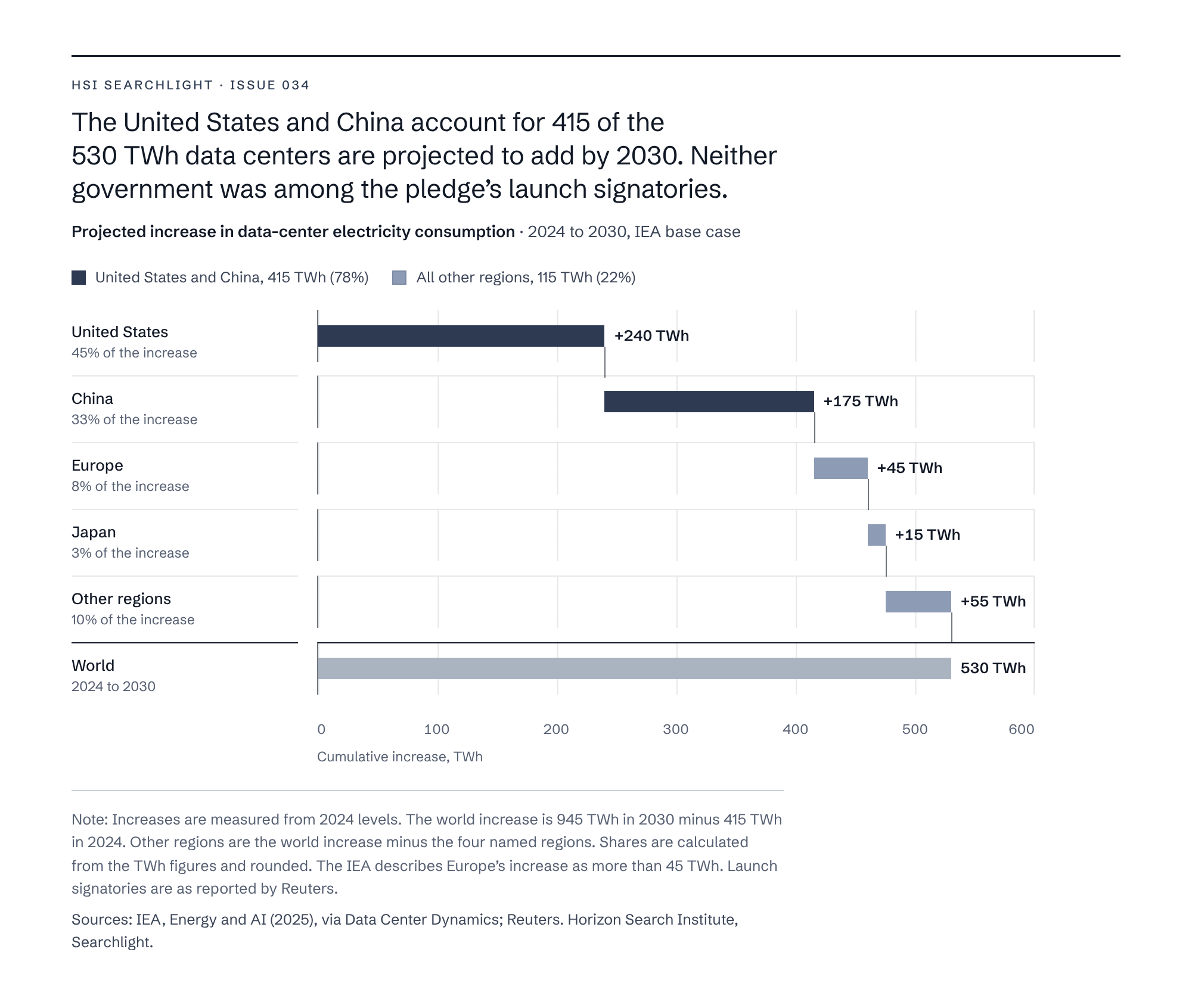
What it measures. The share of projected global growth in data-center electricity consumption through 2030 that the IEA’s 2025 projections attribute to the United States and China combined.
Why it matters now. Neither government behind that 80% appeared among Antalya’s launch signatories. Alibaba was the only major technology company from either market to join. The first stocktake is therefore set to begin without the two governments behind most projected demand growth and without most of the largest operators in those markets.
Caveat. These figures are projections, and efficiency is improving quickly. Google researchers reported a 33-fold drop in the energy used by the median Gemini text prompt over one year. Total electricity demand still increased. The IEA’s 2026 update found that data-center electricity use grew 17% in 2025. Consumption at AI-focused facilities rose about 50%. The agency expects total data-center use to rise from roughly 485 TWh in 2025 to about 950 TWh in 2030. Efficiency at the level of an individual task can therefore improve while overall electricity use continues to grow.
Source. IEA, Energy and AI (2025), via Data Center Dynamics.
Figure 1
The United States and China account for 415 of the 530 TWh data centers are projected to add by 2030. Neither government was among the pledge’s launch signatories.
Projected increase in data-center electricity consumption · 2024 to 2030, IEA base case
- United States and China, 415 TWh (78%)
- All other regions, 115 TWh (22%)
Cumulative increase, TWh
Note: Increases are measured from 2024 levels. The world increase is 945 TWh in 2030 minus 415 TWh in 2024. Other regions are the world increase minus the four named regions. Shares are calculated from the TWh figures and rounded. The IEA describes Europe’s increase as more than 45 TWh. Launch signatories are as reported by Reuters.
Sources: IEA, Energy and AI (2025), via Data Center Dynamics; Reuters. Horizon Search Institute, Searchlight.
View the data and sources
| Region | Increase, 2024–2030 (TWh) | Increase on 2024 level | Share of global increase (calc.) |
|---|---|---|---|
| United States | 240 | 130% | 45% |
| China | 175 | 170% | 33% |
| Europe | 45 | 70% | 8% |
| Japan | 15 | 80% | 3% |
| Other regions (derived) | 55 | n/a | 10% |
| World | 530 | 128% | 100% |
| United States and China | 415 | n/a | 78% |
Source: IEA, Energy and AI (2025), via Data Center Dynamics. The world increase is 945 TWh in 2030 minus 415 TWh in 2024. The figure for other regions is the world increase minus the four named regions, and shares are calculated from the TWh figures. The IEA describes Europe’s increase as more than 45 TWh.
| Year | Consumption (TWh) | Type | Source |
|---|---|---|---|
| 2024 | 415 | Estimate | IEA, Energy and AI (2025) |
| 2025 | 485 | Estimate (up 17% on 2024) | IEA, Key Questions on Energy and AI (2026) |
| 2030 | 945 | Projection, base case | IEA, Energy and AI (2025) |
| 2030 | 950 | Projection | IEA, Key Questions on Energy and AI (2026) |
Sources: IEA, Key Questions on Energy and AI; Data Center Dynamics. The 2026 update also reports that consumption at AI-focused facilities rose about 50% in 2025.
The Playbook
Step 01Report government and corporate signatures separately
The headline figure of 90 endorsements combines two different kinds of commitment. A government signing Annex A states a policy direction. A corporate signatory using Annex B can enter a percentage and a deadline. Reporting those groups separately gives a clearer picture of what has actually been promised.
Step 02Ask each corporate signatory to publish its Annex B values
For B1, the useful information is the clean-power share and the target year. For disclosure commitments, readers need to know how much of the company’s AI activity is covered. Until those values are public, treat a signature as evidence of participation rather than evidence of a measurable commitment.
Step 03Compare non-signatories’ targets with B1
Large companies outside Antalya already have climate goals. Put those goals next to B1 and compare what each one measures. Google and Microsoft already use targets that closely resemble the clean-power ambition behind B1. Amazon measures carbon intensity instead. That comparison shows what joining Antalya would add and where the existing company targets differ from the pledge.
Step 04Check cost allocation in the local tariff
For a signatory building data centers, find the utility tariff or host-community agreement covering its projects. Those documents show who pays for grid upgrades created by new infrastructure. This is where Antalya’s language on cost allocation can be compared with what happens on the ground.
Step 05Adopt common measurement standards before COP32
The pledge points to ITU-T L.1801 for assessing the environmental impact of AI systems. ITU also provides standards such as L.1320 for measuring the energy efficiency of power and cooling equipment used in data centers. Operators that begin reporting with common methods now will give the first COP32 stocktake a clearer baseline.
The Verification Test
Claim under test. The Antalya AI Pledge will change how AI infrastructure is powered.
Test. There are two checkpoints. The first comes when COP31 closes on Nov. 20. Check whether the EU, another government with a large data-center market or any of Amazon, Microsoft, Google and Meta has joined. The second comes at COP32 in 2027. By then, major signatories should have published their B1 values, and the stocktake should show progress against those commitments.
Pass criteria. For this test, a pass by COP32 means at least two of Amazon, Microsoft, Google and Meta have signed with public B1 values. At least one U.S. state with a major data-center market should also have joined with a numeric target. The stocktake should report progress against published commitments in a way that allows readers to compare signatories.
Fail smell. Alibaba remains the only major technology signatory. Annex B values are still unavailable to the public, and coverage continues to focus on the number of endorsements.
The Lens
Governance and Diplomacy. The U.S. federal government is leaving the UN climate process, which gives voluntary COP initiatives like Antalya a larger role. States, cities and companies can still make commitments through these channels even when Washington stays outside the formal process. The first week also showed the limits of voluntary participation. The companies and governments with the largest footprints can simply stay outside. Antalya’s influence will depend on whether it can bring more of those actors in.
Planetary Futures. UNEP’s 2026 Emissions Gap Report projects about 2.6°C of warming this century even if current national pledges are met. ORF America argues that national climate plans should treat data centers as a separate source of electricity demand. That would make AI growth visible in national energy planning instead of folding it into broader commercial demand. The IEA expects data-center electricity use to rise sharply through the end of the decade, with AI driving much of the increase. Antalya begins by making that growth easier to measure internationally. Its harder test comes when those numbers reach local power systems and the communities being asked to host new infrastructure.
Links Worth Your Time
Reuters on the launch. Who signed, who stayed out and how the companies responded.
WRI on the Antalya Pledge. The strongest critique of the pledge’s accountability gap and its silence on local communities.
NRDC’s reaction. A more supportive reading focused on cost allocation and support for developing countries.
IEA, Key Questions on Energy and AI. The 2026 update to the data-center demand outlook.
The Antalya Artificial Intelligence Pledge. Read Annex A and Annex B side by side to see the difference between government commitments and corporate targets.
Sources
Reuters — COP31 AI pledge fails to lure US Big Tech (November 17, 2026)
Microsoft — Made to measure: Sustainability commitment progress and updates (July 14, 2021)
Bloomberg — Microsoft in Talks to Ax Energy Pledge Amid Data Center Boom (May 6, 2026)
International Energy Agency — Key Questions on Energy and AI: Executive Summary (2026)
International Energy Agency — Energy and AI: Energy Supply for AI (April 2025)
The Boston Globe — COP31 UN climate summit in Turkey (November 10, 2026)
Hürriyet Daily News — US lawmakers to attend climate summit in southern Türkiye (November 5, 2026)
How to cite this issue
Chen, G. (2026, November 20). COP31’s AI Pledge Launched Without the Companies Driving Data-Center Growth. HSI Searchlight, Issue 034. Horizon Search Institute. https://horizonsearch.org/publications/searchlight/034/