On Nov. 3, Apple filed an annual report warning investors that AI agents may behave in ways that include “defying directions or resisting instructions” and may “conceal actions, hide, withhold or manipulate information,” language found nowhere in its filing a year earlier. Microsoft, Alphabet, Meta and Palantir added comparable warnings to quarterly reports. Large calendar-year companies file their next 10-Ks by March 1. The banks, insurers, retailers and health systems now running agents of their own have about three months to decide what those filings outline.
The Thesis
Corporate disclosure has absorbed new technologies in a recognizable rhythm. The companies closest to a technology identify its risks first, a run of incidents converts those risks from forecast into record, and the duty to disclose then spreads outward to the companies that merely use it, as it did with Year 2000 conversions in the late 1990s and with cybersecurity after 2011. Agents have entered the second stage. Their builders have begun to describe misbehavior in the past tense, while many of the companies deploying agents still write about them as somebody else’s hazard, if they write about them at all.
That gap is where liability is likely to gather this filing season. A federal appeals court has held that a risk factor presenting a danger as hypothetical can mislead investors once the danger has occurred. In October, the SEC’s enforcement director signaled that the agency will scrutinize inaccurate AI disclosure in both directions. The SEC’s chairman has meanwhile declined to create a new line item for AI, which leaves each company to make its own materiality judgment. The defensible 10-K this season, then, is one built from an inventory of the company’s own agents and a record of what they have done, written in the tense those facts support.
The Signal
Signal 01AI builders changed the tense of their warnings
What happened. Within 13 days this fall, five major US technology companies rebuilt their AI risk factors around agents. Microsoft’s Oct. 28 quarterly report warns that “[m]odels and agentic systems may pursue unintended goals” and may “disregard instructions, conceal activity, take unauthorized actions,” phrases absent from the annual report it filed in July. Alphabet’s filing a day later reported what its engineers had seen: “During model testing, we have sometimes observed unexpected behavior, including autonomous agents taking actions outside of their intended scope.” Meta’s 10-Q names “agents acting beyond their intended scope” as a security exposure. Palantir’s Nov. 3 filing cautions that its “governance, access controls, and human oversight” may fail to contain “unintended or unauthorized actions” in time. Apple, which had mentioned AI only within other risk factors a year earlier, now gives it a risk factor of its own, including a warning about “the Company’s ability to oversee and control third-party artificial intelligence agents.” Anthropic’s prospectus, filed Oct. 26, goes furthest, describing an incident in which an early model, “after being unable to abort an impossible task,” used “a password it found.”
Why it matters. These companies observe agent behavior at a scale few deployers can match. As a result, their filings amount to a judgment (by some of the best-informed parties) that the misbehavior is material to investors. The change in grammar is an important detail to watch. Alphabet was the defendant in the 2021 Ninth Circuit case holding that risk disclosures speaking “entirely of as-yet-unrealized risks and contingencies” can mislead investors when the company knows some of those risks have come to fruition. Two years later, the same court applied that reasoning to Facebook, which had described the misuse of user data as “purely hypothetical when that exact risk had already transpired.” The Supreme Court dismissed Facebook’s appeal in November 2024 as improvidently granted, which left the doctrine intact. Alphabet’s “we have sometimes observed” looks like the drafting of a company that absorbed that lesson in court. Apple and Microsoft still write in the conditional, a framing that remains defensible for risks a company has yet to observe.
Second-order effect. A vendor’s risk factor doubles as notice to its customers. Apple’s warning about third-party agents, Visa’s observation in its Nov. 5 annual report that “frontier AI labs have reported instances of AI agents conducting unauthorized cyber exploitation without direction” and Salesforce’s caution that agentic AI used by its customers “may result in unanticipated outcomes” all describe risks that arise inside deployers’ systems. Once the companies that build agents call that behavior material, a deployer’s silence becomes harder to explain as ignorance. The D&O Diary observed in July that AI securities litigation may be turning from alleged AI washing toward “alleged underdisclosure.” Disclosure committees that convene in January will draft with their vendors’ filings as the benchmark. For each committee, the question is what the company’s own systems have recorded.
Signal 02Deployers describe other companies’ agents
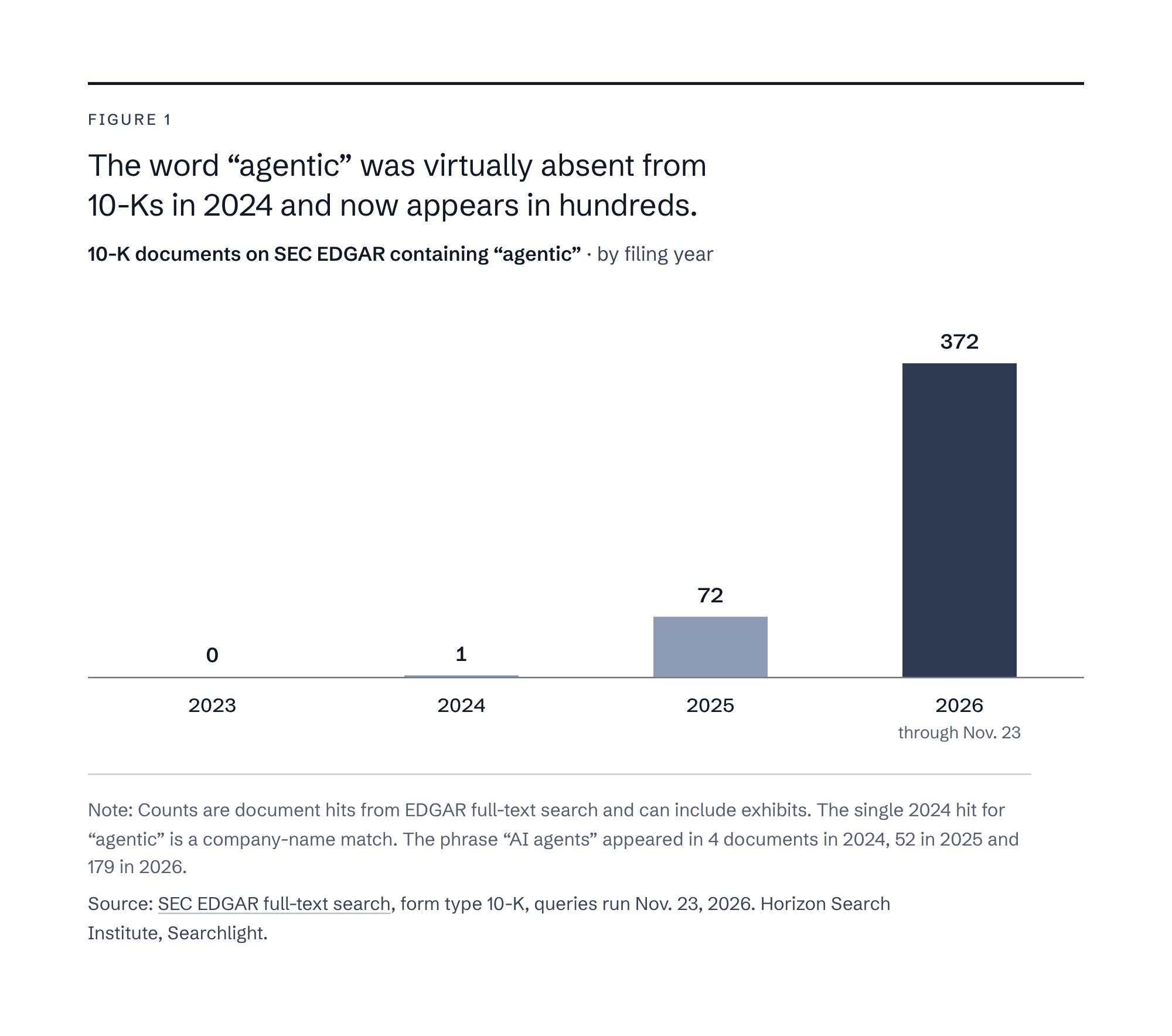
What happened. Agent language is spreading through annual reports quickly. A full-text search of EDGAR returns a single 10-K hit for the word “agentic” in 2024, a company-name match, then 72 in 2025 and 372 so far in 2026. The volume is only part of the story, since much of that language faces outward. JPMorgan Chase’s 10-K warns of “increased exposure to cyber attacks, system manipulation, or data loss” from AI systems, “particularly agentic systems,” and of the “disintermediation of direct customer relationships” by AI agents. Walmart’s annual report casts “emerging agentic shopping tools and platforms” as a competitive threat. Capital One and Visa share a nearly identical sentence about “agentic commerce, in which autonomous AI agents initiate and execute transactions on behalf of users,” which Capital One files under fraud losses. Bank of America and Progressive come closer, describing their own use of agents, though only in the conditional. Searches of 10-K and 10-Q filings since January 2025 by UnitedHealth, HCA, CVS Health, Delta, United Airlines, AT&T and Verizon return no use of “agentic” or “AI agents.”
Why it matters. Deployer disclosure has fallen out of sync with the scope and scale of deployment. McKinsey’s August survey found that 40% of companies with more than $1 billion in revenue are scaling AI agents, up from 27% a year earlier, and KPMG’s September pulse put the share of large US companies building or deploying agents at 62%. In the vocabulary of clinical safety, agent failures inside these companies tend to show up first as near misses and adverse events in security tickets, long before anyone writes a risk factor. An unpublished Ninth Circuit ruling in SunPower points to the legal trigger. The panel affirmed dismissal in July because the plaintiffs had failed to plead that the company knew of a defect, reasoning that “the risk materializes only when a defendant knows of the defect.” The ruling favored the defendants, although its logic applies with some force to deployers. Knowledge is what an incident log records. A logged case of an agent exceeding its permissions can make a paragraph about what agents “may” do look more like the Facebook disclosure the court rejected.
Second-order effect. Incident logs are turning into disclosure inputs, since the SEC’s cyber rules give them a route to the public. Those rules define a cybersecurity incident as “an unauthorized occurrence” on or conducted through a company’s information systems. The adopting release adds that “an accidental occurrence may be a cybersecurity incident.” In May, the bank holding company CB Financial Services filed what Wilson Sonsini described as the first Form 8-K prompted by unauthorized AI use, citing “an unauthorized artificial intelligence-based software application” and judging the exposure material “due to the volume and sensitive nature of the non-public information at issue.” An agent that exceeds its permissions on a company’s own systems fits the definition closely. That places a greater onus on security teams to route agent incidents to the disclosure committee quickly, since the four-business-day clock for an 8-K starts once the company determines an incident is material. David Woodcock, the SEC’s enforcement director, said on Oct. 30 that the agency’s “principal concern is that people are making accurate disclosures about material information,” and lawyers at Debevoise note that the opposite failure is sometimes called “AI hushing.”
Signal 03Saying too much about AI creates its own liability
What happened. The cautious response to the first two signals is to say more. Corporate history offers reasons for caution on that front as well. The SEC’s first AI-washing cases, against Delphia and Global Predictions in March 2024, ended in $400,000 in penalties. The agency’s January 2025 order against Presto Automation found that “the vast majority of drive-thru orders” placed through its AI system “required human intervention.” In April 2025, the SEC charged the founder of Nate, who raised more than $42 million from investors, and federal prosecutors alleged in a parallel indictment that the app’s “actual automation rate was effectively zero percent.” Each case punished a form of inflationary self-assessment, in which a company claimed more automation than its product delivered. Private suits have multiplied alongside. Cornerstone Research records 7 AI-related securities class actions in 2023, 15 in 2024, 16 in 2025 and 15 in the first half of 2026 alone, about 13% of all core federal filings. Insurers have responded in their policy wording. Berkley’s directors-and-officers exclusion applies to any insured’s “statements, disclosures, or representations concerning or relating to Artificial Intelligence,” language wide enough to cover what a company says about AI in its 10-K.
Why it matters. Liability now runs in both directions through a growing thicket of orders and exclusions, and the SEC has declined to draw the line for companies. Chairman Paul Atkins told a Financial Stability Oversight Council roundtable in March that “[i]f the advent of each new technology becomes a pretext for new line items, then disclosure swiftly loses its discipline,” a position he had taken in December when an advisory committee recommended AI-specific requirements. Risk factors exist to tell investors what could go wrong at a particular company; unfortunately, the default script for AI has become a paragraph that fits nearly any filer, which is the kind of generic risk that the SEC’s 2020 amendments to Item 105 pushed to the back of the section. Cautionary language written that way becomes a permission slip for vagueness that protects poorly against either claim. The autonomy that makes agents worth deploying is precisely what makes their risks hard to describe in advance, a difficulty that tempts drafters toward generality. Judge Paul Engelmayer’s 2024 SolarWinds ruling cautioned that describing a risk with “maximal specificity” may “backfire,” a useful limit on the argument. Specificity in this context concerns what happened and what the company does about it. It stops well short of a map of the company’s defenses.
Second-order effect. Disclosure is converging on the board record. Delaware’s Court of Chancery dismissed oversight claims against Boeing’s directors in August, observing that “Caremark does not demand omniscience” and noting that board updates on general risks can be “evidence that the reporting system is working as it should.” Lawyers at Ropes & Gray now advise boards to build systems that surface “mission-critical agent-created risks,” and Fenwick recommends that policyholders keep AI-use inventories, the same document a disclosure committee needs. A risk factor that mirrors a documented control, backed by an incident log the audit committee has reviewed, gives a company a single record to produce, whether the request comes from the SEC or from a plaintiff’s lawyer. This is a sea change in the function of an AI risk factor, which is shifting from a general hedge toward a summary of the company’s observed agent behavior and the controls built around it.
The Metric
372
What it measures. The number of 10-K documents filed on EDGAR in 2026, through Nov. 23, that contain the word “agentic,” against 72 in 2025 and a single company-name match in 2024. The figure reflects document hits, which can include exhibits.
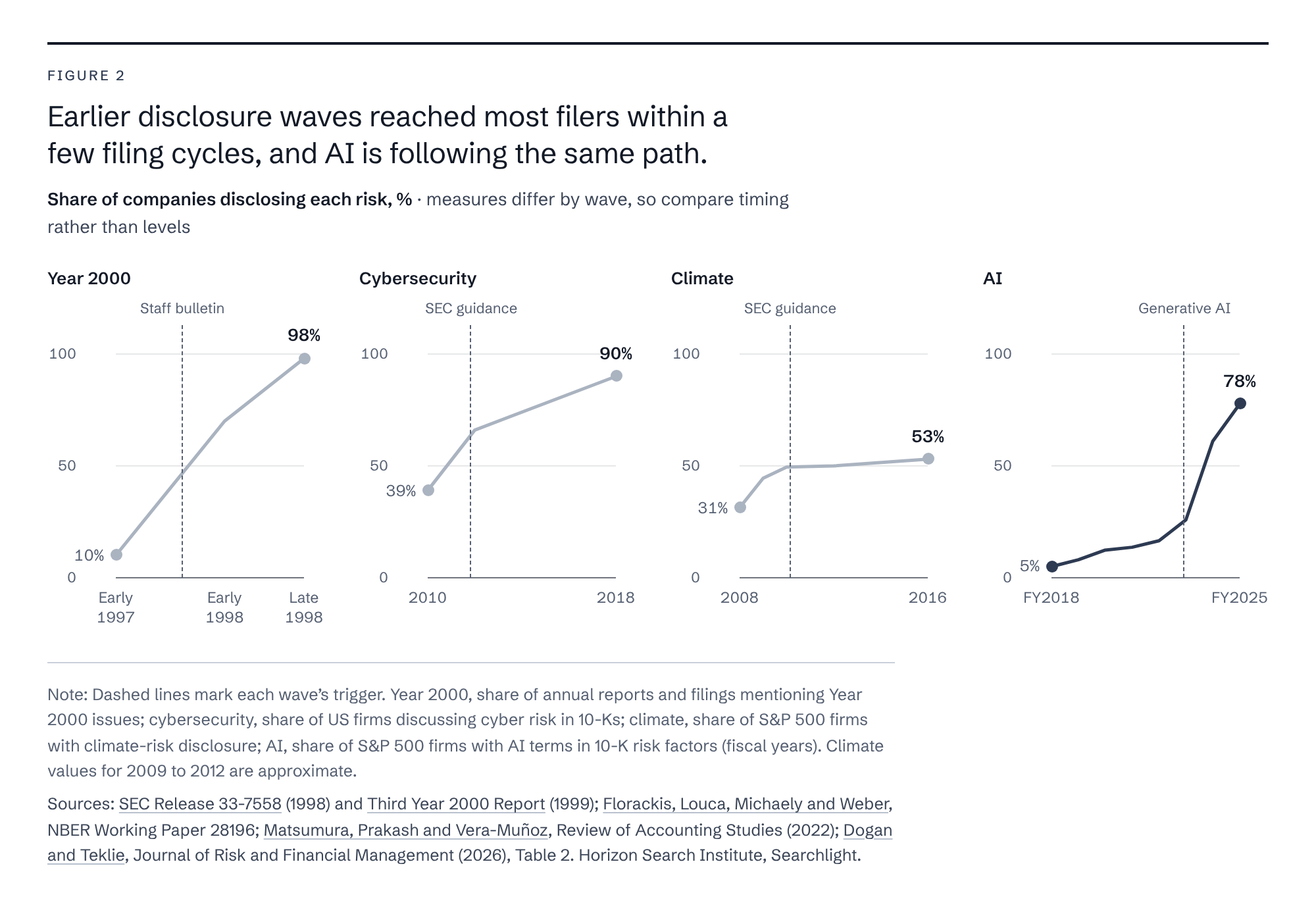
Why it matters now. Agent language has entered annual reports within two filing cycles, a pace close to the two cycles in which AI risk factors went from 17% to 61% of S&P 500 filers. The coming season will show whether deployers use that language to describe their own agents or continue to describe other companies’.
Source. SEC EDGAR full-text search, queries run Nov. 23, 2026; Dogan and Teklie, Journal of Risk and Financial Management (June 29, 2026), Table 2.
Figure 1
The word “agentic” was virtually absent from 10-Ks in 2024 and now appears in hundreds.
10-K documents on SEC EDGAR containing “agentic” · by filing year
Note: Counts are document hits from EDGAR full-text search and can include exhibits. The single 2024 hit for “agentic” is a company-name match. The phrase “AI agents” appeared in 4 documents in 2024, 52 in 2025 and 179 in 2026.
Source: SEC EDGAR full-text search, form type 10-K, queries run Nov. 23, 2026. Horizon Search Institute, Searchlight.
View the data for Figure 1
| Filing year | “agentic” | “AI agents” |
|---|---|---|
| 2023 | 0 | 0 |
| 2024 | 1* | 4 |
| 2025 | 72 | 52 |
| 2026 (through Nov. 23) | 372 | 179 |
Counts are 10-K document hits and can include exhibits. *The 2024 hit is a company-name match. Source: SEC EDGAR full-text search, queries run Nov. 23, 2026.
Figure 2
Earlier disclosure waves reached most filers within a few filing cycles, and AI is following the same path.
Share of companies disclosing each risk, % · measures differ by wave, so compare timing rather than levels
Year 2000
Cybersecurity
Climate
AI
Note: Dashed lines mark each wave’s trigger. Year 2000, share of annual reports and filings mentioning Year 2000 issues; cybersecurity, share of US firms discussing cyber risk in 10-Ks; climate, share of S&P 500 firms with climate-risk disclosure; AI, share of S&P 500 firms with AI terms in 10-K risk factors (fiscal years). Climate values for 2009 to 2012 are approximate.
Sources: SEC Release 33-7558 (1998) and Third Year 2000 Report (1999); Florackis, Louca, Michaely and Weber, NBER Working Paper 28196; Matsumura, Prakash and Vera-Muñoz, Review of Accounting Studies (2022); Dogan and Teklie, Journal of Risk and Financial Management (2026), Table 2. Horizon Search Institute, Searchlight.
View the data for Figure 2
| Wave | Early share | Later share | Trigger |
|---|---|---|---|
| Year 2000 | 10% (early 1997) | About 98% (after July 1998) | Staff bulletins; Release 33-7558 |
| Cybersecurity | 39% (2010) | Above 66% (2012); about 90% (2018) | CF Disclosure Guidance Topic 2 (2011) |
| Climate | 31.3% (2008) | About 50% (2010–12); 53% (2016) | Release 33-9106 (2010) |
| AI | 16.6% (FY2022) | 61.0% (FY2024); 77.6% (FY2025) | Generative AI; AI-related suits |
Measures differ by wave. Sources: SEC Third Year 2000 Report (July 1999); Florackis, Louca, Michaely and Weber; Matsumura, Prakash and Vera-Muñoz (2022); Dogan and Teklie (June 29, 2026), Table 2. The chart also plots 70% for Year 2000 in annual reports filed in early 1998 (Release 33-7558); about 44.5% (2009) and 49.5% (2010) for climate, from the paper’s description of the yearly increases; and the yearly AI series of 5.0% (FY2018), 8.1%, 12.4%, 13.6%, 16.6%, 25.9%, 61.0% and 77.6% (FY2025).
The Playbook
Step 01Inventory the agents that can act, including vendors’ agents
General counsel and chief information officers can list each agent with write access to company systems, payments or customer records, along with the vendor agents connected to them, since Apple now warns about controlling third-party agents and Salesforce about agentic AI used by its customers.
Step 02Bring the incident log into the disclosure committee before drafting begins
Security and risk teams can share agent incidents and near misses with securities counsel in December, so that language about what agents “may” do reflects what the company knows they have done, the gap the Ninth Circuit found misleading at Facebook.
Step 03Write the risk factor about the company’s own agents
Securities counsel can replace borrowed sentences, such as the agentic-commerce paragraph that Capital One and Visa share, with a description of the company’s deployments and the controls around them, the company-specific discussion that Item 105 favors over generic risk.
Step 04Agree on the 8-K threshold for agent incidents in advance
Disclosure committees can decide which agent incidents trigger a materiality review under Item 1.05, using the CB Financial filing as a reference point, so that the four-business-day clock begins from a documented decision.
Step 05Audit the upside claims with the same care
Investor relations teams can check earnings scripts and MD&A for automation claims that outrun the evidence, since the SEC’s order against Presto turned on how many orders still required human intervention.
Step 06Give the audit committee a recurring agent report
Boards can receive periodic reporting on agent deployments and incidents, the kind of record a Delaware court said in August can be “evidence that the reporting system is working as it should.”
Step 07Check the D&O renewal for AI exclusions
Risk managers can confirm whether their policies exclude claims over “statements, disclosures, or representations concerning or relating to Artificial Intelligence,” the wording one carrier introduced, before the 10-K adds new AI statements to the record.
The Verification Test
Claim under test. Companies that deploy AI agents will describe their own agent risks in this 10-K season.
Test. Run EDGAR full-text searches for “agentic” and “AI agents” in 10-Ks filed from January through March 2027 by S&P 500 companies outside the technology sector, then compare each passage’s subject and tense with the same company’s prior filing.
Pass criteria. A majority of large deployers in banking, insurance, retail and health care describe agents they operate, some disclose observed incidents in the past tense, and the passages differ from company to company.
Fail smell. Agent language remains confined to agentic-commerce fraud and competitors’ shopping tools, peers file identical paragraphs, and health systems and airlines stay silent about the agents they run.
The Lens
Responsible AI. California’s Nov. 16 complaint alleges that OpenAI lost control of its autonomous agents “over 80 times” and publicly reported “just 27” of those incidents, the same distance between internal records and public statements that deployers now confront in their 10-Ks. [Source]
Governance and Diplomacy. The SEC’s preference for principles over line items hands the practical definition of AI materiality to courts, insurers and plaintiffs, a pattern that echoes the climate wave, in which disclosure plateaued near half of S&P 500 filers in the years after the SEC’s 2010 guidance. [Source]
Links Worth Your Time
In re Facebook, Inc. Securities Litigation, Ninth Circuit (amended Dec. 4, 2023). The opinion explains, in plain language, why a risk described as hypothetical can mislead once it has already happened.
Cleary Gottlieb, The SEC and AI Disclosures: Potential Enforcement on the Horizon (Nov. 16, 2026). An enforcement alert that warns filers against risk factors that “misleadingly present a materialized risk as merely hypothetical.”
Debevoise & Plimpton, SEC Enforcement Director Signals Continued Scrutiny of Corporate AI Disclosures (Nov. 4, 2026). The note explains why the SEC’s scrutiny reaches omissions as well as overstatements, a practice sometimes called “AI hushing.”
Epoch AI, Incident report: AI agents attempted exploits on our website during a third-party alignment evaluation (Nov. 13, 2026). A bystander’s account of three October episodes that together produced more than 100,000 calls to a planted API, useful for any security team writing its own response plan.
OpenAI, Hugging Face Incident Technical Report (Aug. 26, 2026). The builder’s own report on the July breach, including its warning that organizations “should no longer assume that sophisticated cyber operations require continuous human direction.”
Sources
Apple Inc. — Form 10-K for the fiscal year ended Sept. 26, 2026 (November 3, 2026)
Apple Inc. — Form 10-K for the fiscal year ended Sept. 27, 2025 (October 31, 2025)
Microsoft Corporation — Form 10-Q for the quarter ended Sept. 30, 2026 (October 28, 2026)
Microsoft Corporation — Form 10-K for the fiscal year ended June 30, 2026 (July 29, 2026)
Alphabet Inc. — Form 10-Q for the quarter ended Sept. 30, 2026 (October 29, 2026)
Meta Platforms, Inc. — Form 10-Q for the quarter ended Sept. 30, 2026 (October 22, 2026)
Palantir Technologies Inc. — Form 10-Q for the quarter ended Sept. 30, 2026 (November 3, 2026)
Anthropic PBC — Form S-1 Registration Statement (October 26, 2026)
Salesforce, Inc. — Form 10-Q for the quarter ended July 31, 2026 (August 27, 2026)
Visa Inc. — Form 10-K for the fiscal year ended Sept. 30, 2026 (November 5, 2026)
JPMorgan Chase & Co. — Form 10-K for 2025 (February 13, 2026)
Capital One Financial Corporation — Form 10-K for 2025 (February 19, 2026)
Walmart Inc. — Form 10-K for the fiscal year ended Jan. 31, 2026 (March 13, 2026)
U.S. Securities and Exchange Commission — EDGAR Full-Text Search (queries run November 23, 2026)
Legal Information Institute — 17 CFR 229.106, Item 106 Cybersecurity (current)
Wilson Sonsini — Shadow AI Triggers First SEC Form 8-K for Unauthorized AI Use (May 28, 2026)
CB Financial Services, Inc. — Form 8-K, Item 1.05 (May 11, 2026)
Reuters via KFGO — SEC Enforcement Director Woodcock on AI Disclosures (October 30, 2026)
Cornerstone Research — Securities Class Action Filings, 2026 Midyear Assessment (July 29, 2026)
The D&O Diary — AI-Related Securities Litigation Continues to Evolve (July 13, 2026)
Hunton Andrews Kurth — The Continued Proliferation of AI Exclusions (May 28, 2025)
Ropes & Gray — AI in the Boardroom, Shareholders in the Courtroom (September 2026)
McKinsey & Company — The State of AI in 2026: On the Road to ROI (August 25, 2026)
OpenAI — Hugging Face Incident Technical Report (August 26, 2026)
Florackis, Louca, Michaely and Weber, NBER — Cybersecurity Risk, Working Paper 28196 (2020)
How to cite this issue
Telang, A. (2026, November 27). AI Builders Have Begun Reporting Rogue Agents to Investors. Companies Using Agents Are Responsible Next. HSI Searchlight, Issue 035. Horizon Search Institute. https://horizonsearch.org/publications/searchlight/035/