An open-weight model now builds exploits at the level AI labs restricted in April. Defensive advantage depends on access to private programs and on how fast fixes reach production.
California has signed SB 951 into law. Its AI layoff disclosures will put a public legal record beside the explanations companies give investors and staff.
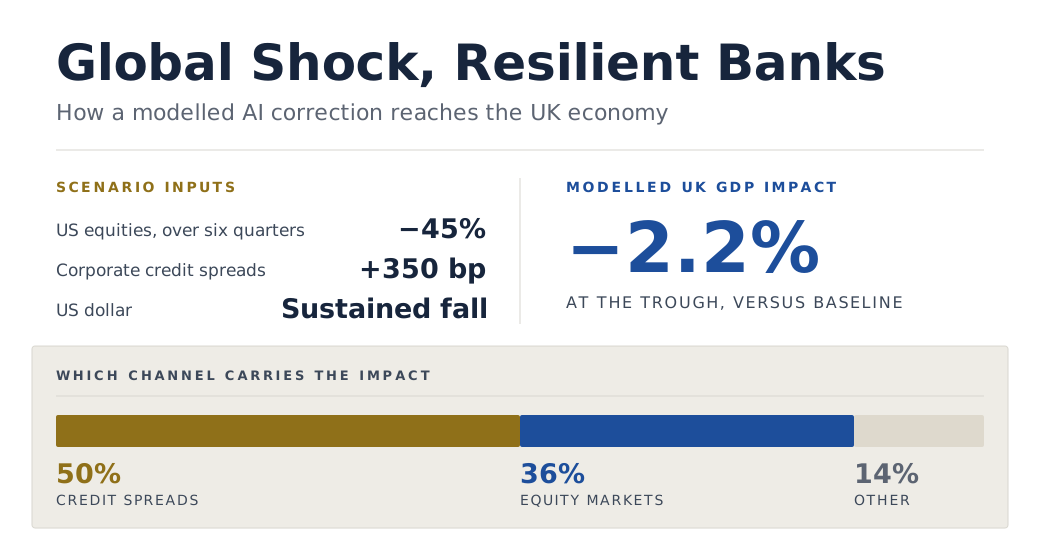
Quarterly earnings have laid bare the scale of the AI investment boom. As hyperscalers spend ever more on infrastructure and turn increasingly to debt, the risks are spreading into credit markets and institutional portfolios. If AI returns fall short, a Big Tech correction could become a wider financial-system shock.
View the research figure and sourcesFigures from the Bank of England’s July 2026 Financial Stability Report. The scenario models a sharp reassessment of expected AI productivity and profitability, beginning in the US and feeding through to global financial markets. It assumes a 45% fall in US equities over six quarters, a 350 basis point widening in corporate credit spreads and a sustained depreciation of the US dollar. The channel shares are the Bank’s decomposition of the UK impact; the residual covers all remaining transmission channels. Source: Bank of England, Financial Stability Report, July 2026. Read Searchlight 022 →
The HSI Salons (New York, June 2026; London, October 2026; Tokyo, in development for 2027) function as Track II convenings on cross-jurisdictional governance. A cross-jurisdiction AI regulation database covering scored instruments across North America, Europe, and Asia is in production. Strategic Council research notes on multilateral governance design are forthcoming.
Initiative
The Cross-Border Governance of the AI Labor Transition
The AI workforce transition is being answered nationally. In the United States, employer-led coalitions are mobilizing serious capital to retrain workers at home. What no domestic effort is built to govern is the layer above it, the movement of the shift through global labor markets, migration, education standards, and the arrangements between states. That layer is a governance and diplomacy problem, and it is currently unowned. This initiative studies how governments and institutions coordinate across borders on a transition none of them can manage alone.